
[ad_1]
Photo by Annie Spratt
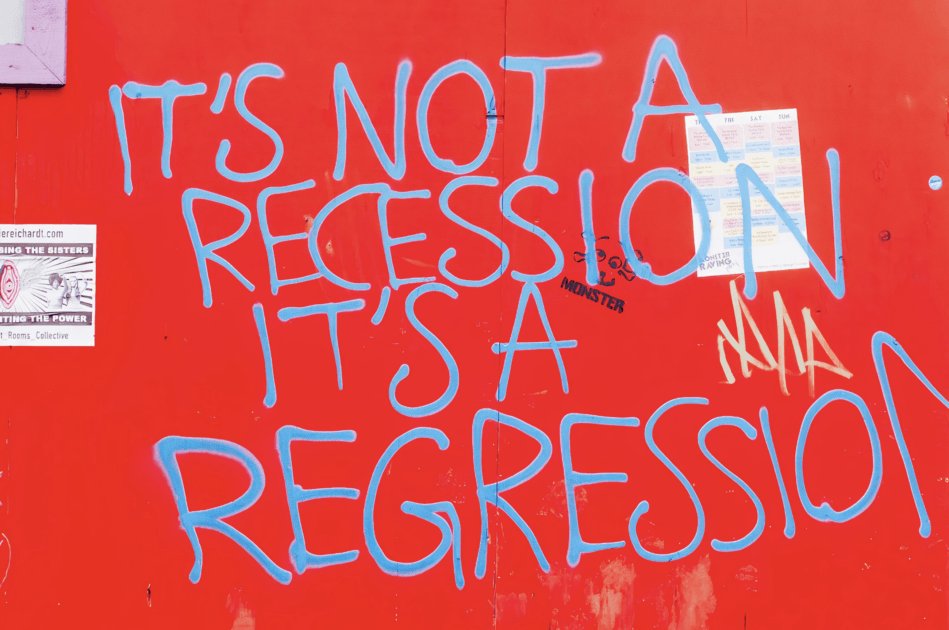
Donald Trump’s second term as president is turning out to be a disaster. His Israel-driven “war” against Iran is failing, with the current “peace” effort a sham. His domestic economic policies — including tax cuts to corporations and the rich, roller-coaster tariffs and support for fossil fuels — have made the U.S. more unaffordable for an ever-increasing number of Americans. Are his policies setting the stage for a bitter economic recession?
Warnings about a possible recession are growing. According to Reuters, “Under the IMF’s [International Monetary Fund] worst-case outlook, the global economy teeters on the brink of recession, with oil prices averaging $110 a barrel in 2026 and $125 in 2027.” Goldman Sachs is sounding an alarm, warning that the U.S. economy is slipping and the war in Iran is making it worse. The bank recently raised its 12-month recession probability to 25 percent. And Moody’s pegged a likely U.S. recession at 49 percent before the Iran war, but with its resulting high oil prices the likelihood of a recession crossed 50 percent.
Most ominous, EuroNews warns, “Every US recession since World War II, apart from the Covid-19 pandemic downturn, was preceded by a spike in oil prices.”
According to the IMF, a recession is “a sustained period when economic output falls and unemployment rises.” It notes, “recessions have occurred in advanced economies several times in the past four decades—the mid-1970s, early 1980s, early 1990s, and early 2000s.” The U.S.’s National Bureau of Economic Research (NBER) defines recession as a “significant decline in economic activity that is spread across the economy and that lasts more than a few months.” This decline is determined by three criteria — depth, diffusion and duration – set against a variety of monthly economic indicators including “income, employment, consumption sales, and industrial production.” It notes that the U.S.’s most recent recession was from March to April 2020.
A look at some of the “indicators” is revealing, including consumer confidence, new job creation, inflation and the ever-growing wealth gap.
Most disturbing, the University of Michigan’s “Survey of Consumers” reveals just how worried Americans are about a possible recession. It notes that “Consumer Sentiment” in April 2025 it stood at 52.2 and rose to 53.3 in March 2026, only to fall to 47.6 in April 2026. It adds:
“Consumer sentiment sank about 11% this month, extending a decline that began with the start of the Iran conflict, and is currently about 9% below a year ago. Demographic groups across age, income, and political party all posted setbacks in sentiment, as did every component of the index, reflecting the widespread nature of this month’s fall.”
It adds, “Assessments of personal finances declined about 11%, with consumers expressing a substantial increase in concerns over high prices and weaker asset values.”
“Affordability” has become a key domestic issue in 2026 and, as The New York Times put it, “The difficulty of purchasing a ticket to the middle class has created a sense that the economy isn’t working, even when the economy isn’t so bad by usual measures like growth or unemployment.” When Trump took office in 2025, affordability was a key concern of his administration, but since he launched the Iran war, it has essentially disappeared.
Josh Bivens, of the Economic Policy Institute, is pretty pessimistic. “Trump policies really are making a recession more likely and even if a recession does not occur, these policies will harm typical families’ ability to afford what they need.” He added:
“This affordability crunch will happen for two reasons: Trump policies will hamstring the economy’s ability to supply goods and services, and these policies aim to increase inequality by transferring income from the bottom and middle toward the top. Sometimes this affordability crunch will manifest as higher prices or faster inflation, but it is more likely to appear as slower wage growth and the rollback of public supports for households.”
He warned, “But its root is always and everywhere poor economic choices, including prioritizing the interests of the rich and corporations over the concerns of typical American families.”
The problem of affordability has come at a time when the cost of gasoline is skyrocketing and increasing for other goods and services. This reflects the deeper structural problem of a consumer’s reduction of purchasing power, accompanied by an increase in the inflation rate. The U.S. Bureau of Labor Statistics (BLS) reports that the consumer price index rose 3.3 percent year-over-year in March 2026, up from 2.4 percent in February. It adds, “On a monthly basis, the all items index increased 0.9 percent, seasonally adjusted, in March 2026, after rising 0.3 percent in February and 0.2 percent in January.”
Compounding this situation, the BLS finds for March 2026 that “Both the unemployment rate, at 4.3 percent, and the number of unemployed people, at 7.2 million, changed little in March. These measures also changed little over the year.” However, it notes:
“The number of long-term unemployed (those jobless for 27 weeks or more) changed little at 1.8 million in March but is up by 322,000 over the year. The long-term unemployed accounted for 25.4 percent of all unemployed people in March.”
And adds:
“Both the labor force participation rate, at 61.9 percent, and the employment-population ratio, at 59.2 percent, changed little in March. These measures also showed little change over the year, after accounting for annual population control adjustments.”
Ominously, it goes further, stating: “Among those not in the labor force who wanted a job, the number of people marginally attached to the labor force increased by 325,000 in March to 1.9 million. These individuals wanted and were available for work and had looked for a job sometime in the prior 12 months but had not looked for work in the 4 weeks preceding the survey. “
Perhaps most worrisome, on January 31, 2025, the Federal Reserve of Minneapolis issued a reportthat cautioned: “Since the 1980s, the US has experienced not only a steady increase in income inequality, but also a contemporaneous rise in residential segregation by income.”
Mark Zandi, chief economist at Moody’s Analytics, goes further, noted, “Household wealth is highly concentrated and becoming steadily more concentrated.” The top 1% of households owned 31.7% of all U.S. wealth in the third quarter of 2025, the highest share on record since the Federal Reserve began tracking household wealth in 1989. Collectively, the wealthiest 1% held about $55 trillion in assets in the third quarter of 2025 — roughly equal to the wealth held by the bottom 90% of Americans combined.
Robert Reich, professor emeritus, University of California, Berkeley, is even more cautious. “Donald Trump talks a lot about the working class, his MAGA base is primarily working class, but if you look at the data, the working class is doing very badly in the second Trump administration.” Reminding readers, “The real growth in the second Trump administration has been in corporate profits and in the wealth of the people at the top.”
Trump may pull off a peace agreement with Iran (along with Israel-Lebanon) that could resume oil shipments and lower the price of oil. But the war’s long-term consequences are all too often overlooked.
Laleh Khalili, a professor of Gulf Studies at University of Exeter, recently appeared on Democracy Now! where she reminded viewers, “the effect of what the war is going to be is going to actually be felt even more strongly in the coming weeks ….” She identified “transportation costs are going to be higher, so food prices are going to be higher, when people’s MRIs are going to be scheduled out by six months or some such, when semiconductor manufacturing is going to be affected.” And added, “This is going to be quite significant.”
Going further, Khalili notes that the long-term consequences of the Iran war will involve “incredible shortage of aluminum,” “Helium reserves are down massively,” and “the question of insurance.” And she warns, “this combination of both the market, the logic of commercial risk, on the one hand, but, on the other hand, the fact that Iran poses a credible threat to ships in the Strait of Hormuz, in the Gulf of Oman, and both directly and via its allies and Ansar Allah in the Red Sea, means that I actually think that the crisis is only going to get kind of more horrific before it gets any better.”
It’s only six months until the 2026 Congressional elections and it’s likely that the Democrats will take back the House. This may put some restrictions on Trump’s – and, more so, Russell Vought, director of the Office of Management & Budget and lead author of Heritage’s “Project 2025” – efforts to shrink the federal workforce and cut social benefits. And even if Trump secures a workable peace agreement, it remains to be seen if he – or the Republicans – can address the challenges of affordability and prevent a recession.
[ad_2]
Source link
