
[ad_1]
U.S. and NATO leaders have waged a multi-year propaganda campaign to convince Western publics that Ukraine is a splendid democracy and that President Volodymyr Zelensky is an extremely popular elected leader who epitomizes those values. Multiple aspects of that carefully crafted image are untrue. Ukraine is a corrupt, autocratic state that maintains strict censorship and brutally represses political opponents. When Zelensky’s term ended in 2024, he and his obedient followers in parliament simply postponed elections indefinitely. Even absent adverse election result, though, there are ample signs that NATO’s much-lauded hero has alienated Ukraine’s public.
The systematic campaign to present Zelensky as a hero is crucial to NATO’s overall portrayal of the ongoing Ukraine-Russia war as nothing less than an existential struggle between freedom and dictatorship – a conflict with truly global implications. New York Times columnist David French contends that “for the first time in my adult life, the moral and strategic heart of the defense of liberal democracy doesn’t beat in Washington. It doesn’t beat in London or Paris or Berlin or Ottawa, either. It’s in Kyiv, where a courageous leader and a courageous people have picked up the torch America has dropped.”
Western leaders have redoubled their propaganda initiatives efforts in recent months to sell the proposition that underdog Ukraine is beginning to win the military contest against Russia. Despite a few flashy Ukrainian military successes, however, the overall picture of an eventual Russian victory in a war of attrition remains essentially the same.
Domestic developments in Ukraine even more strongly suggest that Zelensky may be closer to the precipice of disaster than to the summit of victory. Indeed, his position bears an eerie resemblance to that of an earlier U.S. client and political darling, South Vietnam’s Ngo Dinh Diem. U.S. officials gradually soured on Diem, however, and in 1963 they quietly encouraged South Vietnamese military leaders to oust him. Those generals did so on November 2, killing Diem as well as his brother and chief adviser, Ngo Dinh Nhu.
The Diem episode highlights a broader theme. U.S. foreign clients who become inconvenient to Washington have not fared well over the decades. Given the recent adverse domestic developments with respect to Zelensky, he has ample reason to worry about his long-term survival prospects.
Major political fractures have occurred in Ukraine over the past year, and they are intensifying in both frequency and severity. Zelensky’s actions even alienated some of his most reliable supporters and apologists in the West. For example, the decision by Zelensky and his parliamentary allies in 2025 to curb the independence of anti-corruption agencies proved to be extremely unpopular. Several rounds of anti-government demonstrations erupted in Kiev and several other cities. Zelensky’s reputation throughout the West of being a noble leader dedicated to democracy and honest government was always unwarranted, but this time a good portion of Ukrainian public opinion became disillusioned as well.
Several new incidents indicate mounting political turmoil. General Oleksandr Syrskiy was once considered a national hero. During the early days following Russia’s expanded invasion of Ukraine in February 2022, he masterminded the successful defense of Kiev against a much larger Russian force surging toward Ukraine’s capital. He then planned the counteroffensive that helped his country regain some conquered territory in the east. Zelensky made him commander-in-chief of Ukraine’s armed forces two years later.
By the summer of 2026, though, most Ukrainians no longer viewed Syrskiy as a heroic figure whom they wished to follow. Moreover, Zelensky himself came under intense political fire and confronted waves of street protests throughout the country after siding with the 60-year-old general to fire the country’s charismatic young defense minister, Mykhailo Fedorov, in mid-July. For only the second time since February 2022, thousands of people joined mass anti-government demonstrations. The goal was to pressure Zelensky to change course and reaffirm Fedorov’s vision of technology-driven warfare increasingly relying on drones and robots. (The first large protests, in the summer of 2025, denounced Zelensky’s purge of government anti-corruption agencies.)
Syrskiy also had faced criticism for the heavy loss of life incurred in the Battle of Bakhmut, which drew comparisons with trench warfare in World War I as Ukrainian troops fought for months to defend a town that many analysts considered to have little strategic value.
New York Times correspondents Marc Santora, Liubov Sholudko, and Stanislav Kozliuk conclude that “The current public anger threatens the national unity that has sustained Ukraine through nearly four and a half years of fighting.” They note that “after he was fired, Fedorov issued a scathing public indictment of the military high command.” Other respected Western analysts note the growing bureaucratic turmoil in Ukraine’s government and Zelensky’s ever more perilous political position.
The emergence of such bitter divisions within the top ranks of any country’s military hierarchy is especially destabilizing and ominous. However, the turmoil in Ukraine’s government continues to deepen, not recede. On July 21, 2026, Zelensky capitulated to the demonstrators and fired Syrskiy, replacing him with Major General Mykhailo Drapatyi. Santora asserts that “Drapatyi represents a newer generation of post-Soviet military leadership in Ukraine that has embraced more modern approaches to warfighting.”
An especially crucial question is how the Trump administration views the developments in Kiev. How worried are U.S. policymakers about Ukraine’s continuing viability as a U.S./NATO security client and Zelensky’s status as Ukraine’s leader going forward?
Washington never likes turmoil in any of its client states. Loyal political figures in those countries typically are courted only as long as they advance Washington’s international policy goals. However, even clients who have outlived their usefulness to the United States but depart quietly tend to be treated well and enjoy a cozy retirement. Conversely, clients who become uncooperative or attempt to remain in power beyond their “use by” date fare decidedly less well. One need only consult the ghosts of Manuel Noriega, Saddam Hussein, and Ngo Dinh Diem for confirmation of the latter point.
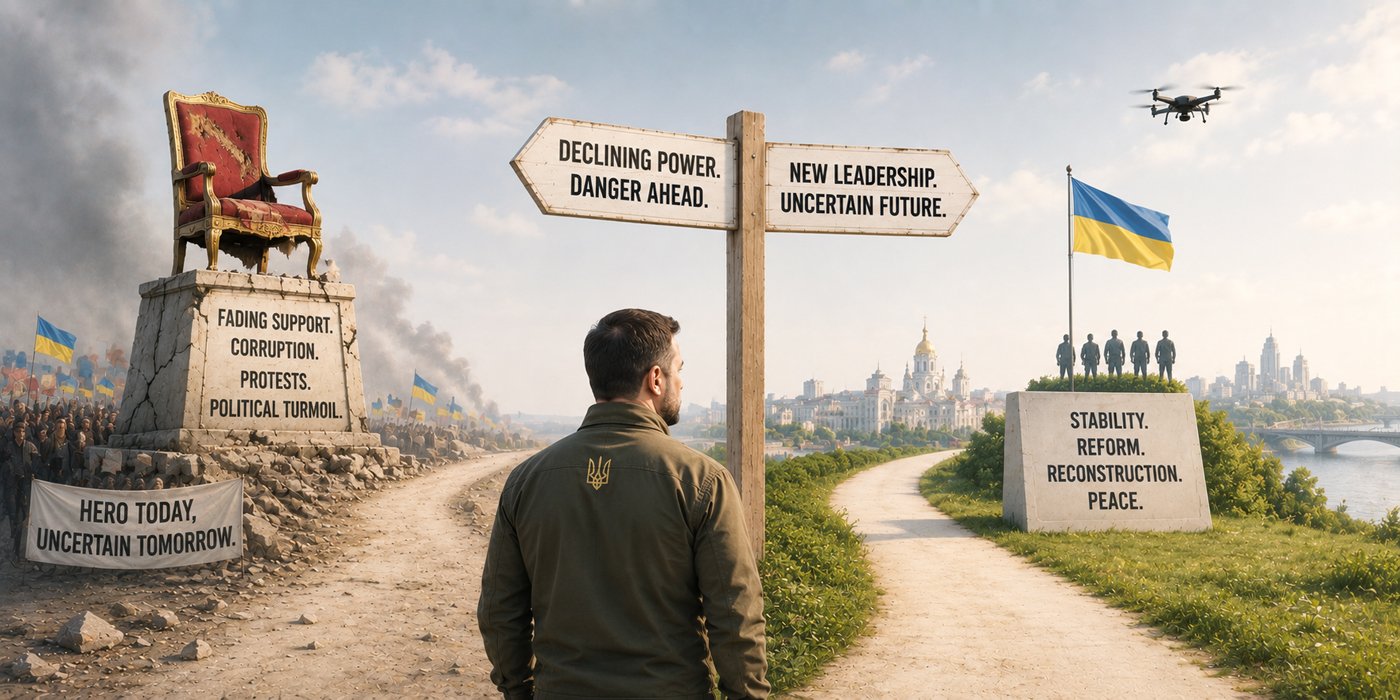
The recent political instability in Ukraine suggests that the time may have arrived when the Trump administration will “ask” Zelensky to step aside and enable a new, more popular and capable figure to take the helm. If such a “request” is made, the Ukrainian leader would be wise to heed it.
Join the Discussion!
We welcome thoughtful and respectful comments. Hateful language, illegal content, or attacks against Antiwar.com will be removed.
For more details, please see our Comment Policy.
[ad_2]
Source link
