
[ad_1]
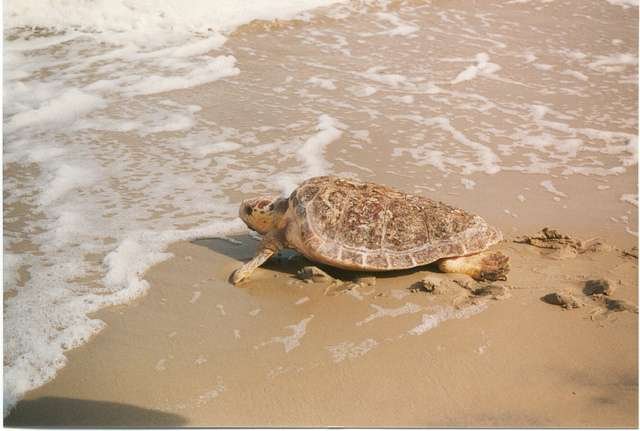
Lights along the beach can create problems for turtles. Bright lights at night can disorient sea turtle hatchlings and prevent them from crawling into the sea. Sufficient beachfront lighting might even constitute a prohibited “take” of Loggerhead sea turtles and other turtle species listed under the Endangered Species Act.
Assume that the erection or maintenance of beachfront lighting in turtle habitat is a take under Section 9 of the ESA. Could a state or local government’s decision to allow such beachfront lighting–either by permitting it or perhaps just failing to prohibit it–also be a take under Section 9? And, if so, could the ESA require a state or local government to take action against private landowners who erect or maintain beachfront lighting when sea turtles are reproducing? Would such a requirement be constitutional? I think not.
Holding state and local governments liable under the ESA for licensing, permitting, or failing to control private conduct violates the anti-commandeering principle, or so I argue in my article, “Conservation Commandeering,” forthcoming in a Catholic University Law Review symposium. Nonetheless, courts impose this sort of vicarious liability on state and local governments with some frequency, most often in response to citizen suits filed under the ESA by environmental groups. Cases have involved state agency’s failing to impose sufficiently stringent limitations on fur trapping or fishing, among other things. In this post I noted a case pending in the U.S. Court of Appeals for the Eleventh Circuit concerning Florida’s alleged failure to adequately regulate septic systems. At the moment, most district courts to have considered such claims have rejected commandeering-based arguments. In my view, they are wrong, and imposing liability in such cases is hard to square with the Court’s federalism jurisprudence.
I have just posted a draft of the article on SSRN. Here is the abstract:
The Endangered Species Act (ESA) prohibits anyone-including state and local governments-from “taking” protected species without a permit. Courts have extended this prohibition to impose vicarious liability on state and local governments, holding that a government’s failure to regulate private activities sufficiently harmful to listed species may itself constitute an illegal take. This Article argues that such “conservation commandeering” cannot be reconciled with the Supreme Court’s anti-commandeering jurisprudence. Under current doctrine, the federal government may not compel state and local governments to enact or administer regulatory programs implementing federal law, nor may it prohibit states from licensing or authorizing private activity. Requiring states to restrict private conduct as a condition of avoiding ESA liability does precisely what these decisions forbid. This Article further argues that enforcing the anti-commandeering principle need not undermine species conservation. The ESA’s cooperative federalism provisions and existing tools for inducing voluntary state participation offer workable alternatives-ones that respect both constitutional structure and the practical importance of state and local cooperation in protecting listed species.
Comments are welcome.
[ad_2]
Source link
