
[ad_1]
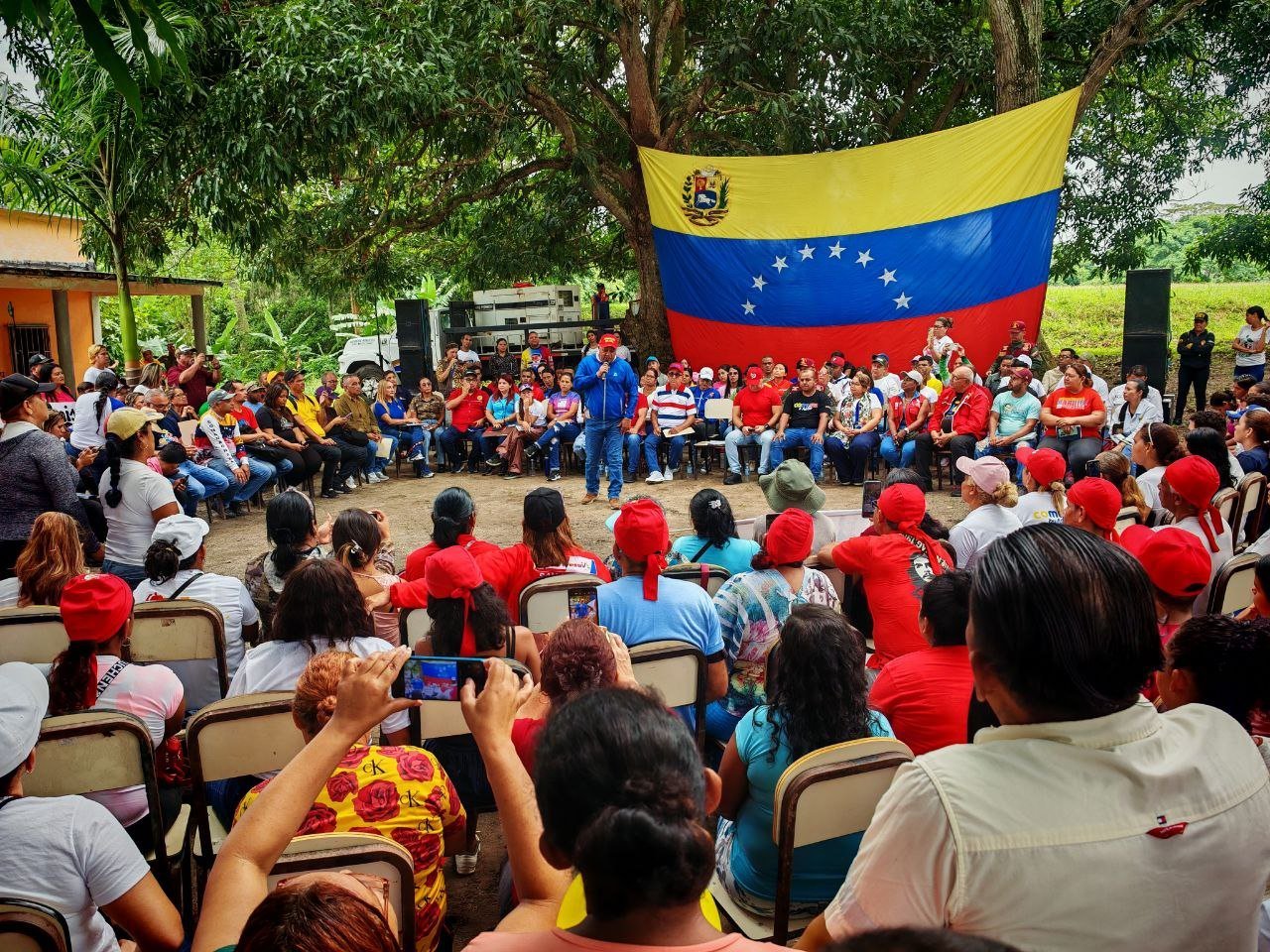
Communards at an assembly in Merida approve the projects that will appear on the ballot for the communal consult (2025). Photograph by Víctor Hugo Rivera.
“This is a system of ants,” Dulce Esperanza, a member of the Candelaria Heroica Commune in Caracas, Venezuela, explained to me as we sat outside of a voting center in her commune. Bit by bit, Dulce told me, she and her neighbors have built a part of the labor, and love, that has sustained her commune of 5,000 families, carrying out the vision outlined by leader and former president Hugo Chávez two decades ago. Here, communards organize citizens’ assemblies to debate and make decisions about their communities, build and manage productive processes, and, ultimately, create an organizational structure that serves as a fundamental building block of Venezuelan democracy and society.
On March 8, Dulce, a woman with a beaming smile and short, grey hair, was among millions of communards around the country who voted to select which projects in her commune would receive government funding (USD $10,000 per project, with one to two winning projects funded per commune). The communal consults, she explained to me, were started by President Nicolás Maduro in April 2024 and take place approximately every 3 to 4 months to fund the projects selected by members of the community based on their most pressing needs, from improving potable water systems and infrastructure[*] to funding productive mechanisms such as bakeries and textile factories that are operated by the commune (known as Socially Owned Companies, or EPSs). After Maduro presented the 7 Transformations national development strategy in early 2024, each consult has begun to focus on specific elements of that plan – this time, the productive economy (T1) and humane cities (T2). The consults are a dynamic process, with improvements identified and made each time.
There are thousands[†] of communes across Venezuela, which function as a form of self-governance with a vision of ultimately replacing the bourgeois state with a communal one driven by popular power. Socialism, Chávez said, “should not be decreed. It must be… a popular creation of the masses.” Communes are the expression of this creation, “the space from which we will give birth to socialism.” The communal consults have become a fundamental aspect of how this process plays out, a school for how decisions are made at a grassroots level, how to build productive mechanisms that build toward economic independence, and how to allocate resources in alignment with the revolution’s values and strategic thinking while expanding the reach of communes and communal circuits. This school rests on two decades of advances of Venezuela’s Bolivarian Revolution, which has dedicated roughly three quarters of the state budget to social spending, eradicated illiteracy, and expanded education at every level, to name a few examples of many – skills that have been put to use by Venezuela’s working class to improve their communities and build a revolution that has been able to outlive the foreign interference that has sought to overthrow it from the onset. As Chávez put it quite frankly in the early years of the revolution, “It is unfair that, despite being a resource-rich country, Venezuela has a population where 70% live in poverty.”
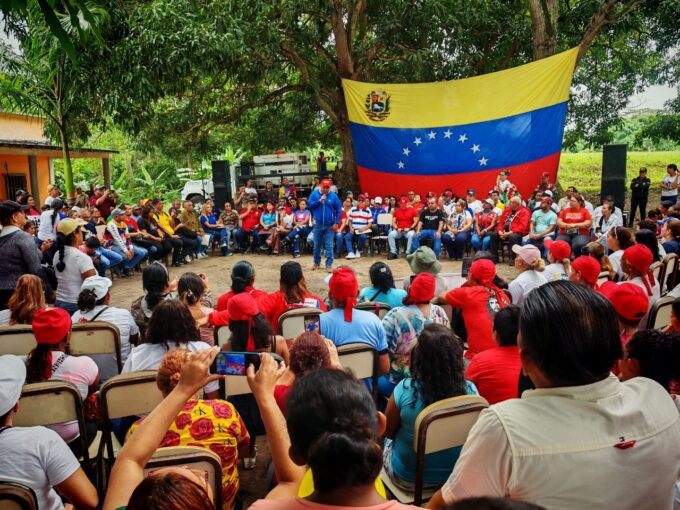
An assembly in Yaracuy, Venezuela, where communards discuss proposals for the upcoming communal consult (December 2024). Photograph by Víctor Hugo Rivera.
The Communes as a School: Self-Governance, Anti-Imperialism, and the New Human Being
Chávez, who was elected in 1998 through popular vote, was aware of the challenge of governing within the confines of a bourgeois state and the inherited structures set up first under colonialism and then under the Venezuelan elite, working hand in hand with the United States. In dialogue with the Venezuelan people and allies such as Cuba’s Fidel Castro, alongside study and a system of trial and error, Chávez would eventually come to see the commune as the core building block – “the cell,” as he called it – of Bolivarian socialism. These communes are made up of smaller communal councils, or “nuclei,” he said, in his metaphor in which the cells and nuclei, together, make up a body, “the new body of the nation.” This model of self-governance gave the working class not only the skills but also the confidence and experience to govern their territory and resources in this “new body.”
Vice Minister of Communes Albanys Montilla explained the importance of this vision today more than ever, as the US has escalated its aggression against Venezuela.[‡] Speaking at one of the thousands of citizens’ assemblies that took place across the country in the lead up to the consult to propose and select projects that would appear on ballot, Albanys told a packed room at a commune in Antímano, Caracas, on February 6:
We are in a very difficult situation. … Even though Maduro isn’t here, we’re still holding the reins in this country. How? In assemblies, deciding where our resources will go, we’re going to carry out the project so that living conditions in the neighborhood and the commune improve. That’s self-governance, isn’t it? Allocating these resources so that we can take matters into our own hands.
Albanys is in her late twenties, a towering figure with a booming voice and a fire that ignites and grounds any room that she is in. The activities of the communes, she explained at the assembly, are a training ground for a country run completely by its people, toward a communal state: “We can apply the same approach we use in our commune to all the resources that come into this country… But to do that, we must remain organized within the commune, showing ourselves, Venezuela, and the world that only the organized people of the territory will provide an answer for ourselves.”
As a part of this exercise, in which the commune is the school to create the “new human being” and the building block to transform society, communards campaigned first for their neighbors to attend the assembly and select the projects, then to garner support for the projects deemed most strategic and turn out the vote on March 8, and finally to plan and implement the projects selected.
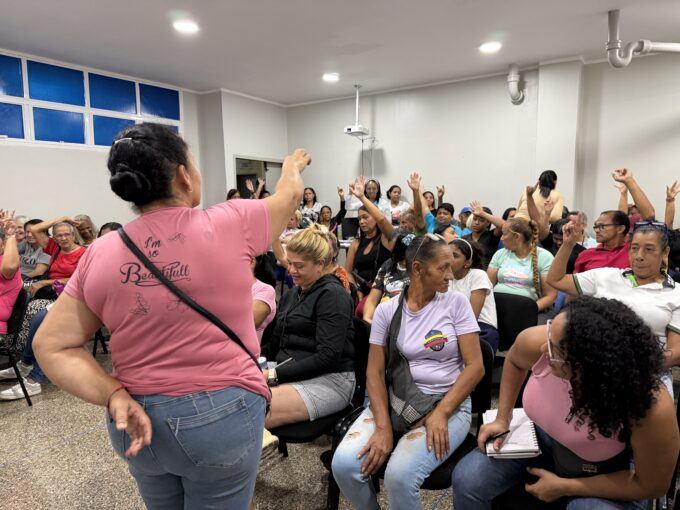
Members of the Socialista Luchadores del Comandante Supremo Commune in Altímano, Caracas, suggest and then vote on which seven proposals will appear on the March 8 communal consult ballot, ranked in order of most to least votes received (February 6, 2026). Photograph by Celina della Croce.
At the assemblies, communards identified the most pressing issues in their communities and then voted to determine which had the most support, tallying them in order of most to least popular, with the seven selected projects appearing in that order on the ballot. One communard in Antímano, at the Socialista Luchadores del Comandante Supremo Commune, advocated for cisterns to combat water shortages (T1, productive economy), while another advocated to build a bakery that could generate funds to finance other projects in the commune (T2, humane cities).
In the weeks leading up to the election, communards knocked on doors and handed out leaflets encouraging their neighbors to vote, in many communes campaigning for the projects that had been recommended by the assembly. The day of the election, communards arrived at voting sites as early as 3 AM to set up the space for the day, complete with a sound system to remind neighbors to come out and vote. “It’s an exercise of patience,” Dulce told me at the Candelaria Heroica Commune. Even though there is broad support for the process, some neighbors “don’t open the door. They beat us up – well, not literally, but they don’t like what we’re doing. … Things don’t change overnight.”
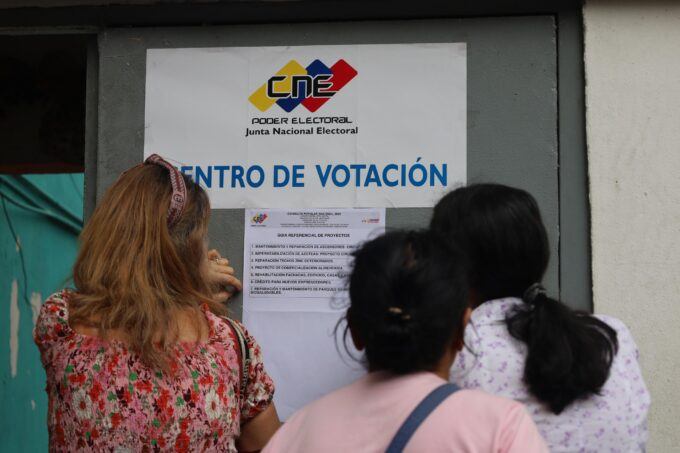
Members of a commune in Caracas arrive early to hang up signage and a list of the projects on the ballot. Photograph by Rome Arrieche.
Building a Collective Consciousness
One aspect of this exercise, Dulce explained, is the process of collective, strategic planning that the consults require in order to be effective. “If you don’t think as part of the collective, and you’re focused on your individual self, we’re screwed,” she said. If the project selected focuses on individual rather than collective needs, she continued, “maybe each family ends up with a screw [for their individual repairs], instead of a functioning water system for the community as a whole. … That’s the individualism that we have to keep combating. So, you have to speak from the love that you have for this project, and getting [to where we need to be] is the work of ants. One step, a few steps, you fall, you get up again, you go forward, you go back to the vision [of the project].”
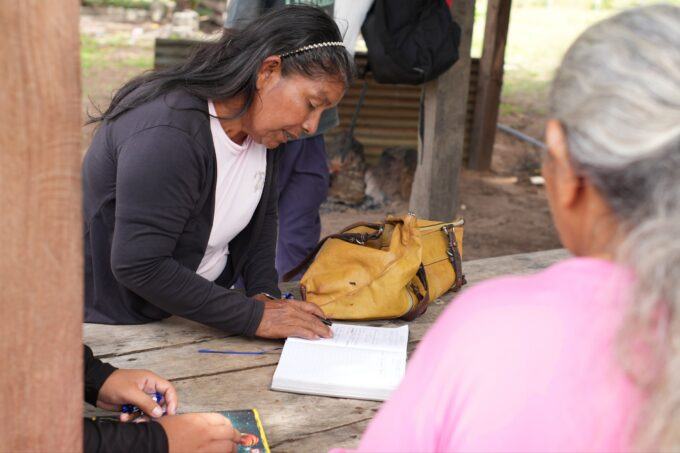
Communards discuss proposals for a communal consult at the Ezequiel Zamora Socialist Agricultural Commune in Amazonas State (November 2025). Photograph by Víctor Hugo Rivera.
This patience and sense of love isn’t just a personal attribute: it’s a core part of the vision of communes. As Chávez outlined in his 2009 address Aló Presidente Teórico 1, one of the core pillars of communes must be a “moral front”: “We’ve been infected by the old values, by selfishness, by capitalism, by the fragmentation of society… they’ve poisoned us, ever since we were children,” he explained. “Wherever we are building the commune… you must start there, from the bottom up, fostering social love and a sense of social duty… We must not merely pay lip service to it; we must begin to build a socialist society.”
Sitting in her living room a few days after the communal consult, Dulce explained to me how she and the commune’s other leaders set up a system to take care of their neighbors, not as charity, not as a side project, but as a core part of what defines them. Many of the people in her building are elderly and living on their own, with their children and grandchildren pushed to migrate as a result of the US-led sanctions regime. In fact, migration increased by up to 706% between 2015 (the year that Barack Obama declared Venezuela an “unusual and extraordinary threat”) and 2021 (the year that United Nations Special Rapporteur Alena Douhan produced a report on the impact of the US-drive sanctions and other unilateral coercive measures in Venezuela). In the same report, Douhan also notes the impact of the mass emigration of professionals in particular – many of them trained by the revolution – with “most public services hav[ing] lost 30 to 50 per cent of their personnel, including many of the most highly qualified workers (such as doctors, nurses, engineers, teachers, professors, judges and police officers), resulting in internal disorganization, increased workloads for remaining staff and reduced services and a decline in their quality. Public hospitals report shortages of qualified personnel, with between 50 and 70 per cent of such posts vacant.” With the attack and economic warfare from which the country is still recovering (as demonstrated by the 9%GDP increase in 2025), many retirees can’t afford medicine or are simply have a hard time getting to doctors’ appointments. So, the commune keeps track of the situations of each person in need, with a leader in each building who is familiar with their neighbors’ situations.
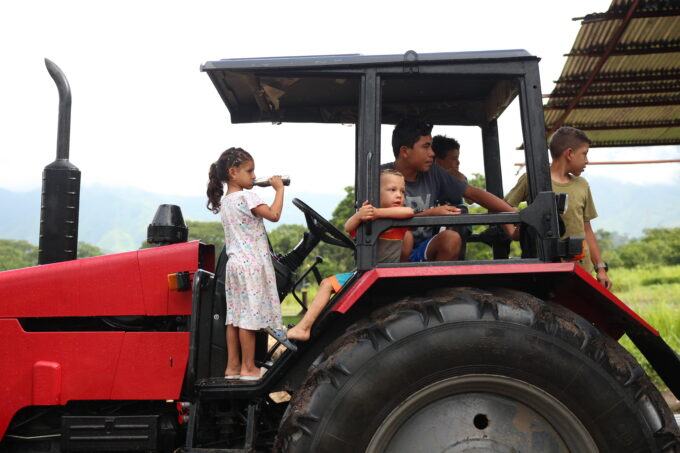
Children sit on a tractor at the Cinco Fortalezas Commune in Sucre while their parents show an international brigade how they process sugarcane into panela, an unrefined brown sugar that the commune produces. Photograph by Celina della Croce.
In Guarenas, Miranda, a small city roughly thirty minutes away from Caracas, Heyerde López, a member of the General José Felix Ribas Commune and co-founder of the cultural collective Nativa, echoed Dulce’s conviction and tenderness: “we can’t leave anyone out of this process, whether or not they participate – we have to lead by example.” Heyerde’s commune voted to create and finance a “people’s mobile market” – a mobile grocery truck that would sell food products from different communes. The mobile market seeks not only to generate funds for the commune, but also to build consciousness among communards, increasing trust and engagement along the way.
In the wake of the January 3 bombing, Heyerde and his neighbors explained to me, many people feel angry, humiliated, and at times defeated. When Chávez was kidnapped in a 2002 coup d’état, that time flown to an island within Venezuelan territory by a small faction of the armed forces backed by the US and the country’s elite, masses of people took to the streets and forced his return within two days.[§] Maduro, however, was kidnapped by the US military and taken to a detention center in Brooklyn, New York. They want to fight, but who? The enemy isn’t in office but thousands of miles away with their leader in a detention center guarded by the world’s largest military power, sending constant threats of further bombings and aggression.
At a citizens’ assembly on March 21, convened to make decisions about how to implement the funds for the mobile market, Heyerde explained the political component of the people’s mobile market: “Given how angry people on the street are about the current situation, there has to be a political message. … We need to win people over given the current situation, the discontent and anger people are feeling on the streets, too.” He called this process, of providing a needed service to the commune that is rooted in revolutionary values, consciousness-building, and patience, enamoramiento communal: falling in love with the commune.
Months since the kidnapping of President Nicolás Maduro and First Combatant[**] Flores, Venezuelans continue to experience a series of forced concessions as US President Donald Trump continues to use the possibility of further violence and intervention to threaten the country’s sovereignty. Yet the widespread sentiment of anger and indignity that this scenario has created is met with one of resolve: “We’re angry, but we’re not just going to sit here with our arms crossed,” another communard told me. Despite decades of attacks, from economic and information warfare to the recent bombing, there is a palpable feeling of the lived memory of what came before the revolution and the feeling of dignity and respect that the majority of the population has gained in the two decades since.[††]
What the Poor Stand to Win or Lose
For Heyerde, like most communards, this project, and his stake in it, is deeply personal. The Bolivarian Revolution not only brought tremendous material gains to a people that had long been pushed to the margins: it also taught them to stand upright, or as Heyerde put it, “It made us the protagonists of our own lives, and it enabled us, the poor, to participate and make decisions about our country.”
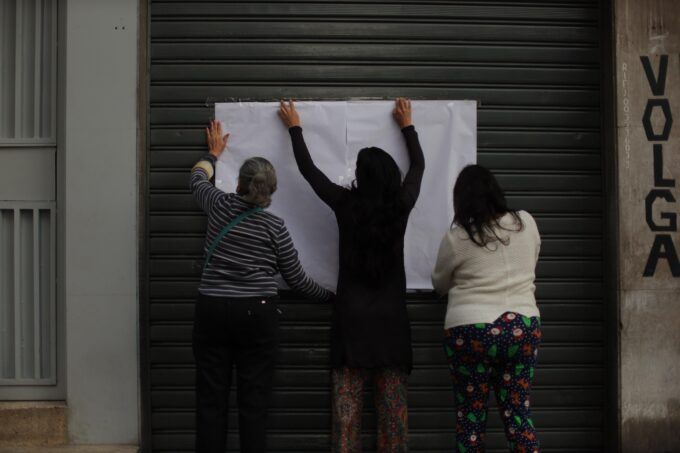
Women hang up paper in preparation for an assembly at the Miraflores Socialist Commune in Caracas to select which projects will appear on the communal consult ballot. Photograph by Rome Arrieche.
The revolution has built a collective consciousness among a people who know that they have not suffered from poverty because of laziness or personal defect but because of a capitalist system that relies on poverty in order to function. Heyerde, who was ten years old when Chávez came into office, has lived this experience first-hand. He recalled that his grandmother, at age 65, was one of 1.5 million Venezuelans who learned to read and write through Mission Robinson, a government program that eradicated illiteracy in the country by 2005. She was also one of the two million Venezuelans who has received eye surgery, which prevented her from losing her vision, through Mission Milagro. “We, the poor, didn’t have anything,” he told me. “With Chávez, the children of ‘the nobodies’ could study. [The revolution] gave us access to things that that were limited to people with power before, while the poor had to work ourselves into the ground.” This year, Heyerde, age thirty-seven, enrolled in the International University of Communications (IUCOM), one of the dozens of free, public universities founded since 1999.
Heyerde’s story is not unique. It shows how the participative democracy of the communes is built on the foundation of a revolutionary process that has used the country’s natural wealth not only to lift the population out of poverty but also to provide it with the skills, confidence, and consciousness-building to take planning into their own hands. For instance, state programs under the revolution have:
+ tripled the amount of university graduates.
+ increased the number of those with secondary education by two and a half times.
+ increased healthcare spending by 497% from 1999 to 2007.
+ made tremendous gains in food security, earning the recognition of the FAO for cutting the amount of hunger in half within the first decade of the revolution. (Studies show that there was an increase in daily kilocalories consumed, from 2.26 in 1998 to 3.092 in 2015, and that the growth of children age 7 increased from 119.8 cm in 1998 to 121.7 in 2011, just over a decade later).
+ built and dispersed over five million homes (compared to a mere 595,156 homes built in the ten years before the revolution).
+ distributed 5 million laptops since 2015 to 14 million students across the country (though, as Douhan notes, this program was suspended as a result of the US-driven sanctions, since “the only way to build new laptop computers under the program has been by assembling them from broken ones, as there is no longer any access to spare parts.”
+ incorporated 25 times more elderly people into pension benefits, from 19.6% to 100% of the eligible population.[‡‡]
For Dulce to check the names of each of her neighbors on the vote registry on March 8 and for Heyerde to write the commune’s plans out on the walls of their sala de autogobierno (self-governance room)[§§] requires a level of literacy and social inclusion that has been guaranteed by the revolutionary process. If it were not for the revolution, 2.4 million Venezuelans, many of them today engaged in popular processes such as these, would be illiterate. Over 2 million children – the equivalent of 25% of Venezuela’s schoolchildren – would be excluded from the education system. Malnourishment would be triple what it is today. Women, who have taken on a leading role in the country’s democratic processes, would be far more tied down with domestic care work which is today provided by the state. For all of the criticism Venezuela receives for relying heavily on oil, this wealth – once harbored by the elite and transnational corporations (many headquartered in the US) – has been redirected to benefit the Venezuelan people. Since the onset of the revolution, government plans have identified the need to dismantle the colonial structure that created this oil dependency and taken steps to diversify the economy (a task that has been made notably harder by interventions from the US and Venezuelan opposition since the revolution began).
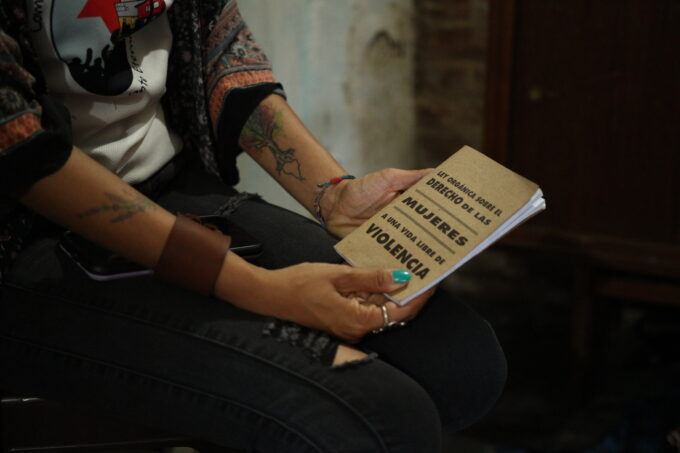
A member of the Cinco de Marzo Commune in Caracas holds a copy of the Organic Law on the Right of Women to a Life Free of Violence, passed in 2007, and explains the model of communal feminism and its connection to the rights guaranteed by the country’s legal framework. Photograph by Celina della Croce.
Interestingly, the very actors that today decry the reality in Venezuela have been responsible for the dips in social advances throughout the revolution. Though social indicators have advanced since Chávez’s inauguration in 1999 and under President Maduro, setbacks align with the most aggressive series of attacks, from the 2002 coup d’état and 2002–2003 oil strike to the escalation in sanctions and other unilateral coercive measures from 2017. For instance, Ricardo Menéndez points out that “Every time the Venezuelan opposition decides to take action to try to overthrow the Chavista government, there is a spike in the unemployment rate; for example, during the oil sabotage of 2003–2004, the rate rose by almost 20 percentage points.” Furthermore, he says, “we can see that the [Gini] inequality index when we took over the country stood at 0.49 and 0.48, and how it has been falling steadily since the revolution began; in 2018, we reached 0.37, the lowest point. … however, in 2019 and 2020 there was a slight uptick in that figure due to the impact of the [economic] war, which took us to 0.38.” As UN Special Rapporteur Alena Douhan’s report bluntly states:
[S]ectoral sanctions on the oil, gold and mining industries, the economic blockade of the Bolivarian Republic of Venezuela, the freezing of Central Bank assets, targeted sanctions imposed on Venezuelan and third-country nationals and companies, and growing overcompliance by banks and third-country companies have… prevented the earning of revenue and the use of resources to maintain and develop infrastructure and social support programs, which has a devastating effect on the country’s entire population, especially – but not only – those living in extreme poverty, women, children, medical workers, persons with disabilities or life-threatening or chronic diseases, and the indigenous population.
The Bolivarian Revolution is not without challenges, both external, in the form of foreign intervention, and internal, as it seeks to dismantle the legacy, or “infection,” as Chávez put it, of what came before it. Yet what is clear is that the “before,” when 70% of the population lived in poverty, is not the answer to Venezuela’s challenges, and that the United States, with a track record of interfering in any sovereign process in which a country seeks to wretch its resources from foreign capital and redirect it to benefit its own people, will not deliver on its promise to “save” the Venezuelan people from its very own grip.
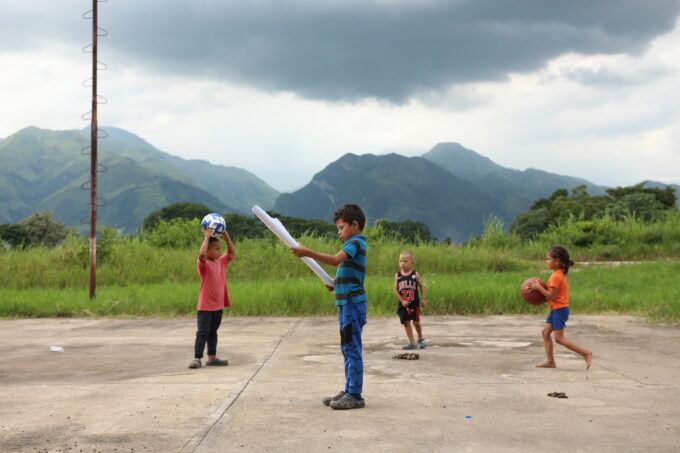
Children play with volleyballs, basketballs, and leftover meeting notes on butcher paper at the Cinco Fortalezas Commune in Sucre, Venezuela. Photograph by Celina della Croce.
As Heyerde told me, “We – the poor – are the ones who have the most to win or lose through this project. Ultimately, it is our project.” It is the Venezuelan people who will struggle through the challenges and contradictions before them to define their own future, as they have time and time again. And it is the Venezuelan people who face the task of enamoramiento, of inviting each of their neighbors to fall in love with the revolution and the promise it holds for the future. This task is one that takes place as the country recovers from years of economic, information, and other forms of hybrid war, as well as direct military aggression. The Venezuelan people are not only ants, marching forward to carry a burden, or social debt, bigger than their individual selves. They are the bricks of a lighthouse that has beaten again and again by the ocean waves yet will not crumble, the particles of light that together hold the power to guide us toward a better future.
Notes.
[*] It is important to note that the communal consults are taking place in the context of a prolonged economic crisis driven by US-imposed sanctions and other unilateral coercive measures (UCMs). These UCMs have blocked the government from the international financial system and caused a severe economic crisis, or, as Venezuelan economist Francisco Rodriguez put it, “the largest economic collapse outside of wartime since 1950.” In terms of the impact on infrastructure, United Nations special rapporteur on the negative impact of unilateral coercive measures on the enjoyment of human rights, Alena Douhan, reported that as a result of UCMs, by 2021 “only 50 per cent of the [water] system’s distribution units were running because it was impossible to buy spare parts and perform maintenance work, so water had to be distributed in rotation to ensure delivery to all.” In other words, amidst crisis and the country’s gradual economic recovery, consults have given Venezuela’s working class a leading role in identifying, funding, and carrying out implementation for their most pressing needs that were once a given, at the same time building up communards’ skills and confidence for self-governance.
[†] There are approximately 4,100 communes in Venezuela and 1,200 communal circuits, a structure that was created as a way to incorporate smaller communal councils into the consults through a “circuit,” thereby enabling them to access funding until they eventually form a commune.
[‡] In the months leading up to the March 8 communal consult, the US killed over 150 fishermen in a series of missile attacks; bombed Caracas, the capital, on 3 January; kidnapped President Nicolás Maduro and First Lady (or First Combatant) Cilia Flores; and threatened acting president Delcy Rodriguez and her cabinet with further bombings and implied assassination (with US President Donald Trump warning in a 4 January interview that if Delcy “doesn’t do what’s right, she is going to pay a very big price, probably bigger than Maduro” and stating that “We are ready to stage a second and much larger attack if we need to do so”).
[§] The slogan cada 11 tiene su 13 – every 11th has its 13th – remains a popular slogan today, referring to 11 April, the day of the coup, and 13 April, the day Chávez was returned to power and the coup failed.
[**] The term “first combatant” has become commonplace in Venezuela to refer to Cilia Flores in lieu of “first lady,” highlighting Flores’s own political accolades and her stature as more than merely the wife of a sitting president. Flores is also a deputy in the national assembly – and was the first woman to become president of the assembly in 2006 – a lawyer, a human rights defender, and has been a political leader since the early years of the revolution.
[††] The phenomenon of collective memory is a fascinating one. Venezuelans who oppose of the government will often cite that things were better “before” – meaning before the revolution. Yet any reputable account shows that before the revolution, the majority of the population was living in abject poverty, as detailed below, and dissent was met with severe repression. For instance, during the 1989 Caracazo, when Venezuelans rose up to protest the economic situation in the country, thousands were gunned down in the streets. A key task of the communes, as Heyerde and Dulce pointed out, is to build a collective consciousness that aligns the interpretation of hardship with the root causes behind it.
[‡‡] Despite the fact that the pension funds received have been severely impacted by the economic crisis, this was not the case in the earlier years of the revolution, and the improved infrastructure nonetheless marks a significant victory in reaching the elderly as the economic situation improves.
[§§] In 2025, President Maduro announced an initiative to support the establishment of a sala de autogobierno (self-governance room) in each of the country’s 5,300 communes and communal circuits, stating that they are “designed as a mechanism to strengthen public participation and promote self-governance within communities, thereby contributing to the development of a more inclusive and effective model of governance.”
[ad_2]
Source link
