
[ad_1]
Some social media users misleadingly compared two different elections — one in Colombia and another in California — to say that cheating is happening in the Golden State.
The social media posts referred to Colombia’s June 21 presidential runoff election, won by conservative candidate Abelardo de la Espriella, and California’s June 2 primary, where final results for some races are still pending.
“How is it possible that the Colombians were able to count 99% of the votes in two hours and California still hasn’t finished counting the votes from three weeks ago?” an X user wrote June 21. “Oh, yeah… Colombia isn’t trying to cheat a result like California is.”
Comparing the Colombian election with an American election is like comparing a bicycle to a spaceship, said David Becker, Center for Election Innovation & Research executive director and founder.
The country and the U.S. state have vastly different processes for vote counting. For one, Colombia’s elections are organized nationally and the June 21 election had only two candidates on the ballot.
Number of contests: California’s election included multiple statewide and local races. In Colombia’s runoff, there was only one race with two candidates.
Voting methods: California typically takes longer than other states to count ballots, mainly because of the state’s laws and mail-voting option. In Colombia, voters cast their votes in person and don’t have mail-in voting.
Administration: County election officials administer California elections and count ballots while the state does the final certification. Colombia’s presidential election is administered at the national level.
Here’s a deeper look into how voting works in both places.
How Colombia counts votes
In Colombia, De la Espriella and Cepeda became the top two frontrunners after the first round of the presidential election on May 31, advancing to the June 21 runoff.
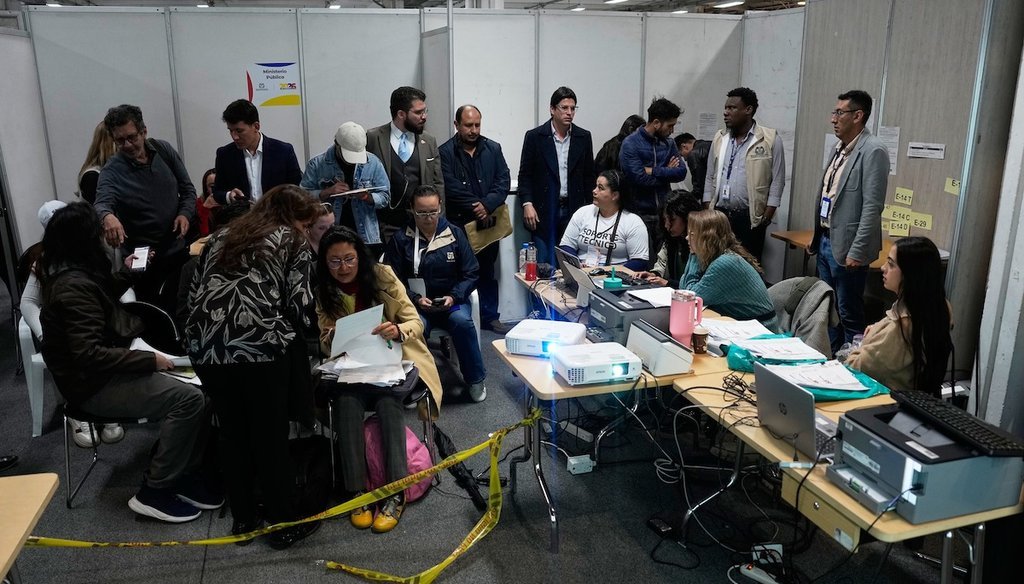
Once voting is complete, judges count the ballots to verify that they match the number of people who voted. After that, they start counting each vote; eventually, a panel of judges, election observers and notaries review the preliminary count to ensure there are no errors.
Then, the National Electoral Council announces the results.
The X post referred to Colombia’s preliminary vote count that showed De la Espriella receiving 49.6% of the votes and progressive candidate Iván Cepeda getting 48.7%. Cepeda conceded the race June 24, hours before the final count ended. The Colombian National Electoral Council announced De la Espriella as the new president that same day, after judges verified the results.
How California counts votes
In California, for most contests the top two vote-getters move on to the November general election, regardless of party preference or whether one candidate receives a majority of all votes cast in the primary election.
All 58 counties must follow state election laws and deadlines, the results come in at different speeds.
State law requires county elections officials to send the first batch of results to the secretary of state’s office no more than two hours after they begin counting votes after polls close on Election Day.
They continue to report results periodically on election night until the total of all the ballots at polling places have been reported.
Officials also continue to count vote-by-mail and provisional ballots up to 30 days after Election Day.
In California, a state with about 23 million registered voters, election officials mail ballots to all active voters. In 2024, about 19% voted in person.
It takes time to process mail ballots, including election workers verifying identity by matching signatures on the envelopes with registration records.
Many voters turn in their ballots on Election Day, experts say. The state counts mail-in ballots even if they are received seven days after the election, but are postmarked on Election Day.
This year, county elections officials must report their final results to the secretary of state by July 3, and the state will certify results by July 10.
As of June 25, most of the local races in California have been called. For governor and attorney general, 99% of votes have been counted.
Kim Alexander, president of the nonpartisan California Voter Foundation, previously told PolitiFact that the pace of the count is not proof the election was rigged. Still, the state should better explain that it is prioritizing access, security and accuracy, she said.
Eduardo Repilloza Fernández, general coordinator of Transparencia Electoral, an Argentina-based organization that oversees elections in the Americas, said that mail-in ballots and drop boxes in the California elections add protocols that don’t exist in the Colombian elections.
“In Colombia, voting takes place on a single day, Sunday, and the entire logistics system is set up to count the votes that same day,” Repilloza Fernández said.
Evelyn Pérez-Verdía, CEO of We Are Más, an agency that focuses on countering disinformation, said these social media posts connect an election in another country with a U.S. state election to make them distrust the U.S. electoral system. She said it’s a strategy to target diasporas who can vote in the U.S. and in their country of origin.
“These strategies are increasingly used by alliances of like-minded political groups in the United States and by sympathizers of extreme political parties in other countries,” said Pérez-Verdía.
[ad_2]
Source link
