
[ad_1]
Adryan Corcione Prism
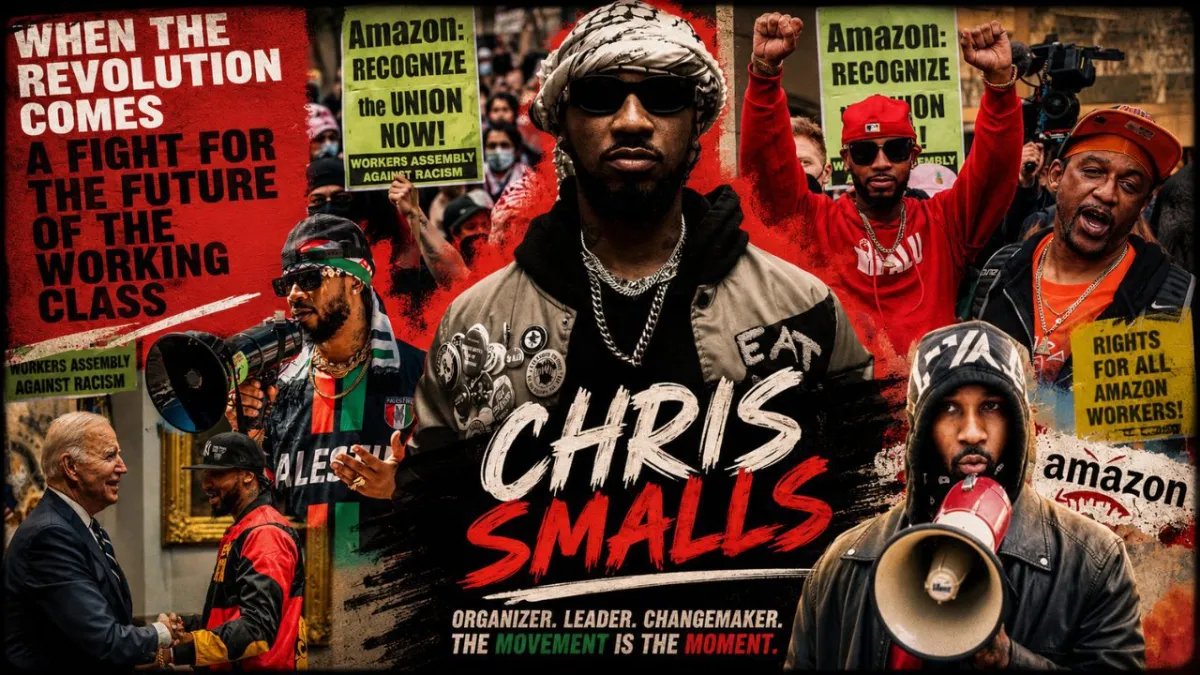
In April 2020, at the height of the COVID-19 pandemic, Chris Smalls worked at an Amazon warehouse in the Staten Island borough of New York City. With no social distancing required and no personal protective equipment provided, Smalls’ co-workers began getting sick with COVID. In response, he organized a workplace walkout, protesting their unsafe conditions. Despite his record as a high-performing employee, he was fired for organizing, which only fueled his efforts.
In May 2020, Smalls co-founded the Congress of Essential Workers, which later became the Amazon Labor Union. Smalls helped lead the drive for a historic National Labor Relations Board election victory for Staten Island Amazon workers in 2022. He served as president of the labor union from 2022 until 2024.
Smalls’ activism has since expanded to aiding flotillas to Gaza and Cuba, proving the labor struggle goes beyond borders and requires international solidarity. Most recently, he participated in a Met Gala protest against Amazon CEO Jeff Bezos, an honorary co-chair of the event who donated $10 million to the Metropolitan Museum of Art.
“When the Revolution Comes: A Fight for the Future of the Working Class,” Smalls’ new memoir, ghost-written by Carvell Wallace, tells the story of how Smalls became a labor organizer. From a workplace injury at Target when he was just a teen and throwing lively parties to promote his music to confronting Amazon management, the book details Smalls’ trajectory to becoming one of the country’s most recognizable labor organizers.
“When the Revolution Comes” was released on June 2 by Pantheon. Smalls recently spoke to Prism about his decision to write a memoir, his fight against Amazon, and why he chose to join the flotillas to Gaza and Cuba.
This interview has been edited for clarity and brevity.
Adryan Corcione: What inspired you to write a memoir? Why write a book?
Chris Smalls: People see articles about me [or] short clips, whether it’s 30 seconds to a minute or something. There’s also a lot of misinformation that’s also spread about me as well. This was an opportunity for me to tell my story, [what] really opened up the world to who I am as a person, starting from my early childhood days. I think people will see a piece of themselves in the journey that I take, whether it’s from quitting jobs, getting fired, being evicted, being married, divorced, trying to raise kids, the trials and tribulations of the workplace. Hopefully, people can relate to one of these different phases in my life and get inspired to organize.
Corcione: From reading about your prior work experience from your teens into your 20s, it seems like you always had a sense of class consciousness. Did your experience with class consciousness change or amplify as a labor organizer?
Smalls: In my young adulthood, [a workplace injury seemed] to be a pivotal moment of when I first realized things at work are not always peachy. I wasn’t an organizer back then, but when I was fired six years ago from Amazon, that was like: You can pour your blood, sweat, and tears into a company for five years like I did, and they can still dispose of you.
I was a late bloomer when it came to class consciousness, but I always had this rebellious side to me. Just from working at Target to all of the jobs after that, there was always some gripe that I had to deal with, [which] naturally molded me into an organizer. When Amazon fired me, unionizing really opened up that doorway to become a labor organizer. Within a short amount of time, I had to be a sponge.
Corcione: Why is it important to organize Amazon warehouses specifically?
Smalls: I think everybody should have some type of job security and some type of protections. It’s important that Amazon workers have these protections.
Amazon is obviously a high-turnover company that’s been around for 30 years, hiring and firing the entire American workforce. Even though they still violate federal laws on a daily basis, the purpose of our union is to hold them accountable and to make sure that they don’t do that anymore. It’s important to plant the seeds in workers’ minds.
There’s been campaigns all over the world, not just here in the U.S. Workers are starting to wake up more. The Amazon fight is very important to the working-class struggle.
Corcione: The Amazon Labor Union didn’t affiliate with Teamsters until 2024. For the first few years, was it intentional that the union was built independently?
Smalls: Most unions have a traditional-style method of organizing. Originally, one of my other co-workers [and I were] fired because we were the COVID-19 whistleblowers. [It] wasn’t about unionizing at first. It was about health and safety.
Once Amazon doubled down, the nonprofit emerged: the Congress of Essential Workers. We protested in front of every Jeff Bezos mansion in America pretty much. We did that for about a year [when we heard about a warehouse unionization] campaign in Alabama. That was kind of like a turning point for us to start to think about unionizing.
We drove 16 hours down to Bessemer, Alabama, to have conversations with workers and with the union. We wanted to learn as much as possible. Unfortunately, when [the labor campaign in Alabama] lost, that was our moment. We felt, as Amazon workers, we know the company and our working conditions best. We started independently. We did things completely against the book. Amazon spends millions of dollars in union busting. The way to be organized was really guerrilla tactics. Setting up an encampment for over 300 days. Most unions in this country are not willing to make these sacrifices.
The affiliation part [with Teamsters] was because, as an independent startup union with no contract, we didn’t have dues-paying members. When I was the president, I made sure we had an affiliation that was going to make sense. The biggest thing from that affiliation agreement was strike benefits, something that we couldn’t do as an independent union with no money.
Corcione: In your book, you discuss being invited to the White House by the Biden administration. Did your experience as a labor organizer influence what you thought about the Democratic Party?
Smalls: In the very early stages of our organizing journey, a lot of politicians—[Alexandra Ocasio-Cortez], Bernie Sanders, all these progressives—they flock to us after our victory. At first, we didn’t have a relationship. Taking on Amazon, we needed all hands on deck; we had faith in some of these progressive Democrats, but we realized that they’re not doing much. They’re just using our struggles for their talking points. When it came to asking for accountability for legislation, I didn’t get my questions answered.
Especially when I went to the White House, they released that little 30-second clip of me greeting the president, but they never released the whole entire meeting where I asked, “How are we going to bring Jeff Bezos to come negotiate a contract if there’s no laws that’s been touched since the 1930s?”
I’ve been vocal about the fact that the Democratic Party and labor unions are failing the working class. These labor unions—Teamsters included—even endorsed the two-party system, which is not working for us. Why do we endorse the Democrats when we get nothing in return? We have a responsibility to the working class, and unfortunately, both parties are failing us. We have to do better.
Corcione: Why should labor leaders act in solidarity with oppressed nations like Palestine and Cuba, especially in this political moment?
Smalls: As trade unionists, we take pledges that we are to be the shield for the working class. When we say these slogans like “an injury of one is an injury to all,” it doesn’t say “except if you’re Palestinian or Cuban.” To me, labor unions will say these slogans, but not really practice what they preach.
We can see these labor unions are now screaming about [Immigration and Customs Enforcement], but not making that relationship that ICE trains in Tel Aviv. ICE uses the same police brutality tactics that they use on Palestinians.
Cuba is one of the last socialist safe havens on this planet. Their country is led by trade unions. It’s not taught to us in our classrooms. I think this is really important, as far as what I’m doing with my platform. It’s to spread that type of awareness. Going to Gaza, as an American taxpayer, we all should be outraged with what’s happening over there. Besides the fact that Amazon is investing billions of dollars into the technology that’s being used to target and surveil and kill innocent Palestinians, we shall all be outraged.
These international struggles come back home. It’s already happening now. We see what’s going on right here in New Jersey at Delaney Hall. We saw what happened in Minneapolis.
When we see the rise of fascism all over the world, if labor unions are not at the front of that flight, they’re failing the working class. We can’t just sit back, wait four years, and then say, “Let’s go vote for a progressive.” This is not going to work anymore. We have to be proactive.
Corcione: What strengths do you see in the current labor movement?
Smalls: It gives me hope for the future. It gives me the motivation to continue my work.
Just seeing the younger generation being a lot more class conscious. They’re not waiting for things to get worse. They’re being proactive. They’re taking to the streets. I hate that our labor unions didn’t really support pro-Palestine student encampments because that was a huge opportunity for established labor unions to usher in the younger generation.
I see the younger generation is going to lead by example. How do we accelerate that? We all have to do something. We all have to sacrifice. That’s the question I ask myself, that I tell other people to ask themselves: What are you willing to sacrifice for the greater good—whether it’s time away from your friends, family, loved ones, or the things you love to do on a daily basis? It cost me my job six years ago, but I cost Amazon $4 billion. They had to protect every worker for COVID-19. That was my sacrifice.
Editorial Team:
Tina Vasquez, Lead Editor
Lara Witt, Top Editor
Stephanie Harris, Copy Editor
Adryan Corcione is a white queer essayist and journalist living on occupied Lenape land. Their writing has appeared in Teen Vogue, Truthout, Filter Mag, and more, covering topics like harm reduction, policing, and LGBTQ+ issues. They also write about technology and online culture on Substack at adryancorcione.substack.com. Adryan is currently seeking representation for their hybrid memoir about growing up online in the mid-’00s. Follow them on Bluesky at @adryancorcione.bsky.social and learn more about their work at adryancorcione.com.
Editor’s Note: At a moment when the once vaunted model of responsible journalism is overwhelmingly the play thing of self-serving billionaires and their corporate scribes, alternatives of integrity are desperately needed, and ScheerPost is one of them. Please support our independent journalism by contributing to our online donation platform, Network for Good, or send a check to our new PO Box. We can’t thank you enough, and promise to keep bringing you this kind of vital news.
You can also make a donation to our PayPal or subscribe to our Patreon.
Please share this story and help us grow our network!
[ad_2]
Source link
