
[ad_1]

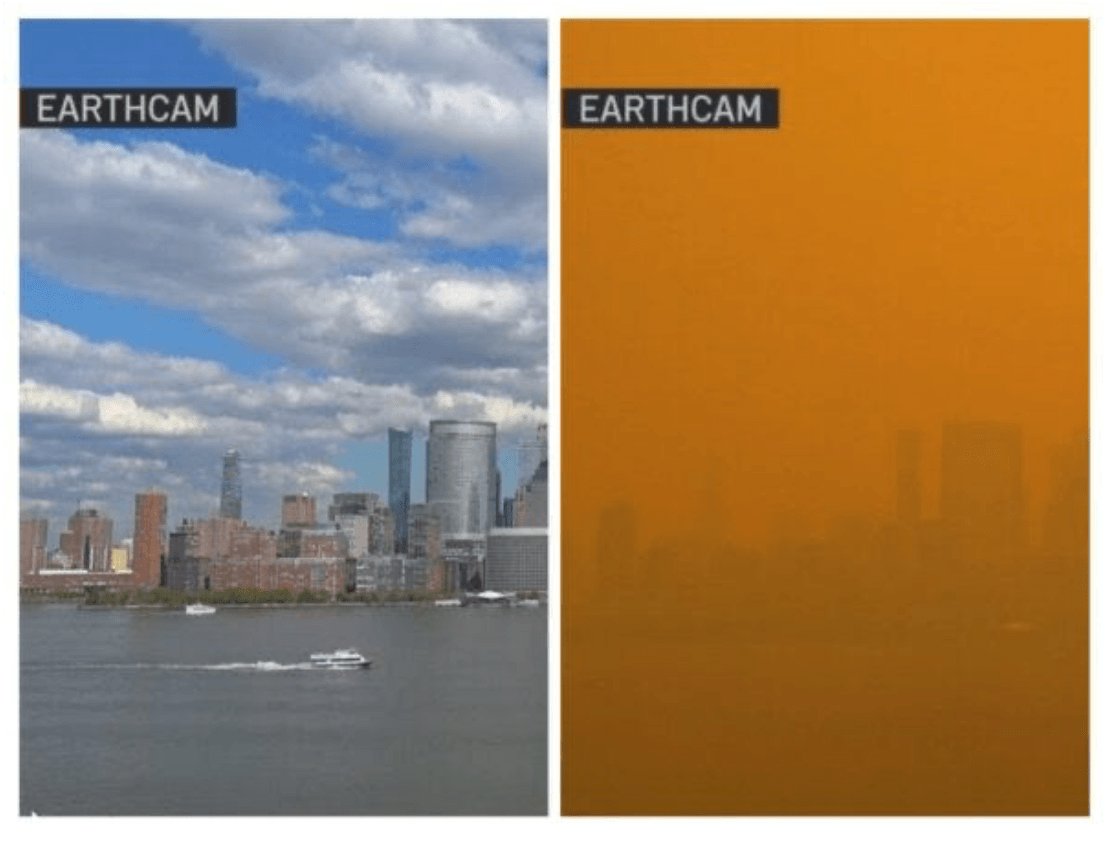
Smoke from Canadian wildfires has occasionally led to hazardous air conditions in major US cities.
As smoke from wildfires in Canada billowed across the central and eastern parts of the United States, President Trump once again demonstrated his utter ignorance of wildfire ecology.
Detroit on Friday remained the most polluted city in the world, according to tracker IQAir. Other major cities like Washington DC and Chicago were equally polluted.
Trump declared: “We are holding Canada responsible,” he wrote, “for the fact that they are not properly maintaining their Forests, and Brush therein, and the United States is being unnecessarily invaded by filthy, polluted, and unhealthy air, the quality of which is dangerous, and totally unacceptable!”
Trump suggested that he will increase tariffs on Canada to pay for the “willful negligence” ensuring even more animosity towards the US from our best neighbors and allies. Will Trump increase tariffs this winter if a “polar express” sweeps out of the Arctic and across the US driving up heating costs? I am surprised he hasn’t immediately shipped more rakes to Canada so they can clean up their forests and make them tidy.
All cynical comments aside, Trump’s response demonstrates how clearly he fails to understand the relationship between fossil fuel burning, warming climate and wildfires. He has repeatedly declared that climate warming is a “hoax.”
Worse for the planet, his energy policies that promote fossil fuels are willfully increasing climate warming.
The first problem with Trump’s irrational response is his failure to understand the scope of the wildfire issue. Canada’s boreal forest encompasses 1.3 billion acres. That’s almost the size of the lower 48 states combined (1.9 billion). Thus far, wildfires have burned 7 million of Canada. Across most of this vast area there are no roads, not even much forestry. It is impossible to have any substantial impact on wildfires burning across such a huge area.
Second, wildfires are a natural part of the boreal forest. These forests do burn on occasion when conditions are “ripe” And those conditions include drought, high temperatures, low humidity and wind. All those conditions exist across much of Canada today.
Third, though high severity burns release carbon into the atmosphere, which is one factor driving climate warming, much of the carbon in burnt forests remains locked up in snags, roots and charcoal.
By contrast, logging and wood products production, which Trump is proposing, should be increased both in Canada and here in the United States, releasing a far higher percentage of the carbon locked in forests. For instance, in Oregon, the Wood Products Industry releases more carbon than all the transportation sectors in the state.
Plus, there are substantial economic and ecological costs associated with logging that are often ignored.
However, the other major problem with Trump’s cognitive dissidence is his energy policies. Trump has basically unleashed massive new inputs of carbon from burning fossil fuels.
He has attacked energy efficiency requirements of the transportation sector. He has canceled wind energy and solar projects. He has supported elimination of tax incentives to support electric automobile conversion, solar energy on homes, energy conservation measures in building construction and other renewable energy policies.
According to a report by the Bluegreen Alliance, 223 clean manufacturing, energy, and industrial projects across the country—representing at least $82.8 billion in capital investment—have been canceled or stalled.
Trump is even paying 2. 3 billion of taxpayer dollars to cancel wind farm projects.
Worse for American consumers, his unnecessary War in Iran has driven up energy costs for all Americans. While he gloats that America is the largest producer of crude oil, implying this will result in lower gas and energy costs, it ignores the basic economic reality that the global market sets oil and gas prices. Energy producers in the United States may produce a lot of oil and gas, but they sell it at the global price. And that price has risen due to the uncertainty about oil supplies resulting from the Iranian War.
There is evidence from over millions of years that adding carbon, whether from natural sources or human emissions, can increase wildfires. If we continue to release carbon into the atmosphere, we can anticipate large wildfires.
[ad_2]
Source link
