
[ad_1]
In one of the scariest moments in modern history, we're doing our best at ScheerPost to pierce the fog of lies that conceal it but we need some help to pay our writers and staff. Please consider a tax-deductible donation.
By Sasha Abramsky
This article was originally published by Truthout
The state’s messy primary underscores the urgent need for ranked-choice voting in California — and beyond.
With just weeks until California voters cast ballots for the next governor in the primary, five candidates are clustered atop the polling, each with at least 10 percent but less than 20 percent support among the electorate. A sixth candidate, San Jose Mayor Matt Mahan, is at 5 percent and has been gaining visibility in recent weeks. More than a quarter of the electorate has yet to make up its mind.
In a closed primary system, the Democrats and Republicans each choose their candidates in the primaries, and those candidates face off in the general election in November. But since 2012, the first election cycle after California voters passed Proposition 14 in 2010, the state has had what is known as a “jungle primary.” In such a system, all the candidates are thrown into a single primary in which all registered voters can vote, and only the top two then proceed to a general election runoff.
At the time that California passed this election reform, only Louisiana and Washington State ran a similar primary process, though in Louisiana’s system, if a candidate gets more than 50 percent there is no runoff election. Proponents argued their system was the way of the future because it would force candidates to hew to the middle to woo independent voters, and that once its success was apparent, other states would adopt it en masse.
That hasn’t happened. In fact, since 2010, only Massachusetts has flirted with adopting such a system — although its proponents are careful to argue it isn’t actually a “jungle primary.” (In reality, the Massachusetts proposal is largely the same as that in California — but proponents are seeking to distance themselves from the messy consequences of California’s system.)
The reason other states haven’t emulated the California system is fairly straightforward: It turns out it’s a really bad way to choose political candidates. Championed in 2010 by then-Gov. Arnold Schwarzenegger, who argued it would “give power back to the people,” and a coalition of business groups and other organizations that predicted that such a system would reduce polarization and attract centrist candidates who could appeal to independent voters who might typically sit out closed primaries, the jungle primary has instead locked in place some of the worst, least-representative tendencies in U.S. politics.
In a polarized age, the system hasn’t stopped candidates jumping into races and appealing exclusively to their party’s base — hoping to energize them to vote in large numbers in the primary. At the same time, it has raised the risk of one party winning both runoff places and seriously limiting options come the general election.
This electoral cycle, the governor’s race has an added wrinkle of uncertainty. Eric Swalwell, the onetime front-runner, withdrew in disgrace a few weeks ago in the wake of multiple allegations of sexual abuse, including one from a former staffer who said the congressional representative raped her.
The withdrawal of Swalwell has left the race wide open. In a state where Democrats outnumber Republicans by nearly two to one, several Democratic candidates are vying for their portion of the Democratic-leaning electorate — but none of them have broken away from the pack. And in fact, because Swalwell, and also Betty Yee, withdrew after the deadline for dropping out, both of their names will remain on the ballot, thus further dividing the Democratic field.
Meanwhile, because there are only two Republicans in the race, there is a real (and growing) possibility that the top two spots in the jungle primary will be taken by the Republicans. If this were to occur, ultra-blue California would be in the ludicrous position of having a Democratic supermajority in the legislature, two Democratic senators, 90 percent of its congressional representatives being Democrats, and every statewide officer except the governor being Democratic — but with a Trump-backed Republican in the governor’s office.
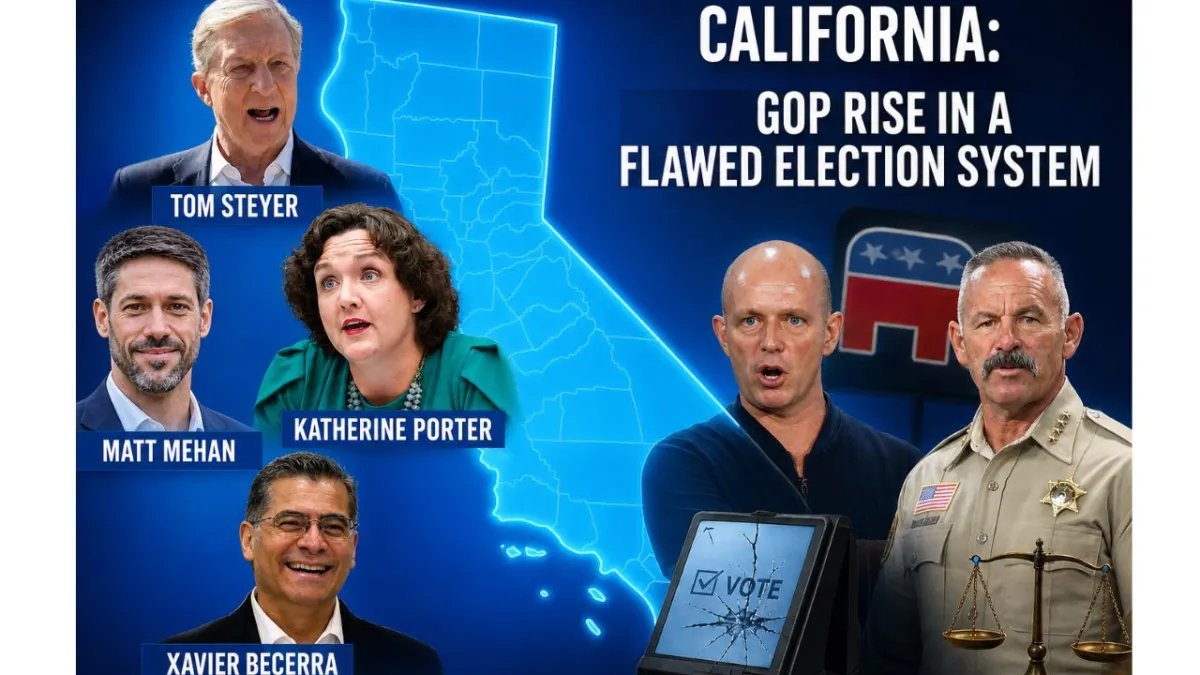
The recent gubernatorial debate in San Francisco featured four Democrats — San Jose Mayor Matt Mahan; Xavier Becerra, former California attorney general and U.S. health secretary; billionaire environmentalist Tom Steyer; and former Rep. Katie Porter — and two Republicans: England-born real estate developer and Fox News commentator Steve Hilton, and Riverside County Sheriff Chad Bianco — a denizen of the hard right who shamelessly pandered to the MAGA base earlier this year and seized hundreds of thousands of ballots from last year’s elections in California under the pretense of investigating “voter fraud,” despite orders from California’s Supreme Court that he back off and admonitions from the state attorney general.
Post-debate polling suggests none of the candidates had a true breakout moment, which means that, heading into the primary election, it’s unlikely any of the four Democrats will pull far ahead of the crowd.
This opens up the chance that Sheriff Bianco and the Trump-endorsed Hilton could each get just shy of 20 percent of the primary votes, roughly splitting the 38 percent of California voters who went for Trump in 2024. If they do, it’s statistically possible that they end up taking the top two spots, thus leaving Democrats without a candidate to vote for in the general election.
All of this undemocratic messiness could have been avoided had California combined its jungle primary process with ranked-choice voting — the system adopted in 2022 for statewide races in Alaska, and now also used in Maine, in New York City’s mayoral race, and in a number of other municipalities around the country.
In a ranked-choice system, voters don’t just vote for one candidate. Instead, they rank all the candidates. If their first-choice candidate finishes in the top two, that vote holds, but if their top choice candidate doesn’t, their second-choice vote gets registered; if, in that round of vote counting, that candidate also doesn’t finish in the top two, the third-choice vote kicks in. Eventually, as the choices are allocated, a candidate will end up with more than 50 percent of the vote and be declared the winner. Or, in the primaries, two candidates will emerge with an insurmountable lead and they will proceed to the runoff. That is how voters in D.C.’s municipal primary elections will be voting this June 16.
It sounds complicated, but ranked-choice voting is actually rather elegant. It means that in the first round of voting, people can vote their conscience without worrying that their vote will be wasted or will help usher in a democratically counterintuitive result such as two Republicans ending up in the general election runoff in a state where Democrats vastly outnumber Republicans.
Most states in the country now have reform groups campaigning for the implementation of ranked-choice voting. California’s current bizarre situation, in which a party commanding the loyalty of barely a third of registered voters may field both general election runoff candidates for governor, is a signal that reform groups in the Golden State need to pivot quickly after this election season to pushing ranked-choice voting. The jungle primary has long been a catastrophe in the making; ranked-choice voting would at the very least smooth out this system’s roughest edges.
This article was originally published by Truthout and is licensed under Creative Commons (CC BY-NC-ND 4.0). Please maintain all links and credits in accordance with our republishing guidelines.
Editor’s Note: At a moment when the once vaunted model of responsible journalism is overwhelmingly the play thing of self-serving billionaires and their corporate scribes, alternatives of integrity are desperately needed, and ScheerPost is one of them. Please support our independent journalism by contributing to our online donation platform, Network for Good, or send a check to our new PO Box. We can’t thank you enough, and promise to keep bringing you this kind of vital news.
You can also make a donation to our PayPal or subscribe to our Patreon.
Please share this story and help us grow our network!
[ad_2]
Source link
