
[ad_1]

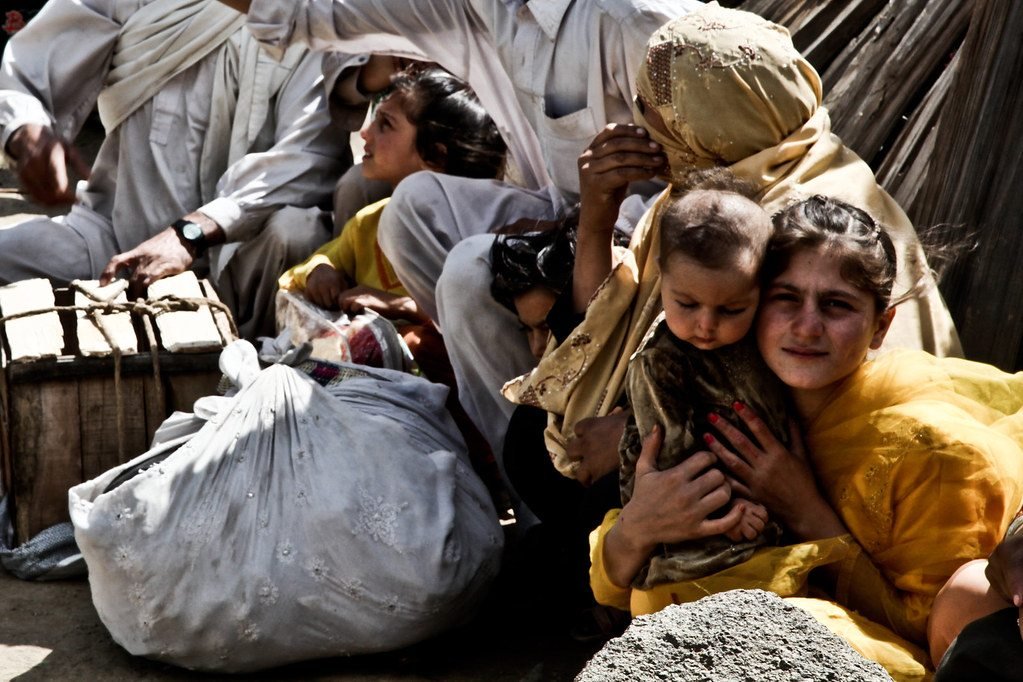
Female refugees in Pakistan. Wikimedia Commons. CC BY-SA 4.0
A family arrives at a camp in Sudan carrying everything they still owned. A few cooking pots. Some blankets. Perhaps a plastic bag of clothes.
They expect to stay a few weeks before returning home.
Instead, they are displaced again.
And again.
And again.
The war that unsettled them has become one of the largest humanitarian disasters on Earth. Tens of millions have been uprooted. Aid agencies inform those who listen that millions face hunger, disease, and violence.
Yet outside these aid agencies and diplomatic circles, many struggle to explain anything of what is happening.
How does one of the largest humanitarian disasters become something so barely noticed?
Some of humanity’s largest emergencies unfold in relative obscurity. History is full of such examples. Entire populations suffer while the rest of us scroll past.
Sudan is not unusual. In fact, that isone of the most unsettling things about it. “Well, everywhere is war,” as Bob Marley sang, “Me say war.”
Then there is the Democratic Republic of the Congo (DRC)—the Heart of Africa. In 2019, WHO officials working in North Kivu reported that ongoing armed conflict was hampering Ebola contact tracing because communities were repeatedly displaced by violence. Today, humanitarian agencies warn that renewed fighting in eastern Congo has further displaced millions and restricts access to vulnerable communities. Many are fleeing a vicious cocktail of violence and disease, making containment and relief efforts almost impossible.
It is a crisis that combines—right across Central Africa— mass displacement, public health emergencies, mineral geopolitics, and regional instability.
Further east—all the way across the Indian Ocean—and the pattern appears again.
Following major flooding in Myanmar—in happier days, known as the Land of Pagodas—some villages receive emergency assistance only to find themselves cut off again when renewed fighting closes roads and restricts access.
For many communities, conflict and natural disaster no longer arrive separately; they compound one another, turning recovery itself into a massive struggle.
International attention on Myanmar tends to spike after major disasters or military offensives, only to fade again. Yet the conflict continues with unerring malevolence. Humanitarian agencies estimate that roughly one-third of the population requires assistance today, with conflict, economic collapse, and disaster recovery all feeding into one another.
Myanmar occupies a critical position between South Asia, Southeast Asia, and China. Its instability inevitably disrupts regional security. It is driving migration and placing growing strain on trade routes and supply chains.
The geography changes. The neglect does not.
Take Haiti on the other side of the world—the so-called Pearl of the Antilles. Especially in the capital, Port-au-Prince, residents have described journeys of only a few miles taking hours because of routes necessarily passing through territory controlled by rival gangs. In some neighbourhoods, people have to wait for word that a road is temporarily safe before attempting to go to work, school, or a hospital. Even then, safety is not guaranteed.
International stabilisation efforts struggle to produce improvements. Haiti is like a test case for whether the international community can respond at all to a near-state-collapse scenario that falls short of a conventional civil war.
Nor is every neglected crisis a war.
Marine scientists describe returning to reefs they know well only to find them utterly transformed—vast gardens of colour turned pale and ghostly beneath unusually warm currents. Coral reefs are often called the rainforests of the sea. From Australia’s Great Barrier Reef to reef systems around Hawaii and Japan, warming oceans are steadily erasing ecosystems that took centuries to develop.
Scientists continue to warn that prolonged marine heat stress is driving one of the most extensive global coral bleaching events ever observed. Coral reefs support fisheries, tourism, and coastal protection for hundreds of millions of people. Their loss would rank among the most consequential ecological changes of the century, carrying economic and food-security consequences far beyond environmental circles.
There are, unfortunately, many other entries on this ghastly list of underreported crises. There is the growing impact of conflict-driven energy and food-price shocks on global hunger, particularly in countries such as Somalia and Afghanistan. There are displacement crises in places like Mozambique, Cameroon, and Colombia that humanitarian organisations say receive far less attention than their scale deserves.
We assume that what matters will naturally dominate headlines, social media feeds, and public debate, forgetting that algorithms—not public judgment—now determine much of what we see.
The displaced family in Sudan does not cease to exist because we are not watching. The mother waiting for a safe road in Port-au-Prince, the aid worker tracing disease through camps in Congo, the villagers cut off by flood and conflict in Myanmar, and the communities watching reefs turn white beneath warming seas all continue to live through their emergencies whether the rest of us notice them or not.
Somewhere in Sudan tonight, another family will arrive at another camp carrying what remains of their lives. They will unpack blankets and pots, and tell themselves they will be home soon.
Perhaps they will.
But whether they are or not has nothing to do with whether the rest of us are paying attention.
As Simone Weil wrote in the early 1940s, “L’attention est la forme la plus rare et la plus pure de la générosité”—“Attention is the rarest and purest form of generosity.” People living through these emergencies do not need our pity. They need our attention: a refusal to succumb to callousness or institutional amnesia, and a commitment to remember them long after the headlines have moved on.
[ad_2]
Source link
