
[ad_1]
With the midterm elections rapidly approaching and polls showing Republicans in serious trouble with voters, they have become frantic to pass the SAVE America Act. Twenty-five House members are now promising to vote no on everything until the act is passed. Their panic is based on the entirely unfounded belief that passing the act would make some meaningful difference in the midterm results.
There are two principal provisions of the SAVE Act. First, it imposes a photo ID requirement to vote in any federal election. Second, it requires proof of citizenship for anyone to register to vote in a federal election. Significantly, it imposes significant administrative and criminal penalties for violating its provisions.
Today, let’s focus on the photo ID requirement.
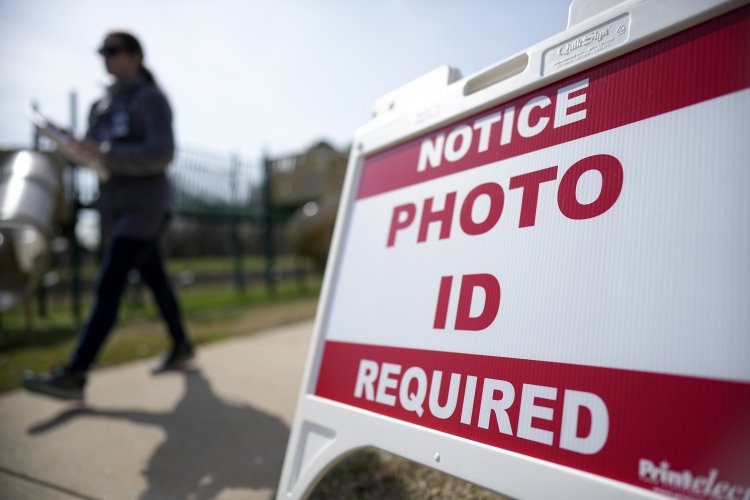
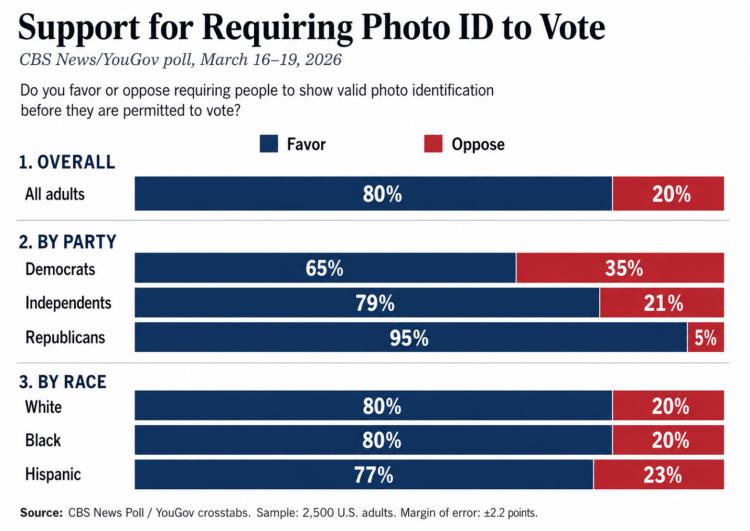
It is important to note that the requirement for voters to present a photo ID when voting is very popular and widely supported across the political spectrum and by all demographic groups.
About half of Americans are already required to present a photo ID to vote. Fourteen states and D.C., home to about a third of all registered voters, have no ID requirement. These are mostly states where Democrats dominate elections. The rest have some requirements, but not necessarily a photo ID.
Opponents of the act argue that the photo ID requirements are overly burdensome for certain groups that do not already have photo IDs. As a practical matter, this comes down to whether a person has a driver’s license. The act provides several other alternatives, but it will be relatively rare for a person to have one of those and not have a driver’s license.
According to this 2024 University of Maryland survey, about 21 million Americans do not have a non-expired driver’s license, another 28 million have a driver’s license that does not match their current name or address, and a little over 2 million have no ID at all. So, in total, about 50 million people might have some problem meeting the photo ID requirement. What the study does not tell us is how many of these people are registered voters. About a quarter of all qualified voters in the U.S. (~62 million) are not registered voters. My guess is that there is a large overlap between people who do not have a valid ID and those who are not registered to vote. So, how often this would come up is questionable. Nonetheless, there will inevitably be voters who show up with an expired driver’s license or who have moved and not updated their address.
This is where the SAVE Act’s rules governing provisional voting become important. Under the act, if a person shows up to vote without the required photo ID, they are not turned away. In fact, the act requires that the state provide the person with the option to cast a provisional ballot.
Provisional ballots are already widely used in elections across the country when there is some question about a person’s right to vote in a particular election. Those ballots are set aside and not counted in the initial tally. Only if the margin in a particular election is less than the number of provisional ballots that were opened and examined does the outcome depend on those ballots. In other words, if a candidate wins by more than the total number of provisional ballots, the votes on those ballots are irrelevant to the outcome. Which is almost always the case.
That reality, of course, begs the question of whether photo ID is a solution in search of a problem. I think largely it is. After working in Texas elections for nearly 50 years, I can tell you I have rarely seen anyone vote who should not be voting. That does not mean that it never happens – it does. But I can think of only a handful of very low turnout elections (like city council and school board) where I thought the outcome might have been affected by illegally cast ballots.
Regardless, many Americans have doubts about our elections. The same CBS poll found that 32% of Americans believe illegal voting and other irregularities are widespread. Whether it is true or not – and personally, I do not believe it is – the mere fact that a third of the country believes there is widespread fraud is a problem.
Requiring voter ID would alleviate some of those concerns. So, while implementing the photo ID requirements will be a hassle for some voters and election officials, I believe increasing confidence in our elections is worth it.
The SAVE Act’s requirements around proving citizenship when registering and how states maintain the voter rolls are somewhat more problematic. More on that next time.
[ad_2]
Source link
