
[ad_1]
Misinformation is one of the most pressing challenges of our time. The World Economic Forum has even identified disinformation (false or misleading information spread intentionally to deceive or harm others) as the foremost global threat, shaping public perception, eroding trust, and influencing policies (Ecker et al. 2024). Yet despite growing awareness, common misunderstandings and mistakes in mythbusting persist.
Well-intentioned mythbusting is not necessarily effective mythbusting. In some cases, attempts to correct misinformation can even backfire, unintentionally amplifying falsehoods rather than dismantling them. Research shows that once misinformation takes hold, it can be highly resistant to correction (Walter and Tukachinsky 2020; Lewandowsky et al. 2020). Even professionals engaged in educational research, science communication, and media fact-checking risk inadvertently reinforcing misinformation if their approach does not align with the latest psychological and cognitive research.
So, how can we bust myths without making them stronger?
This article identifies six common myths about mythbusting and explains how to avoid some pitfalls. Instead of relying on intuition, mythbusting should be grounded in evidence-informed strategies, such as the fact-myth-fallacy-fact approach (Lewandowsky et al. 2020). This four-layer truth sandwich helps to debunk myths more effectively by:
- Leading with a factual statement: framing accurate information in a clear and memorable way.
- Identifying the myth and warning: explicitly naming the misconception and highlighting why the myth is problematic and/or misleading.
- Unpacking the fallacy behind the myth: helping people understand why and to what extent a specific claim is inaccurate.
- Reinforcing the fact: ending on an evidence-informed takeaway to leave a stronger impression.
Fact #1: Mythbusting Is Necessary and Can Be Effective
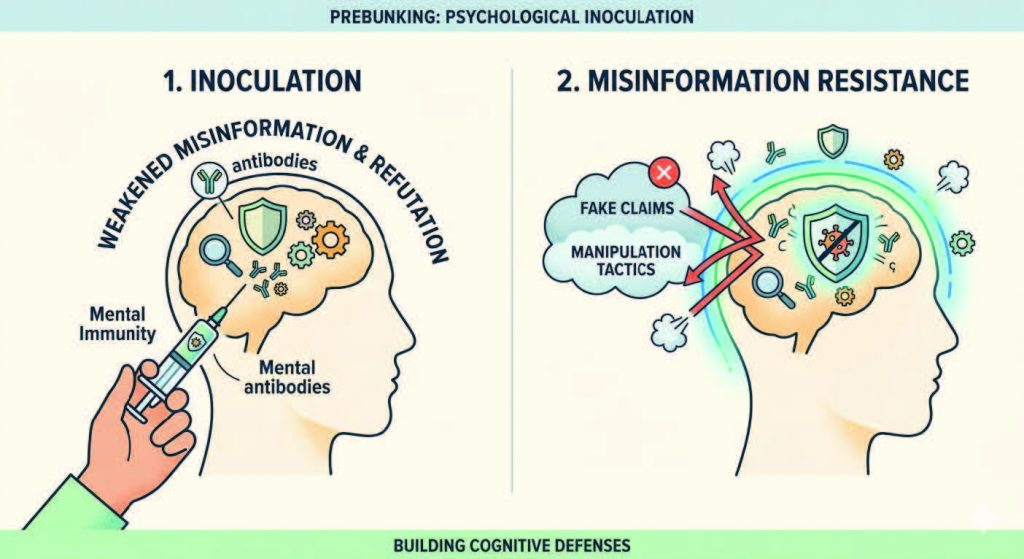
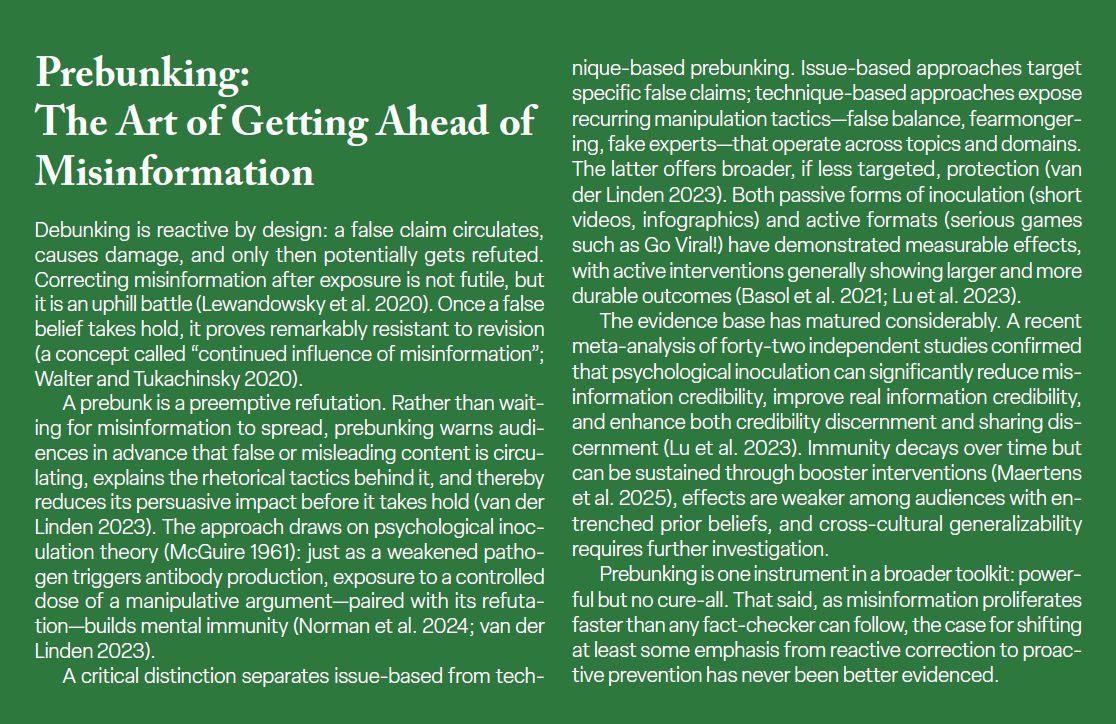
Fact statement: Busting myths is challenging but not futile. Research in disciplines such as cognitive psychology or science communication show that strategic mythbusting—debunking (Lewandowsky et al. 2020), prebunking (van der Linden 2023), and fostering mental immunity (Norman et al. 2024)—can effectively reduce misinformation’s influence. (For more on prebunking and fostering mental immunity, see the sidebar titled “Prebunking: The Art of Getting Ahead of Misinformation.”)
Myth and warning: Some argue that mythbusting is an unwinnable battle because misinformation is constantly generated—an idea reinforced by Brandolini’s Law (Williamson 2016), also known as the bullshit asymmetry principle—or because debunked myths keep resurfacing. This perception can lead to capitulation by individuals and institutions, allowing misinformation to persist unchallenged.
Fallacy: This myth is rooted in the fallacy of impossible expectations—the flawed assumption that mythbusting must completely and permanently eradicate misinformation to be effective. However, myths persist because they are socially and institutionally entrenched and can serve psychological functions, such as providing guidance under time pressure or stress (Sinatra and Jacobson 2019). Additionally, the argument presents a false dichotomy: either myths are fully eliminated, or mythbusting has failed. In reality, awareness and mitigation are already valuable outcomes.
Reinforcing the fact: It is easy to feel discouraged when misinformation is persistent and widespread. While mythbusting may feel like Whack-A-Mole, strategic and continuous efforts to counter it matter. Choosing battles wisely (Siegel 2024a), focusing on the moveable middle and using evidence-informed strategies, such as prebunking or debunking, can break the cycle of misinformation. Silence enables myths to flourish, reinforcing the spiral of silence—the phenomenon where individuals avoid expressing dissenting views due to perceived social pressure (Noelle-Neumann 1993). A reasonable goal is not total victory but making misinformation less sticky, less persuasive, and less socially dominant. Abandoning the fight would be far more dangerous than refining our methods.
Fact #2: Mythbusting Is More Than Just Correcting Facts
Factual statement: Facts are necessary but not sufficient in mythbusting. People do not process information in a vacuum; ideology, emotions, values, and social identity all influence how they interpret evidence. Research shows that simply presenting better arguments often fails when they conflict with personal identity or deeply held core beliefs. Effective mythbusting requires framing messages in ways that resonate with audiences and acknowledging the emotional and social dimensions of misinformation (Siegel 2025).
Myth and warning: A common misconception is that misinformation persists simply because people lack knowledge and that the solution is to provide them with correct facts (a view known as the knowledge deficit model [Simis et al. 2016]). This assumption is flawed. Actions fall short when based on the belief that if people just knew the facts, they would change their minds and act differently.
Fallacy: This myth oversimplifies how people form and change beliefs. It assumes that humans are brains on sticks—purely rational processors of information—when in reality, social, emotional, and ideological factors strongly shape belief systems (Ecker et al. 2022). People do not just need information; they also need framing, context, and emotional engagement to reconsider their perspectives.
Reinforcing the fact: Facts matter, but mythbusting must go beyond just correcting misinformation. A purely cognitive approach is insufficient because people’s values, emotions, and identities influence how they accept or reject information. Effective mythbusting should:
- Address ideological and cultural worldviews first, creating a foundation for change
- Use narratives, analogies, and familiar framing to make correct information more relatable and engaging
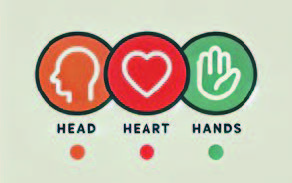
- Focus on “heads, hearts, and hands”—a framework emphasizing cognitive understanding (heads), emotional engagement (hearts), and practical application (hands) to enhance learning and action (Figure 1)
- Avoid overwhelming people with too many facts—instead, provide sticky, memorable, and simple key takeaways (Siegel 2024b)
Fact #3: Mythbusting Is Empowerment, Not Mind Control
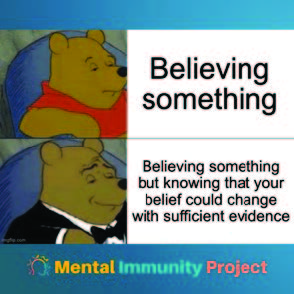
Factual statement: Mythbusting is about empowerment, not indoctrination. It can help foster critical thinking (Trecek-King 2024), intellectual independence (Shephard 2020), and mental immunity against misinformation (Norman et al. 2024). Rather than dictating what to think, it equips individuals to critically evaluate claims and distinguish between facts and misinformation.
Myth and warning: Ironically, contrarians often argue that mythbusting imposes a “correct” view, equating it with thought policing, censorship, or even brainwashing (Taylor 2006). Accordingly, they claim that mythbusting stifles intellectual freedom and suppresses open discourse, framing it as an attack on free speech. These concerns often stem from misunderstandings of what mythbusting (e.g., fact-checking) is and how it works. Misrepresenting mythbusting as suppression of debate can be a rhetorical strategy to discredit legitimate efforts to counter falsehoods.
Fallacy: This myth conflates argumentation with imposition. Effective mythbusting presents evidence-based reasoning, while censorship silences dissent—a crucial distinction. The fallacy assumes a false dichotomy: either people are left entirely to their own beliefs (no matter how flawed), or they are forced into a singular perspective. However, mythbusting does not impose views but challenges misinformation through reasoning and evidence (Lewandowsky et al. 2020).
Reinforcing the fact: While mythbusting is sometimes misperceived as policing thought, it actually stimulates discourse by ensuring debates are grounded in evidence, not misinformation. The phrase “I’m entitled to my opinion” is often used to shield weak arguments, but intellectual freedom does not mean all opinions are equally valid. Choosing battles wisely (Siegel 2024e), using prebunking and debunking strategies (van der Linden 2023), and fostering critical-constructive dialogue rather than confrontation can reduce psychological resistance to corrections (Chinn and Brewer 1993). Ultimately, effective mythbusting is a science, craft, and art (Siegel 2024c) grounded in research, refined through skill, and adapted for different audiences. It strengthens autonomy rather than control, not telling people what to think but helping them learn how to think critically (Trecek-King 2022).
Fact #4: Mythbusting Requires a Multi-Faceted Approach
Factual statement: While debunking myths can correct misconceptions and foster critical thinking, misinformation is deeply embedded in social, psychological, and institutional structures. Just as public health requires more than curing individual diseases, combating misinformation requires a multi-faceted approach that builds mental immunity in systemic resilience (Norman et al. 2024; Ecker et al. 2024).
Myth and warning: Do not assume that mythbusting alone will eliminate misinformation. This panacea belief is itself a myth. Some think that if we debunk falsehoods thoroughly enough, they will disappear. Educational myths function like zombie concepts (Sinatra and Jacobson 2019), refusing to die even when repeatedly debunked. Some myths shape-shift, adapting to new narratives, while others persist because they fulfill psychological or ideological functions.
Fallacy: The assumption that mythbusting can eradicate all myth sets unrealistic expectations and is a form of naive wishful thinking. Misinformation is not just a knowledge deficit; it thrives, for instance, on identity protection, emotional appeal, and social reinforcement.
Reinforcing the fact: Myths are not static; they sometimes resurface, morph, and persist. Expecting a world entirely free of myths is wishful thinking (Siegel 2024d). The real goal is not elimination but resilience, fostering a culture where myths are challenged and critically examined. Mythbusting should be seen as a component of a larger effort to create evidence-informed education and critical engagement rather than a standalone fix (Siegel 2024d). Mythbusting, therefore, must be part of a broader strategy that includes:
- Using different types of inoculation for prebunking, building resilience before misinformation spreads (van der Linden 2023)
- Gaining media literacy and critical thinking education, teaching individuals how to evaluate information critically (Trecek-King 2024)
- Fact-checking infrastructure and institutional safeguards, ensuring that misinformation is quickly and effectively countered
- Addressing the emotional and social dimensions of belief, understanding why people hold on to myths rather than just presenting more facts
Fact #5: Mythbusting Works Best When Addressing the ‘Movable Middle’
Factual statement: Effective mythbusting aims to reduce the overall influence of misinformation by focusing on the movable middle—people who are undecided, misinformed, or uninformed but open to change (Sinatra and Hofer 2021). Research shows that targeting this group is far more impactful than trying to persuade die-hard deniers or merely reinforcing what the already convinced know. Mythbusting works best when it builds critical mass and fosters mental immunity (Norman et al. 2024).
Myth and warning: Beware of the claim that mythbusting is either futile (because it tries to persuade die-hard contrarians who will never change) or redundant, merely preaching to the choir of people who already accept scientific reasoning. This perspective is misleading as it assumes that mythbusting either fails to convert skeptics or simply reinforces existing beliefs without reaching a broader audience.
Fallacy: This myth falls into the logical trap of misplaced focus; it assumes that changing the minds of die-hard deniers is the goal of mythbusting. However, research suggests that science-based messages are often ineffective or even counterproductive for those motivated by ideology (Sinatra and Hofer 2021). Instead, the biggest group to target is the movable middle. It is a false dichotomy to suggest that mythbusting must either convert deniers or reinforce existing beliefs, ignoring that most people fall somewhere in between. In reality, strategic communication can shift public understanding without needing to convince the extremes.
Reinforcing the fact: In short, mythbusting is neither a futile fight nor a redundant exercise. It is a strategic effort to reduce misinformation’s influence, ensuring that accurate knowledge spreads where it matters most. To be effective, mythbusting should:
- Target the right audience—the movable middle, not the extremes.
- Use evidence-informed strategies such as prebunking and debunking (van der Linden et al. 2023).
- Think about leveraging trusted messengers—those who are more likely to accept corrections from sources they trust.
Fact #6: Mythbusting and Fact-Boosting Are Complementary, Not Contradictory
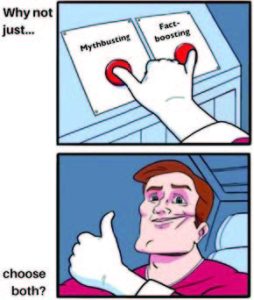
Fact statement: Emphasizing correct information is essential, but ignoring misinformation allows it to spread unchecked (Ecker et al. 2024). Misinformation is not simply a passive lack of knowledge but an active force that misleads and shapes public perceptions. To ensure evidence-informed understanding and action, both fact-promotion (boosting) and myth-correction (busting) are necessary and complementary strategies (Ecker et al. 2024).
Myth and warning: Be cautious of the claim that mythbusting is unnecessary or counterproductive. Some argue that we should focus solely on correct information rather than addressing falsehoods, suggesting that debunking is too deficit-oriented, risks amplifying misinformation (Lewandowsky et al. 2012), or wastes time. However, ignoring myths does not make them disappear; on the contrary, it allows them to spread unchallenged. While promoting accurate knowledge is essential, failing to counter misinformation leaves people vulnerable to falsehoods, which can shape attitudes and decisions in harmful ways.
Fallacy: This myth is based on a false dichotomy, that is, framing mythbusting and fact-boosting as mutually exclusive when they are, in fact, complementary. Ullrich Ecker and colleagues (2024) emphasize that misinformation is not just a passive absence of truth but an active distortion that influences attitudes, decisions, and behaviors. Combating misinformation and promoting facts are two sides of the same coin.
Reinforcing the fact: While promoting factual knowledge is crucial, ignoring misinformation allows it to take root unchecked, reinforcing misconceptions rather than replacing them. The real question is not whether we should focus on facts or debunk myths, but how we can strategically combine both efforts to enhance learning, instruction, and improve discourse through prebunking and debunking myths while also promoting accurate knowledge and critical thinking. Research shows that directly addressing myths can be a powerful learning tool; challenging misconceptions stimulates curiosity, critical inquiry, and more sustainable learning (e.g., Cook et al. 2014). This strategy aligns with the core principles of scientific inquiry—balancing openness to new ideas with rigorous scrutiny of existing claims (Sagan 1995). Ultimately, we do not have to choose between mythbusting and fact-boosting; we should do both.
* * *
Mythbusting is an essential tool in the fight against misinformation, but it must be applied strategically and evidence-informed to be effective. Ultimately, effective mythbusting is a science, a craft, and an art (Siegel 2024c). Insights from disciplines such as education, cognitive psychology, and communication provide evidence-informed strategies for addressing misinformation. However, as we refine our approaches, we must remain mindful of the potential pitfalls of mythbusting itself. By recognizing and avoiding these misconceptions, we can improve our ability to engage in evidence-informed public discourse and ensure that our efforts to combat misinformation are as effective as possible.
References
Basol, M., J. Roozenbeek, M. Berriche, et al. 2021. Towards psychological herd immunity: Cross-cultural evidence for two prebunking interventions against COVID-19 misinformation. Big Data & Society 8(1): 205395172110138. Online at https://doi.org/10.1177/20539517211013868.
Chinn, C.A., and W.F. Brewer. 1993. The role of anomalous data in knowledge acquisition: A theoretical framework and implications for science instruction. Review of Educational Research 63(1): 1–49. Online at https://doi.org/10.3102/00346543063001001.
Cook, J., D. Bedford, and S. Mandia. 2014. Raising climate literacy through addressing misinformation: Case studies in agnotology-based learning. Journal of Geoscience Education 62(3): 296–306. Online at https://doi.org/10.5408/13-071.1.
Ecker, U.K.H., S. Lewandowsky, J. Cook, et al. 2022. The psychological drivers of misinformation belief and its resistance to correction. Nature Reviews Psychology 1: 13–29. Online at https://doi.org/10.1038/s44159-021-00006-y.
Ecker, U.K.H., L.Q. Tay, J. Roozenbeek, et al. 2024. Why misinformation must not be ignored. American Psychologist. Online at https://doi.org/10.1037/amp0001448.
Lewandowsky, S., J. Cook, U. K. H. Ecker, et al. 2020. Debunking Handbook 2020. Databrary. Online at https://doi.org/10.17910/B7.1182.
Lewandowsky, S., U.K.H. Ecker, C.M. Seifert, et al. 2012. Misinformation and its correction: Continued influence and successful debiasing. Psychological Science in the Public Interest 13(3): 106–131. Online at https://doi.org/10.1177/1529100612451018.
Lu, C., B. Hu, Q. Li, et al. 2023. Psychological inoculation for credibility assessment, sharing intention, and discernment of misinformation: Systematic review and meta-analysis. Journal of Medical Internet Research 25: e49255. Online at https://doi.org/10.2196/49255.
Maertens, R., J. Roozenbeek, J.S. Simons, et al. 2025. Psychological booster shots targeting memory increase long-term resistance against misinformation. Nature Communications 16(1): 2062. Online at https://doi.org/10.1038/s41467-025-57205-x.
McGuire, W.J. 1961. Resistance to persuasion conferred by active and passive prior refutation of the same and alternative counterarguments. The Journal of Abnormal and Social Psychology 63(2): 326–332. Online at https://doi.org/10.1037/h0048344.
Noelle-Neumann, E. 1993. The Spiral of Silence: Public Opinion, Our Social Skin. 2nd ed. Chicago, IL: University of Chicago Press.
Norman, A., L. Johnson, and S. van Der Linden. 2024. Do minds have immune systems? Journal of Theoretical and Philosophical Psychology. Online at https://doi.org/10.1037/teo0000297.
Sagan, C. 1995. The Demon-Haunted World: Science as a Candle in the Dark. New York, NY: Ballantine.
Shephard, K. 2020. Higher education for sustainability: Seeking intellectual independence in Aotearoa New Zealand. Berlin, DE: Springer Nature.
Siegel, S.T. 2025. Educational myths debunked: Insights into the development, implementation, and evaluation of a course for University faculty. Zeitschrift für Hochschulentwicklung 20(1): 45–66. Online at https://doi.org/10.21240/zfhe/20-1/03.
———. 2024a. A battle we can(’t) win? Why mythbusting in education feels like a futile fight we can’t afford to lose. Evidence-Informed Sustainability Education (EvSusEd). Online at https://doi.org/10.58079/12m80.
———. 2024b. Educational myths debunked. Lehrblick – ZHW Uni Regensburg. Online at https://doi.org/10.5283/ZHW.20240215.EN.
———. 2024c. The science, craft, and art of mythbusting. Journal Trends und Themen aus der Wissenschaftskommunikation. Online at https://www.wissenschaftskommunikation.de/the-science-craft-and-art-of-mythbusting-79205/.
———. 2024d. What a wonderful world!? A world with or without myths in and about sustainability education. Evidence-Informed Sustainability Education (EvSusEd). Online at https://doi.org/10.58079/12vjr.
———. 2024e. When to bust, and when not to bust, that is the question—a mythbusting decision tree. Evidence-Informed Sustainability Education (EvSusEd). Online at https://doi.org/10.58079/12m7x.
Simis, M.J., H. Madden, M.A. Cacciatore, et al. 2016. The lure of rationality: Why does the deficit model persist in science communication? Public Understanding of Science 25(4): 400–414. Online at https://doi.org/10.1177/0963662516629749.
Sinatra, G.M., and B.K. Hofer. 2021. Science Denial: Why It Happens and What to Do about It. Oxford, UK: Oxford University Press.
Sinatra, G.M., and N. Jacobson. 2019. Zombie concepts in education: Why they won’t die and why you cannot kill them. In Misinformation and Fake News in Education, edited by P. Kendeou, D.H. Robinson, and M.T. McCrudden. Charlotte, NC: Information Age Publishing, 7–27.
Taylor, K. 2006. Brainwashing: The Science of Thought Control. Oxford, UK: Oxford University Press.
Trecek-King, M. 2022. Teach skills, not facts. Skeptical Inquirer 46(1) (January/February): 30–34. Online at https://skepticalinquirer.org/2021/12/teach-skills-not-facts/.
———. 2024. Thinking critically about critical thinking: What do we really mean? Skeptical Inquirer 48(6) (November/December). Online at https://skepticalinquirer.org/2024/10/thinking-critically-about-critical-thinking-what-do-we-really-mean/.
Van der Linden, S. 2023. Countering misinformation through psychological inoculation. In Advances in Experimental Social Psychology, edited by M.P. Zanna. Cambridge, MA: Academic Press, 1–65. Online at https://doi.org/10.1016/bs.aesp.2023.11.001.
Walter, N., and R. Tukachinsky. 2020. A meta-analytic examination of the continued influence of misinformation in the face of correction: How powerful is it, why does it happen, and how to stop it? Communication Research 47(2): 155–177. Online at https://doi.org/10.1177/0093650219854600.
Williamson, P. 2016. Take the time and effort to correct misinformation. Nature 540(7632) Online at https://doi.org/10.1038/540171a.
[ad_2]
Source link
