
[ad_1]

Photograph Source: Gogerr – CC BY-SA 4.0
The morning of June 27, 2021: Lytton, British Columbia, woke up and, without realizing it, set a record it never knew it was in the running for. This is, in the popular imagination, the country of igloos and toques and six unbroken months of snow, a place where the postcard weather report is permanently set to “bundle up”, the last country on earth anyone would picture reaching for sunscreen instead of a parka. By midday it had reached 46.6°C (115.9°F), a new Canadian all-time high. Not to be outdone by itself, it broke that record the next day: 47.9°C (118.2°F). And on June 29, still climbing, alone now on a mountain no one else in the country’s recorded history had ever stood on, it reached 49.6°C — 121.3°F, hotter than has ever been recorded in Las Vegas, a desert city built to expect exactly this kind of heat and mocked, that week, by a rail-and-river town in the Fraser Canyon. Then, on June 30, as though some tribunal of sky-gods had decided a village had no business reaching that high, a wall of fire came down out of the hills and in under twenty minutes, did what fire does. Lytton did not burn partway. Lytton, as a going concern, a post office, a grocery store, a shift at the mill, simply stopped being a sentence with a subject in it.
It was not an act of God. It was an act of atmospheric chemistry, and the chemistry has a return address. A hotter atmosphere holds more moisture, which means longer droughts between longer downpours, which means forests primed like kindling between floods; heat domes that would once have been freak occurrences now arrive with the punctuality of a subscription service. Scientists, who continue to suffer from the professional defect of checking whether things are true before saying them, attributed the 2021 heat dome, without much hedging, to human-caused warming. The kind of warming that does not accumulate evenly, that has a ledger, and the ledger has a name at the top of it.
Since 1750, Lytton’s neighbor to the south has pumped more carbon into the atmosphere than any other nation on earth, something on the order of a quarter of everything that has ever gone up, roughly double the historical share of China, the country the world outsourced everything to, now shouldered with the “world’s biggest polluter” label because it finally out-produces America in a single year’s tally. Cumulatively, ounce for ounce, degree for degree, nobody has done more to cook the boreal forest than the country now presenting Canada with an invoice for the smoke. That is not incidental irony. That is the whole joke, and it is not funny, and the only man in the joke is the one who cannot locate himself in it.
Ninety-four percent of Canada’s forest sits on Crown land: the public’s…at least on paper. The logging companies that cut it don’t own it; they hold tenure, a license good for a footprint that can sprawl past ten thousand square kilometers (roughly 3,861 square miles), large enough that from a distance a company starts to resemble a small kingdom. They take the timber and leave the slash, the deadfall, the understory tinder that a healthy fire regime would once have burned off in small, survivable doses before a century of total suppression let it all pile up like a debt nobody was paying down. The profit gets harvested. The risk stays behind. Crown land in name, everyone’s problem in fact, which is a tidy enough metaphor for the emissions themselves: the benefit privatized for a century and a half, the bill now arriving, itemized, on a whole continent’s front porch.
The World Cup final offered the same lesson in miniature. The tournament arrived preaching universality while behaving like a private members’ club. FIFA’s president found time to invent a “Peace Prize” of his own and hang it around the neck of the tournament’s host, as though history were something one could sponsor between television timeouts. When an American striker’s red-card suspension inconveniently threatened the home team’s chances, it somehow dissolved after a phone call. The laws of football, like so many other laws, turned out to be firm principles right up until they encountered sufficient influence.
The borders proved equally flexible. A Somali referee was turned back despite carrying a valid visa. An Iraqi player and his team’s photographer spent hours in detention. Moroccan supporters discovered that permission to enter had become a revocable privilege rather than a guarantee. The bid documents had promised the world open doors. The small print, as usual, specified that openness was conditional.
Even football itself yielded. A game that has survived wars, dictatorships and commercial television with its two uninterrupted forty-five-minute halves intact was quietly re-engineered to accommodate ‘hydration breaks’ (read commercials), extended halftime entertainment and the rhythms of an American broadcast schedule. It is remarkable how often institutions discover that their oldest principles were merely provisional once sufficient money arrives.
Then came the only guest no committee could credential.
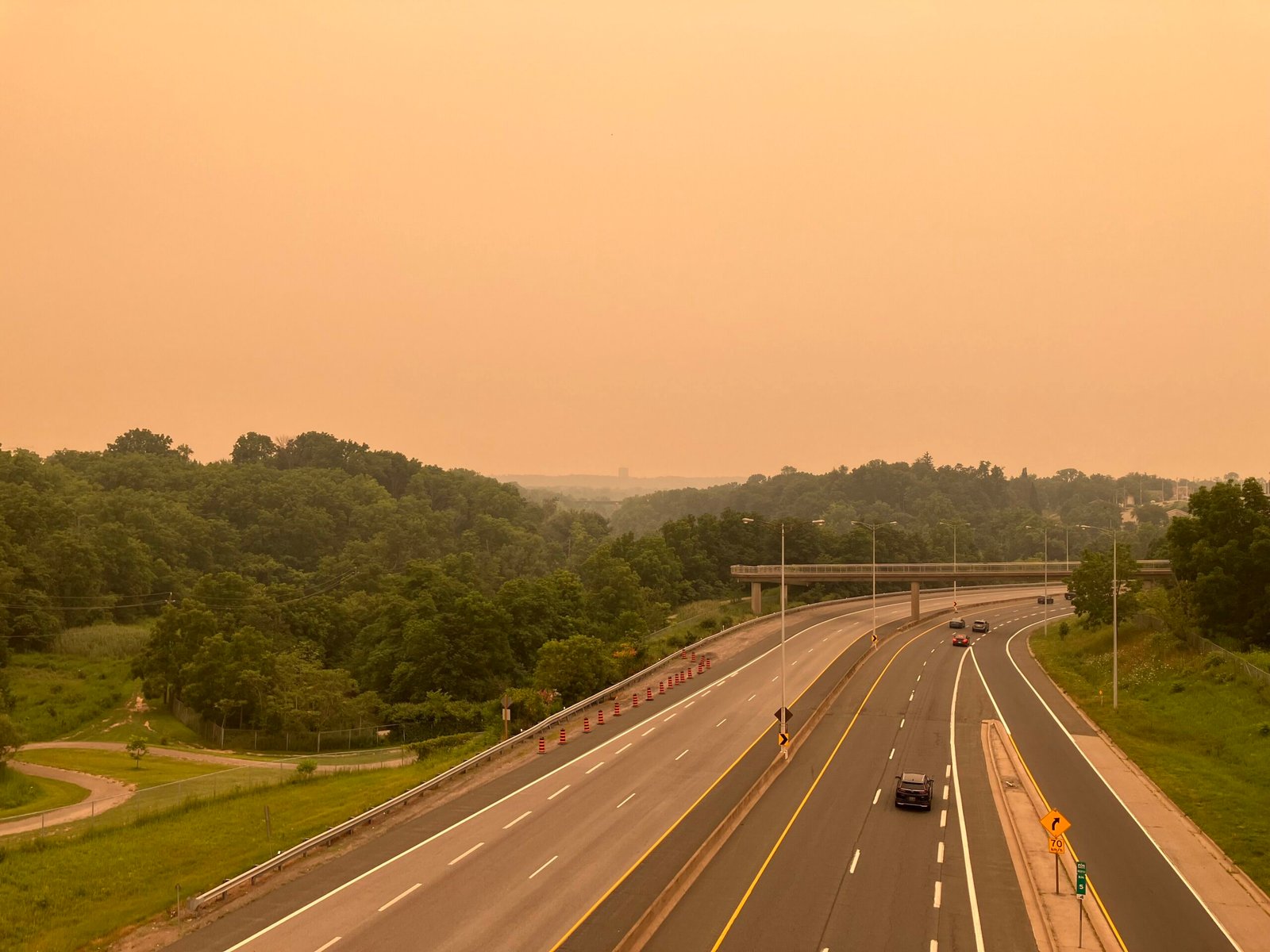
The northern smoke did not require a visa. It could not be detained, deported or persuaded to wait politely behind a barrier. It crossed the border with the same indifference to sovereignty that carbon has always shown. Molecules, unlike politicians, have never mistaken a customs booth for a law of nature. They followed the wind south, carrying with them a simple reminder that the atmosphere remains stubbornly unimpressed by passports, tariffs or threats. There was something almost poetic about it: the one arrival no wall could stop drifting into the showcase event of an administration determined to demonstrate that walls still worked.
Like salmon, it was only doing what it has always done. It was going home.
So the commander in chief did the only thing he knows how to do when the world declines to cooperate with his sense of how it ought to behave: he blamed someone else. He called Canada’s fire season “willful negligence,” accused Ottawa of failing at “basic Forest Management and Debris Removal,” and announced that the cost of America’s bad air would be added to the tariffs Canada already pays, this, while nearly nine hundred wildfires burned across Canada, and while a lightning-sparked outbreak of its own burned seventeen fires through northern Minnesota that week, several of which crossed the border and kept burning on the Canadian side. Ontario’s premier, sounding less like a diplomat than a man just tired, asked the country pricing the smoke to send help instead of a bill. Firefighters, not fees. Water bombers, not warnings. It is the reasoning of an arsonist suing the firefighters for arriving too late.
There is an old imperial superstition that sees consequences as things that happen in far away places. Wars happen abroad. Coups happen abroad. Famines happen abroad. Refugees arrive from abroad. Carbon, however, has always been embarrassingly provincial. It insists on coming home, whether you believe in climate change or not. It drifts back across the frontier carrying no ideology, no flag and no opinion about who started the fire. It merely delivers the invoice.
Americans have long preferred to imagine blowback as a foreign language. It came home from Kabul wearing boots stamped “Made in the U.S.A.” It crossed the Rio Grande speaking the dialect of decades spent backing dictators who were dependable only in their appetite for power and American approval. Now it arrives as smoke, carrying no ideology at all, only chemistry. It is coming home now in the form of a specter that no longer has a shape, a fire season that keeps breaking its own record, and a sky over New Jersey that FIFA has to “monitor closely” before letting eighty thousand people breathe it through a World Cup final.
Canada is the canary, and the coalmine is the one mostly built on the American side of the line. Most climate catastrophes, hurricanes aside, carry the mercy of distance for the United States: a drowned delta somewhere else, a burning hillside where they don’t speak English, sad enough to acknowledge, far enough to file away. This one arrived with every breath you take. It shut Broadway marquees behind a curtain of haze and put free masks in a mayor’s hands. And on Thursday it reached into Central Park, where Mavis Staples, eighty-six years old, a woman who marched with Dr. King and has spent eight decades singing this country’s conscience back to it one gospel chord at a time, was silenced. Not by a permit denied, not by a network that grew tired of her, not by white Christian nationalist threats, but by the air itself, made unbreathable by the very ideology her whole career has stood against. The conscience got canceled by the thing it kept warning everyone about.
That is the accounting nobody sends an invoice for. Two hundred and seventy-five years of treating the atmosphere as a place to dump the cost of not caring, and the bill arrives anyway, itemized in ash, delivered by a wind that was never going to stop and ask permission. You can put a wall on a river. You can put a fence across a desert. You cannot tariff the sky, and if you could, the largest debtor in that particular ledger has never once, since 1750, been Canada.
[ad_2]
Source link
