
[ad_1]
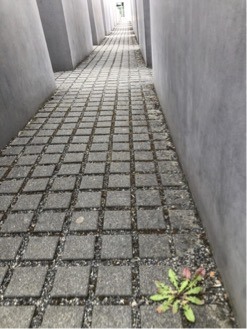
A dandelion grows in the Memorial to the Murdered Jews of Europe. Photo: David Yearsley.
As I suggested last week, Jeremy Eichler can’t visit all memorials or write about them in his book, The Second World War, the Holocaust, and the Music of Remembrance. Let’s leave Eichler’s tour of monuments, musical and architectural, and head out on a different excursion—a bike ride through Berlin.
Our itinerary begins in Schöneberg, where John F. Kennedy held his famous “Ich bin ein Berliner” speech in May of 1962 in front of the municipal hall with its clock tower. When I first moved to the district with my family in 2003, a friend pointed out a trio of old women sitting on a park bench in the Bayerischer Platz (Bavarian Square) and told me that they were SS widows still living in apartments stolen from Schöneberg’s many Jewish families evicted by Albert Speer, architect of their dispossession and deportation.
In streets running off from the square, intermittent street signs affixed to lampposts grab the attention of passers-by. On one side of each is a striking image, for example, of a chess piece or a cat. Curious, one wants to see what’s on the other side and finds there a quotation from the relevant Nazi law, in these two cases, forbidding Jews to be members of chess clubs or from owning pets.
The sidewalks of Schöneberg have many Stolpersteine (stumble-stones)—small brass plaques with the names, dates, and places of birth and death attached to cobbles in the sidewalks in front of the homes of the former Jewish owners. Unlike in Saarbrücken, these plaques are visible for those who care to notice these small sidewalk testaments.
Inside the Schöneberg Rathaus, there is a permanent exhibit called “Wir waren Nachbarn” (We Were Neighbors) that includes a reading room where one can research the addresses of, and find information about, the district’s former Jewish residents. There are also film interviews with some of the survivors, such as the musicologist Helmut Kallmann, who, as a seventeen-year-old, escaped Berlin on one of the Kindertransport trains, eventually becoming a Canadian citizen and establishing the music division of the Canadian Library Archives. The Stolpersteine for Kallmann’s parents, who died at Terezin, and for his older sister, deported to Riga and murdered there, are to be found in the Geisbergstraße, a mile north of the “We Were Neighbors” exhibition.
The street where the Kallmanns once lived takes me to the Nollendorfplatz, long a center of gay life in Berlin, and the place where W. H. Auden and Christopher Isherwood (two more literary figures in the cast of Time’s Echo) came to live in the late 1920s. A pink triangle monument inside the subway station commemorates Nazi raids on homosexuals in the area.
From here it’s a short distance to the Kurfürstenstraße, where Walter Benjamin, also cited and mourned in Time’s Echo, lived for a time during his youth. Then it’s across the Landwehrkanal, laid out by the celebrated Prussian landscape architect Peter Joseph Lenné in the middle of the nineteenth century. The revolutionary Rosa Luxemburg’s body was pulled out of its waters in January 1919.
On the northern bank of the canal is the Ministry of Defense. Within the complex—tiny by comparison to the American Pentagon—is a complex of fascist buildings surrounding a stone courtyard (the so-called Bendler Block). It was here that Claus von Stauffenberg and his co-conspirators nearly took control of Germany on July 20, 1944, in the hours after the failed attempt to blow up Hitler in the Wolf’s Lair in East Prussia. Stauffenberg was executed that night in the courtyard. The Center of Remembrance for the German Resistance is housed here.
The dense green canopy of Berlin’s great central park, the Tiergarten, lies ahead. Turning east, a bike path follows the southern edge of the park past the Kulturforum and the Philharmonie, home of the Berlin Philharmonic. In front of the concert hall is a long blue glass wall that is a monument to the victims of the Nazi euthanasia program that oversaw the murder of some 70,000 people deemed genetically suspect. Continuing east for a few minutes, one crosses over the bricks built into the pavement marking the course of the Berlin Wall. Along this East-West Berlin border, just south of the Brandenburg Gate and the Bundestag (the federal parliament building), stretches the Memorial to the Murdered Jews of Europe.
Until 1990, the area was in the No-Man’s-Land between the inner and outer sections of the Berlin Wall. Designed by the American architect Peter Eisenman, the Monument’s nearly 3,000 rectangular slabs are each the length and width of a very large coffin but emerge from the earth at varying heights. Some of the outer blocks reach your ankles, others your knees. Cramped, shoulder-width paths lead between blocks and descend toward the center of the matrix while the slabs rise above ground level. When you stand in the middle of the monument, the blocks tower above, nearly twice your height. Each is set at a slight angle, this out-of-plumbness contributing to a broad undulating effect across the entire field.
In the fall of 2003, as work continued on the Memorial, which was dedicated two years later, a Swiss newspaper reported that a subsidiary of the construction company, Degussa, had produced the Zyklon B used in the gas chambers. After much debate and controversy, it was decided to continue working with the firm. Many, including the architect Eisenman, had to admit that it was impossible—or at least too expensive—to disentangle the project from the Nazi past. And its economic legacy. The Memorial lies at the moral center of Germany—its historical consciousness, its politics, its culture, its crimes. The Nazi Chancellery and Hitler’s bunker were nearby, though their exact location is not marked and therefore not available as a site of pilgrimage for Fascists. The Mohrenstraße (Street of the Moors) subway station is a block from the Memorial. Germany’s colonial past in Africa is increasingly a subject of the nation’s confrontation with its history and the name of the street is contested. Years ago, waggish activists took to adding the two dots of the German Umlaut above the “o”—converting “Street of Moors” to “Street of Carrots.” Various alternatives had been proposed and finally, in July of 2025, the street was renamed after Anton Wilhelm Arno, an eighteenth-century philosopher of African descent active in Germany.
Yet the old name echoes still. As Eyal Weizman, founding director of Forensic Architecture and a Professor of Spatial and Visual Cultures at Goldsmith’s, University of London, reported in a recent issue of the London Review of Books, Germany refuses full acknowledgment of, and payment of reparations for, the colonial genocides of the early twentieth century that it perpetrated in what is now Namibia. This was a campaign that, between 1904 and 1908, led to the death of 65,000 Ovaherero people and 10,000 Nama—more than two-thirds of the entire Ovaherero population and half of the Nama. Weizman and his team have mapped the killing sites, many of them now threatened.
In 2022, Weizman and Forensic Architecture joined with Ukrainian colleagues in mapping out Russian missile strikes directed at Jewish cemeteries and other cultural sites at Babi Yar, some of the same ones visited a few years earlier by Eichler. The Forensic Architecture website puts it this way: “Given Russian claims about the ‘de-Nazification’ of Ukraine, the damaging of one of the Holocaust’s most significant symbolic sites is particularly ironic.” (Forensic Architecture has also been detailing Israel’s targeting of medical facilities in Gaza and ongoing ethnic cleansing.)
A few blocks away from the Monument for the Murdered Jews and the Anton-Wilhelm-Arno-Straße stands the Komische Oper—Comic Opera. As even this partial catalog shows, history looms everywhere when one is underway in Berlin, as from Schöneberg to the Comic Opera. Between 2012 and 2022 the company’s artistic director (intendant) was Barrie Kosky. Grandson of German Jewish immigrants to Australia, he concluded his decade-long tenure with what he called “Barrie Kosky’s All-Singing, All-Dancing Yiddish Revue.” I was lucky enough to be at the final matinee performance on a July Sunday in 2022, having arrived at the opera house, as always, by bike.
Kosky saw his last show as a gift for the cadre of singers who had contributed so vitally to the great success of his productions and of the house more generally over the foregoing decade. He also wanted to thank the city of Berlin for following him down sometimes contentious artistic and political paths. He conceived of his final production as an affirming and necessary complement to the concrete graves a few blocks away. As he stressed in an interview printed in the program book, he had “wanted to open the public’s spirit to other facets of Jewish culture. Because when you hear the word ‘Jew’ in Germany, it always has to do with Auschwitz and Nazis, or Israel and its current politics. That’s it. The treasury of Jewish, and especially Yiddish culture of the nineteenth and twentieth centuries is, for the most part, simply ignored.”
One tremendous source of their cultural contributions was made in the Catskill Mountains of New York State in the 1950s and 60s. Denied entry to country clubs, hotels, and resorts closer to New York City, many Jews spent their summers in the Borscht Belt, a proving ground for the leading entertainers of the age.
Kosky and his colleague Adam Benzwi, the terrifically talented musical director who conducted the orchestra from a piano in the pit, sifted through thousands of musical sources from the period and selected two dozen that would play to the strengths of their cast and also come together in two hours devoted to the pleasures of the theater: songs of longing and joy, silliness and regret; dances (choreographed by Otto Pichler) both suave and spoofy, and ranging in styles from riotous to refined; off-color jokes and colorful costumes. This revue was a celebration, not a memorial.
The lithe and powerful Ruth Brauer-Kvam as Mitzi Rubenstein (with the Otto Pickle Dancers) welcomed the audience (“Hallo Berlin!”) with the buoyant “Abi gezunt” (As long as you’re healthy), a huge hit in the late 1930s. The text by the original performer herself, Molly Picon, reminded us not only that we had come through a pandemic (even as infection rates soared in those summer months), but also that the best things in life are (or should be) free, even if this revue wasn’t:
Di luft iz fray, far yedn glaykh,
Di zun zi sheynt far yedn
eynem orem oder raykh.The air is free for everyone equally,
The sun shines for everyone,
poor or rich.
The variety of Koskian song and dance was far too rich to be précised here. But among the string of unstoppable winners (twenty-one numbers in all) were Hershey Baumann and Manny Renz (scantily camouflaged stage names of Helmut Baumann and Peter Renz), two aged entertainers on a park bench in Tel Aviv—though it could have been Miami Beach—indulging a reverie of their youthful loves with “Bay mir bistu sheyn” (To Me You’re Beautiful). As the nostalgic strains of the song’s first stanza hung in the air, the strings surged from below in the pit. The men shed their bathrobes to reveal smart dinner jackets as the blonde loves of their past lives entered, almost unseen, from the wings and the two pairs danced in defiance of the accumulated years.
Soon after that, a quartet of Jewish Elvises rocked-out, and then a Berlin Jewish cowboy sang of sex and rodeos in Yiddish and told jokes in Berlinisch (the Berlin dialect of German), which, with its soft Gs and alternate grammar, shares much with Yiddish. Depths of sadness were plumbed by a mother imagining the wedding of her long-dead daughter that will never take place.
Colossal hits were recast, as when the Yiddish translation of “My Way” (Mayn veg) was delivered in the cool Latin rhythms of a Catskill lounge by a male singer (Christoph Marti) dressed as an air hostess in a stunning thigh-length smock, lush blue with an orange placket down the middle, matching shoes and a hat featuring the imaginary airline’s insignia.
Just before the rousing ensemble finale came the Barrie Kosky Sisters, a punning reference to the real Barry Sisters (Minnie and Clara Bagelmann), who reeled off a raucous medley of tunes that had been sung by that real Yiddish girl group of yore. The first of these was “Tropns fun regn oyf mayn kop” (Raindrops keep falling on my head), the music by Burt Bacharach, who had himself worked the Catskills in the 1950s. Many of the musical arrangements were taken from the original Borscht Belt (aka Yiddish Alps) or silver screen versions. Other numbers were set anew with pitch-perfect authenticity, nuance and charm by Benzwi.
The dirty jokes and dazzling musical performances were not for everybody. The long-time season ticket holders next to me didn’t laugh once throughout the entire show and bolted before the bows. I was surprised that they had even come back after the intermission.
In contrast to that couple staring sullenly at the high-calorie theatrical buffet, Kosky savors the deliciousness of sound and sight, movement and music, nonsense and profundity. This show had so much life and charm and humor and art that its two hours flew by even while the individual numbers held the attention and seemed to slow time.
I’m no producer (by the way, Mel Brooks spent his youthful summers as a busboy in the Catskills, as Ulrich Lenz’s excellent program book essay on the Yiddish entertainment pointed out), but this show could have conquered Broadway, and then the world. But Kosky’s way is not to cash in. He didn’t regift his present of thanks for his decade at Berlin’s Comic Opera to the Great White Way and enrich himself in the process. Instead, he let theater be what it must be: evanescent on stage, thrilling in the moment, then living on in memory.
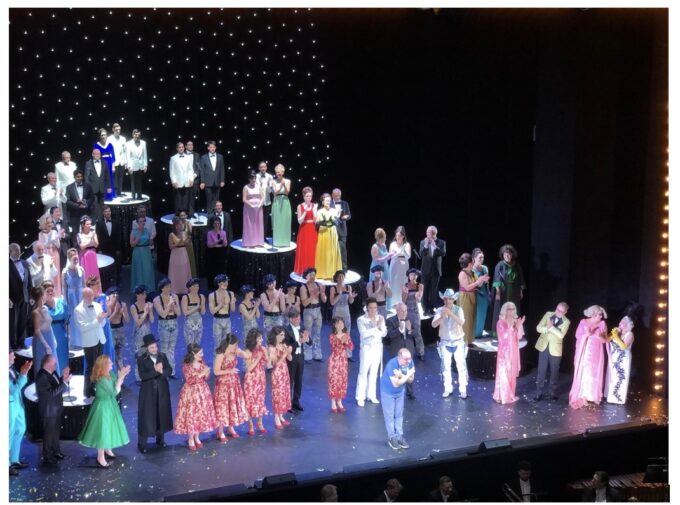
Barrie Kosky takes his last bows as Artistic Director of the Comic Opera Berlin, July 10, 2022. Photo: David Yearsley.
I read the first half of Time’s Echo while hiking on the Finger Lakes Trail in Central New York. I put the bulky book in my backpack with my sleeping bag and tent and other gear and headed up through Watkins Glen, one of the most spectacular gorges of the region. A brass plaque at the entrance to the gorge says that first purveyor of the place as a tourist attraction was Morvalden Ells, who “Opened this Book of Nature as a Private Enterprise on July Fourth, 1863.” That was the day after the Battle of Gettysburg had concluded 200 miles directly to the south.
In the afternoon after walking for a few hours, I read a hundred pages of the book while sitting inside a Civilian Conservation Corps pavilion on the shoulder of the upper gorge. The titmice emitted their piercing calls from the hemlocks on that spring day, the sounds of nature harassed by the distant complaint of high-speed motors at the Watkins Glen International Raceway on a distant hilltop.
That night in my tent I read another hundred pages before darkness set in. In the morning, I got up with dawn and hiked the fifteen miles back to the trailhead, the chaotic coloratura of the Louisiana Waterthrush echoed up from the watery gorge floor eighty feet below the rim trail.
After a few hours I reached the entrance to the park. The Visitor Center and other facilities have been improved since I’d last been here before the pandemic. There were new interpretative signs about the flora and fauna, the Great Flood of 1935, the industrial and tourist developments in the gorge over the previous century-and-a-half.
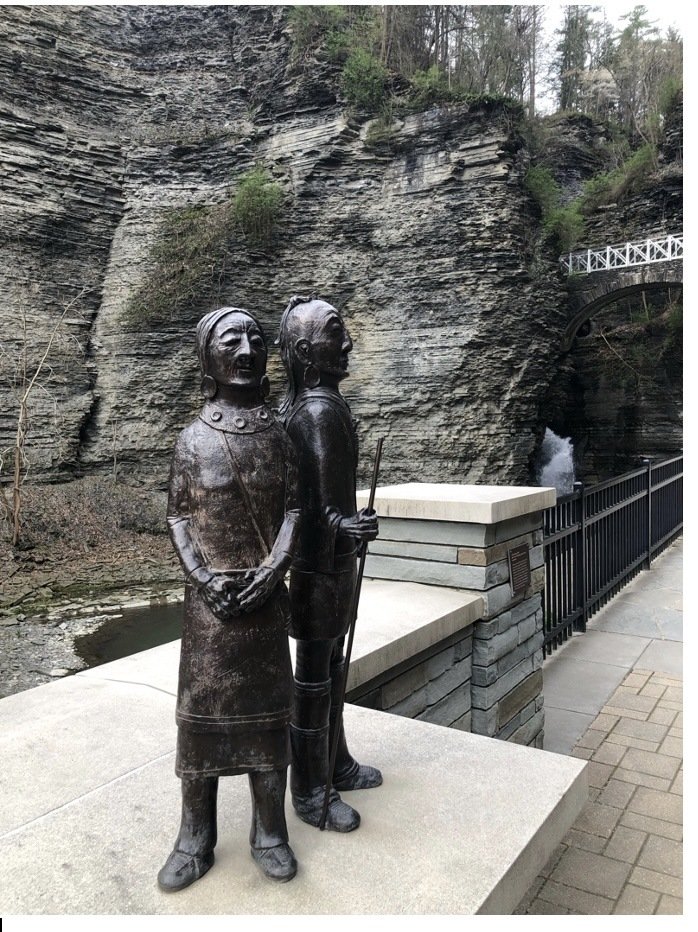
Closest to the lowest stretch of falls near where they tumble out of a twist in the rock was a plaque entitled “Seneca Homelands—1600s—1863.” Next to the sign, on a wide blue-stone balustrade were two bronze figures, each about two feet high, tiny against the cliff behind
They would be dwarfed even by child visitors to the park. The pair of statues faced away from the creek behind and below them. Below on the stone wall, the explanatory label read:
Homecoming, 2018
Peter Jones (Onondaga, Beaver Clan) 2018This area around Seneca Lake was once occupied by several villages of Seneca people. One village was located near Catherine’s Town and Watkin’s Glen. In an effort to push the Iroquois north into Canada, the villages were removed during the Clinton-Sullivan Campaign of 1779. This sculpture commemorates the Seneca people and their spiritual ‘homecoming’ to this area.
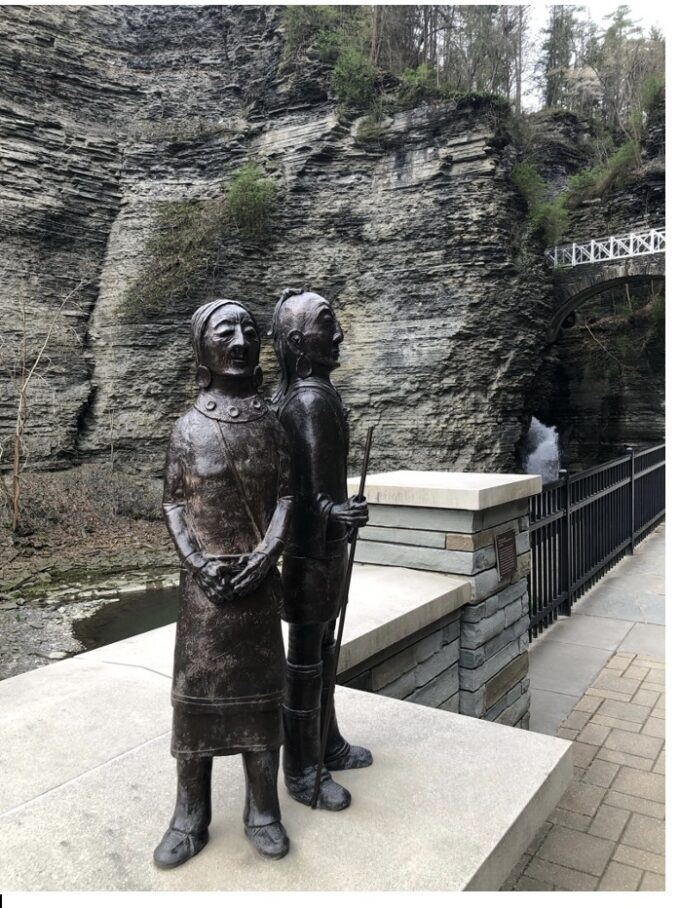
Peter Jones, Homecoming, bronze. Watkins Glen State Park. Photo: David Yearsley.
After having read Eichler’s book the previous day, I had been pondering displacement and death, nature and art, music and memory while walking down along the gorge that morning. The bronze Haudenosaunee figures I regarded were tiny compared to the immensity of the loss. The Haudnosaunee are still here, even if not in the Glen.
In Time’s Echo, Eichler donned earbuds at least one of his sites of pilgrimage to summon the music he required for the purpose and place. I do not own any earbuds. The bronze statues before me now were not remembered by grand requiems, sublime symphonies, or anguished atonal choruses. There was just the rushing of the water.
[ad_2]
Source link
