
[ad_1]
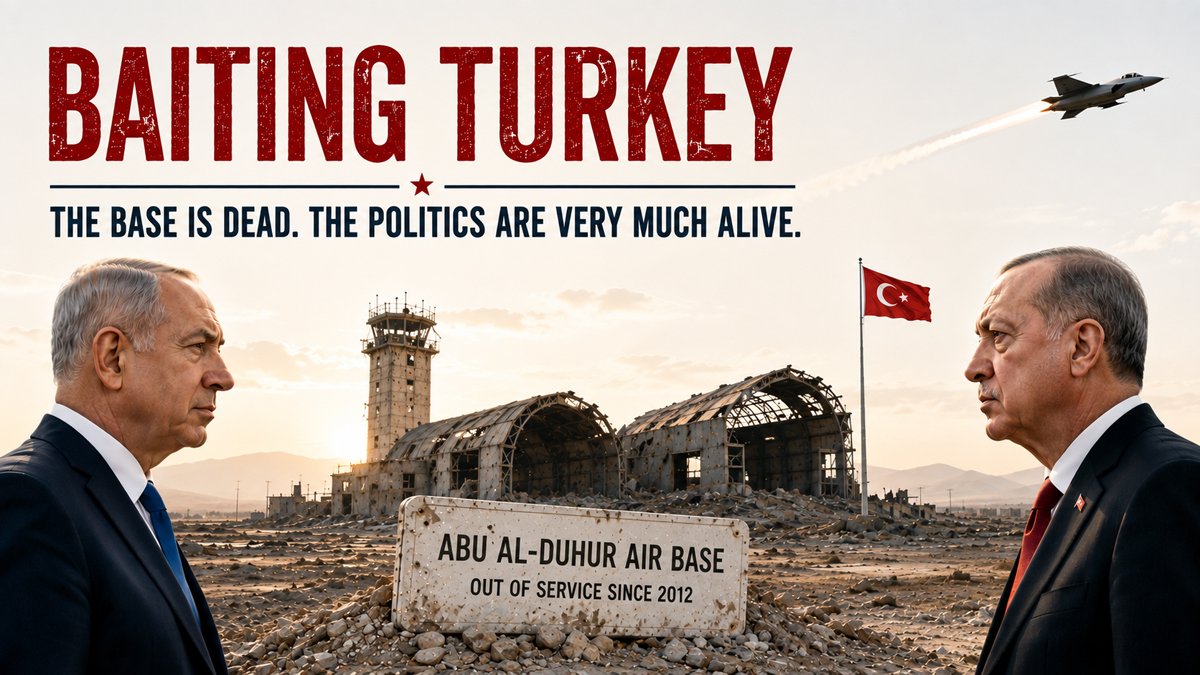
The base at Abu al-Duhur had been dead for thirteen years. Wrecked in the Syrian war, out of service since 2012, its runways cratered and its hangars stripped, it sat in Idlib province about 60 kilometers from the Turkish border, useful to no air force. On the night of August 18 eight Israeli missiles fell on it. Israel said it had struck to stop Turkish troops from moving in.
Six days before the strike, Israel had gone to Washington with the same warning. Its intelligence, it said, indicated there might be Turkish movement into the airfield. The Americans took the warning and ran it down through their own agencies. Tom Barrack, Donald Trump’s ambassador to Ankara and his envoy for Syria, described what came back. “We all did our due diligence. We went back to our respective intelligence agencies. The answer we got is, no, that’s not happening.”
Then Barrack said the thing an envoy is not supposed to say in public about an ally. “One theory is they were just baiting Turkiye.” He called the strike aggressive and timed, and he named what it was timed to. Israel votes on October 27.
Israel’s defence minister, Israel Katz, called Barrack’s account “full of inaccuracies” and said the intelligence had been clear. Both cannot be true. Either Turkey was about to seize a derelict runway and the closest ally Israel has could not find the evidence, or it was not, and a NATO member’s base was bombed on a claim that dissolved the moment anyone checked it. The envoy who checked it settled the matter to his own satisfaction on a podcast, five days after the missiles landed, by guessing at the motive.
The motive was on a billboard before it was in the air. Along Tel Aviv’s main highway, above the traffic, Recep Tayyip Erdoğan had appeared beside Iran’s supreme leader, the head of Hezbollah and the mayor of New York, under a single line: “They want Netanyahu to lose. Don’t let them win.” Benjamin Netanyahu is the first sitting Israeli prime minister to be tried for corruption. His Likud has been falling in the polls. Trump has told him to wind down the wars on Iran and Lebanon that filled his last two years. A man who runs as the wall between his country and its enemies had run short of enemies he was still allowed to fight.
Turkey filled the gap, and filled it safely. Iran could be bombed toward collapse. Turkey cannot. It holds NATO’s second-largest army, its president has a warm line to the American one, and a quarrel with it can be conducted in airstrikes on other people’s territory and in warnings traded through the press, at no risk of a war that reaches Israeli cities. The opposition read the timing on sight. Yair Lapid, who backed the strike, ridiculed the noise around it: “if you struck, stay quiet.” Ehud Barak wrote that the whole escalation smelled of a plan to fight the election on a war footing.
What is less often said is that the man on the billboard had his own use for it. Through the past year Erdoğan jailed Ekrem İmamoğlu, the Istanbul mayor who was his most dangerous rival, and opened a settlement with the imprisoned Kurdish leader Abdullah Öcalan meant to draw Turkey’s Kurds out of the opposition and clear the path to a new constitution, one that might let him run again after his term ends in 2028. An Israel behaving as an aggressor on Syrian soil handed him a cause under which Kurds, Islamists and nationalists could stand behind the same government. His officials called the strike “cheap politics” for Netanyahu, which it was, and treated it as a gift, which it also was. Barrack, once more on the record, said both leaders were “in a political campaign,” each running toward a vote, each knowing what his voters wanted to see. A confrontation with two authors is harder to call off than one, because calling it off costs both of them something at home.
None of which makes the underlying quarrel invented. A year before the strike, a committee Netanyahu had appointed under his former acting national security adviser, Jacob Nagel, told him to prepare for direct war with Turkey. The Syrian threat, the report said, “could evolve into something even more dangerous than the Iranian threat.” It urged raising the defense budget by up to 15 billion shekels a year and buying the long-range aircraft such a war would require. After October 7 Israel had already traded deterrence for prevention: not to wait for a threat and answer it, but to destroy it before it forms. Abu al-Duhur was that rule carried out on concrete. Hit the runway while it is still only a runway, before Turkish soldiers arrive and turn it into a piece of NATO. The rehearsal was on the record too. In the spring of 2025 Turkish teams had surveyed the airfields at T4, Palmyra and Hama for a deeper presence, and Israel had struck each in turn.
The legal cover was being drafted while the fires were still out at Abu al-Duhur. Two days after the strike a former Israeli official, Shay Gal, wrote in the Adelson-owned daily Israel Hayom that Turkish soldiers in Syria would be, in plain terms, targets. Article 5 of the NATO treaty, he argued, “protects Turkish territory; Turkish troops do not carry that territory with them” onto Syrian ground. Israel had acted, he wrote, “before Turkish military depth matured.” The paper is owned by Miriam Adelson, the largest single donor to the American president. An opinion column in such a place is not a fringe position tossed into the void. It is a balloon released over friendly airspace to see who salutes.
Underneath the doctrine and the theater lies something plainer, which is money. Turkey’s arms exports reached about 10 billion dollars in 2025, close to half again what they had been the year before, and climbed another 26 percent through the first seven months of 2026, to 11.2 billion dollars over the trailing year. Ankara now sells something near two-thirds of the world’s armed drones. The pitch it makes is the one Israel has made for decades to the Gulf and the wider Arab world: capable weapons, delivered faster and cheaper than the Western competition, to the same buyers. And the rivalry runs straight through Netanyahu’s own telephone. Before Trump flew to Ankara in July, Netanyahu called him to press him not to let Turkey back into the F-35 program or sell it the F110 engines its home-built KAAN fighter needs. To do so, he told Fox and afterward CNN, would “upset the power balance in the Middle East, which is ultimately guaranteed by Israeli air superiority.” The sentence is honest about what is being defended. Air superiority is a weapon over Israeli cities and it is also a catalogue, and the customers are the ones Turkey is taking.
The two designs for Syria cannot both hold on the same soil. Turkey wants a single Syrian state under Ahmed al-Sharaa, its Kurdish militias folded into a national army, its refugees sent home, its northern border shut. Israel wants Syria kept weak and split, its minorities shielded from Damascus, its south left open to Israeli entry. The foreign minister in Jerusalem has been clear that Turkish radar and air defense and aircraft would close skies that Israeli jets now cross at will, and would make a future strike on Iran harder to fly. Al-Sharaa, pressed from both sides, takes Turkish training and reconstruction while quietly thinning the Turkish-shaped units inside his own army, unwilling to become anyone’s client. Syria is not where the rivalry is happening. Syria is what it is over. The place it is most likely to tear is the Kurdish seam, where a force armed by Washington is being pushed into a state that Turkey wants it dissolved by, and that Israel would sooner see it armed against.
That Turkey is not Iran is the danger, not the reassurance. It carries NATO’s second army, a new mutual-defense pact with Saudi Arabia and Pakistan, and a president nearer to Trump than any in years. To bomb a base that Turkey backs is to strike at the rim of the alliance that underwrites Western security, and the alliance has no agreed answer for the morning after. The shield may bring the collision on rather than hold it off. If NATO membership tempts Ankara to push a little deeper into Syria, trusting that Israel will not risk hitting a protected army, and if that trust pushes Israel to strike sooner, before the protection attaches, the deterrent has turned into its opposite. Washington sees it. Barrack has spent weeks trying to build a channel among Israel, Turkey and Syria so that jets do not meet by accident. Israel does not want the channel. A formal mechanism, its officials fear, would set into intelligence-sharing and bind their hands, taking from them the freedom to strike whenever they alone decide a threat is forming.
Netanyahu once ran precisely such a channel with Vladimir Putin, to keep Israeli and Russian pilots from firing on each other over Syria, and it held for close to a decade. It worked because both sides wanted it to. This time one side is bombing empty runways two months before an election and filing the result under deterrence.
For a generation the region was arranged on the belief that Israel stood at its center, wired to Washington, its supremacy the fixed point the Abrahamic accords and all that followed were built around. That belief is coming apart. The strike on Abu al-Duhur was not the confident act of a power sure of its place. It was the nervous act of one no longer sure of it, a country cratering a dead airbase to prove a dominance that a NATO member’s drones and export ledgers are quietly taking away. The threat the missiles answered could not be found by the ally sent to look for it. What could be found was the billboard, the trial, the sinking polls, the rival in an Istanbul cell, the constitution still to be rewritten in Ankara, the engines Netanyahu wants Turkey never to hold. Two men who need the same war moved a step nearer to it, on land that belongs to neither, over a runway no one was using.
Thomas Karat writes investigative work published at karat.substack.com and the Libertarian Institute, drawing on a corporate career and academic training as a behavior analyst to examine how institutions manufacture consent and influence.
[ad_2]
Source link
