
[ad_1]
 Are we getting close to the time when parents would have the option of genetically engineering their children at the embryo stage? If so, is this a good thing, a bad thing, or both? In order for this to happen such engineering would need to be technically, legally, and commercially viable. Let’s take these in order, and then discuss the potential implications.
The main reason this is even a topic for discussion is because genetically engineering is technically feasible. Obviously we do it to plants and animals all the time. We also have increasingly powerful and affordable technology for doing so, such as CRISPR. This is already powerful and practical enough for small startups to perform CRISPR as a service, if it were legal. We already have FDA-approved CRISPR treatments, and have performed personalized CRISPR therapy. CRISPR is fast and affordable enough to have made its way into the clinic. But there is a crucial difference between these treatments and genetic modification – these treatments affect somatic cells, not germ-line cells. This means that whatever change is made will stay confined to that one individual, and cannot get into the human gene pool. What we are talking about now is genetically modifying an embryo at an early enough stage that it will affect all cells, including germ cells. This means that these changed can be passed down to the next generation, and effectively enter the human gene pool.
This difference is precisely why there is regulation dealing with such procedures in many countries, including the US. In the US the situation is a little complex. It is not explicitly illegal to perform germ line gene editing on humans. However, there is a ban on federal funding for any such research. This does allow for private funding of such research, but any resulting treatment would still need FDA approval, which is highly unlikely in the current environment. Despite this, there is discussion among several startups to start exploring this idea. Why this is happening all at once is not clear, but it seems like we have crossed some threshold and startups have noticed. With current regulation, where does that leave us regarding our three criteria?
Technically a CRISPR-based germ-line treatment for humans is possible. We do have the technology. What needs to be worked out is specific changes and their results. This would require clinical trials, and that is the main stumbling block in the US and some other countries. It seems unlikely the FDA would approve such trials, and therefore there would be no way to even work towards FDA approval. A company could theoretically do privately funded studies that are not part of FDA approval, but they would still need ethical approval (IRB approval) for such studies, which may prove difficult (although not necessarily impossible). Such research could be carried out in countries with more lax regulations, however. Over 70 nations have such regulations, which means many do not. So technically we are theoretically close to having marketable treatments designed to change actual human genetic inheritance.
Legally, in most developed nations there does not appear to be any appetite for allowing human germ-line manipulation. However, such services could be offered in countries without hindering regulations, perhaps the same countries in which the translational research was done. We currently do not have any international bans or regulations. The WHO advises against germline engineering, but there are no legally-binding international regulations. This is a technology that definitely requires not only an international consensus but enforceable regulations, because what happens in one country can affect the entire human population.
In short, there is a pathway to skirt any current regulations and make such treatments available. However, if startups start developing germline-altering treatments, that might motivate governments to find ways to regulate and effectively ban such treatments. Would such treatments be commercially viable? If by this you mean – would there be a customer base willing to pay enough to make it a profitable service, the answer is clearly yes. If you mean – are there companies currently offering such services, the answer is no. But that may be changing soon.
What could be the implications of this technology? It depends on how it is regulated and used (like so many advanced technologies). I will speculate on what I think is the best-case and worst-case scenarios. Best case, such technology would be used to minimize the burden of genetic disease. We already have treatments to sort sperm to avoid sex-linked mutations and to select more genetically healthy sperm. But what if we could do this down to the individual gene, and make sure the IVF occurs only with sperm that does not contain an allele for a genetic disease? I can’t see any downside to this.
The next step, however, would be altering genes, not just selecting them. But again, this could be limited to altering genes that would result in a genetic disease to a healthy version. The resulting gene would be one that is already in the human population, and the only result would be the elimination of one version of that gene that is disease-causing. Again, hard to see a downside. Such treatments would almost certainly be more cost effective than managing the genetic disease itself. And if it were done to the germline, it would only have to be once for that genetic line. I suspect that when such treatments become technically available, and confidence is high enough in the technology itself, they will become legal and available.
But there are at least two other categories of genetic alteration that become increasingly problematic. The first category we can call disease treating. The second is risk modifying. What if we could also alter a gene from one version that conveys a high risk of ultimately developing Alzheimer’s disease, to another version that has a relatively low risk? This would not be treating a genetic disease, but simply altering the genetic risk of developing a disease. We could potentially do the same for high cholesterol, diabetes, obesity, and high blood pressure. Again, we would not be introducing any new genes into the human gene pool, just giving people alleles that convey lower risk of specific diseases.
However, there is a potential downside here. If such treatments became common, they would potentially reduce genetic diversity in the human population. Many genes that convey a high risk in one area have other benefits. They just have different tradeoffs. We may be reducing disease risk in one area, but also reducing resilience to other diseases. In other words, there is a potential for unforeseen consequences. Also, the number of people who could potentially benefit from such genetic alterations is much higher than for genetic diseases, so the implications for the human gene pool are greater. The risk-benefit ratio is therefore harder to calculate. I think such treatments might be viable one day, but would require a lot of research to minimize the possibility of unforeseen negative consequences.
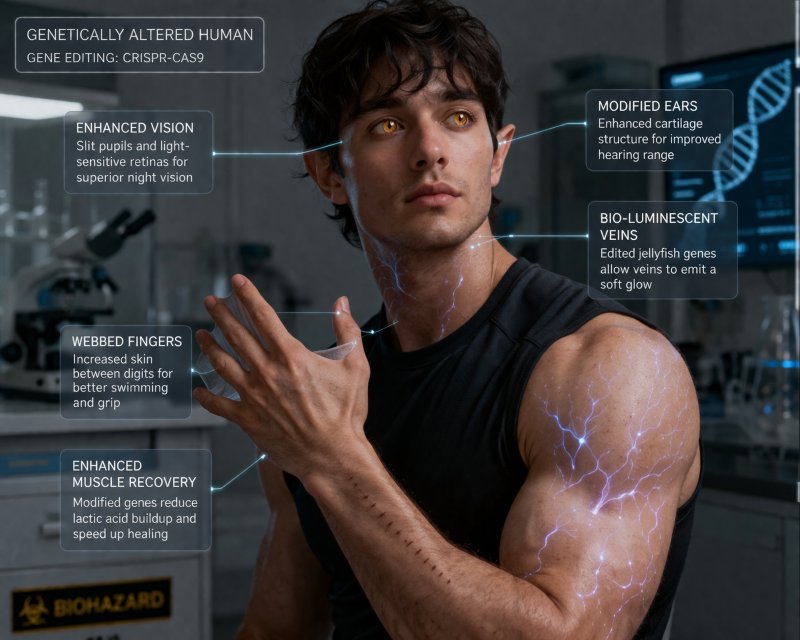
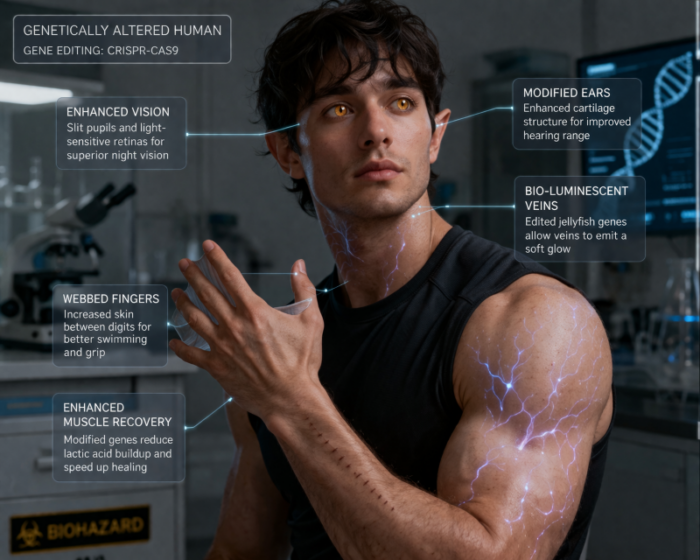
The final category I will call gain-of-function alterations. This might include introducing genes from other species or novel genetic alleles that provide a phenotype that does not currently exist in the human population. This category has the greatest potential for change, and therefore for both best-case and worst-case scenarios. Some people might think there is no best-case in this category, and that is reasonable if you think that the risk will never be worth it, and such changes could alter what it even means to be human. If we still want to imagine a best-case, that might involve limiting such changes to ones for which there is a robust consensus that they would be good for humanity with little to no down side. This would also have to include some consideration of fair and just access to such changes. Perhaps this might include genes that help adapt people to living in space or on Mars, or eliminate addiction. It’s hard to think of a lot of examples outside of disease modification, however.
It is much easier to imagine worst-case scenarios. The common ones that are frequently raised include creating not just different classes of people, but different subspecies. Wealthy individual could potentially afford a suite of upgrades to their children, making them smarter, stronger, healthier, with a longer lifespan. It’s hard to imagine such a thing ending well. Another classic doomsday scenario is the creation of genetic supersoldiers, creating an arms race among competitive nations to engineer the most deadly soldiers. Again, hard to see this ending well. Yet another common sci-fi scenario is the introduction of genes that will significantly alter the human phenotype, blurring the lines between human and non-human. And of course the ultimate worst-case scenario, an accidental (or perhaps not so accidental) genetic apocalypse. There is a range of possibilities here as well, with the absolute worst imagined in a Rick and Morty episode where the entire planet was reduced to genetic monstrosities.
There are also some edge cases that have complex elements, including some truly horrific ones. What if, for example, genetic alteration could change someone’s apparent “race” or even their biological sex? What would be the social implications of an African family deciding they wanted a European looking child, or vice versa. How common would this become? Would apparent race become a fad, shifting from generation to generation? It is now common among some Asian youth to seek eyelid cosmetic surgery. What if this could be accomplished with gene therapy? How accepting would society be towards pre-pubescent children wanting gene therapy to alter their biological sex so that they go through puberty as the other sex? How would the furry community react to the possibility of genetic furriness? What if parents wanted for their children a standard of beauty that is generally considered to be extreme, even freakish? What if a culture decides that women should be genetically prevented from having certain bodily functions?
Genetic alteration is a powerful technology, especially when applied to the germline. There is the potential for extreme good, extreme harm, and extreme weirdness. Sounds like an area that would benefit from thoughtful regulation, and not left to the whims of startup culture.
[ad_2]
Source link
