
[ad_1]

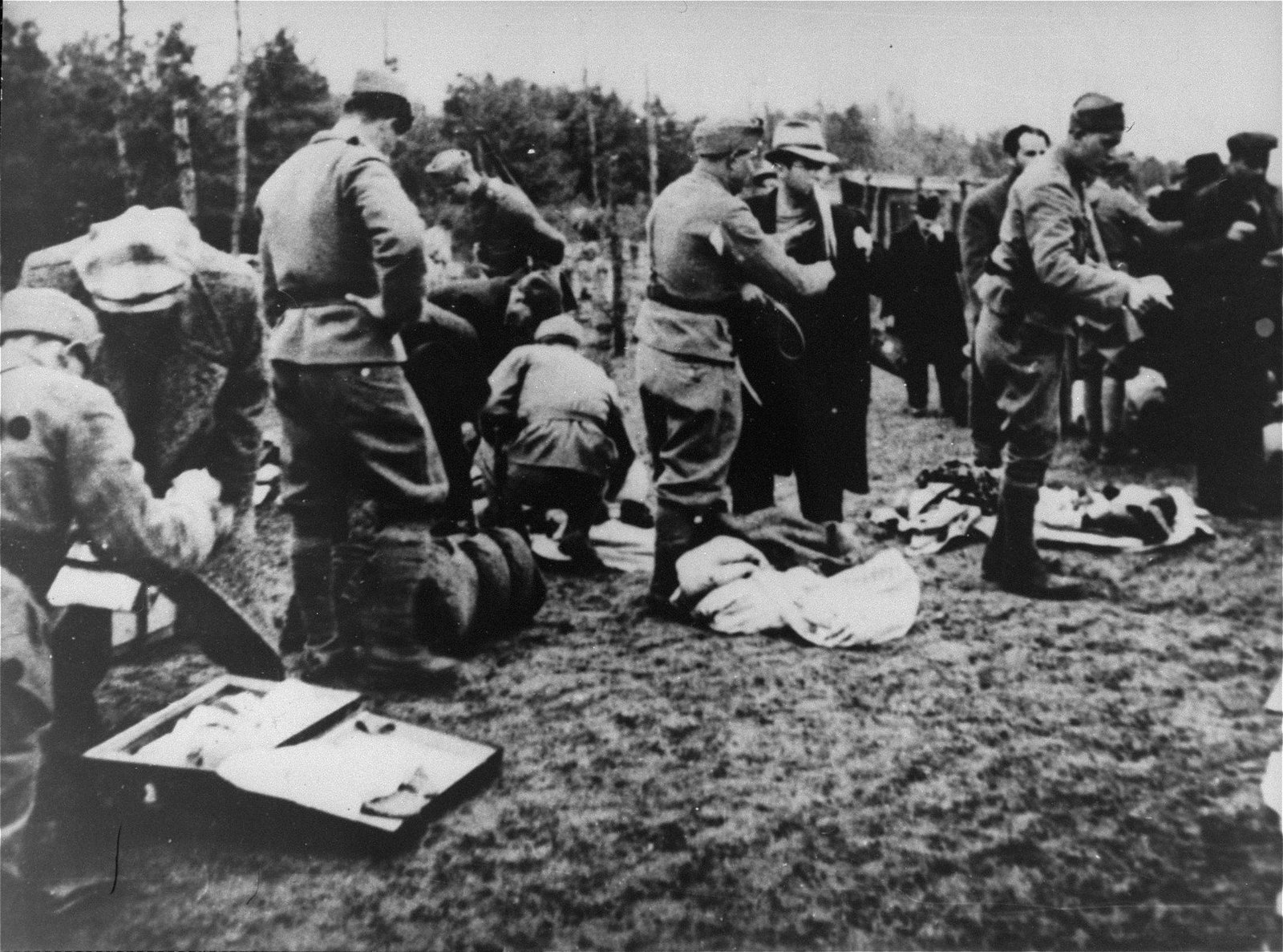
Jasenovac prisoners. Unknown author – Public Domain
There are moments in public discourse that do not surprise by their content—because they belong to well-established ideological patterns of the darker post-Yugoslav era—but still manage to shock by the coldness with which they are delivered, as if they were stating something entirely self-evident. One such example can be found in an interview given by Andrija Hebrang Jr. to the Belgrade weekly NIN in 2009—a format that, at the very least, presumes a degree of reflection. And we are not speaking about a marginal figure from the radical fringe: Hebrang is a medical doctor by profession, a long-time senior member of the Croatian Democratic Union (HDZ), multiple-term Minister of Health, briefly Minister of Defense, Deputy Prime Minister, a member of parliament, and even a presidential candidate. In other words, someone who has occupied nearly every key position within the Croatian political establishment.
It is precisely such a political veteran who, in that interview, chooses to present an almost literary scene from Jasenovac—the largest concentration camp in the Independent State of Croatia (NDH), a fascist puppet state during World War II, where tens of thousands of Serbs, Jews, Roma, and anti-fascists were systematically murdered—recounting it with a curious, almost familial warmth. In this scene, as he reconstructs it, his father, Andrija Hebrang Sr.—a high-ranking Croatian communist official later killed in Tito’s Stalinist purges of 1948—was leaving Jasenovac as part of a prisoner exchange, when he was seen off by Vjekoslav “Maks” Luburić, the commander of all Ustaša concentration camps, with the words: “Hebrang, you are returning to your own. Work there for the interests of the Croatian state!” To which the father, “in a resolutely Croatian manner,” replied: “As far as the Croatian state is concerned, my head will fall for it before yours.”
Already here, somewhere between dramatization and family legend, one can discern the distorted pattern associated with Franjo Tuđman—the founding president of independent Croatia in the 1990s—who promoted a controversial policy of “national reconciliation” between the descendants and ideological legacies of the Ustaša (the fascist movement that ran the wartime NDH) and the Partisans (the communist-led anti-fascist resistance). In practice, this meant reframing World War II history in a way that sought to symbolically integrate both traditions into a single national narrative. Within such a framework, figures like Luburić are no longer seen solely through the lens of their crimes—including those committed against Croatian anti-fascists—but are recast as actors driven, however misguidedly, by a notion of “Croatian state interests.” What emerges is a subtle but profound shift: from moral judgment to historical relativization, in which even perpetrators can be reinterpreted as part of a broader, ambiguously defined national project.
When the journalist then directly asks whether he believes that Luburić, too, was fighting for Croatian interests, Hebrang responds without hesitation: “Absolutely. Through his own vision. Now, his methods were fascist, the side he was on was wrong, but he was not fighting against Croatia (unlike Tito, as Hebrang implies); he had his own vision of Croatia, and for him that was the only correct path.”
At this point, the entire mechanism is laid bare: a formal condemnation remains as a kind of decorative fence (“the methods were fascist”), but the essential distinction between ends and crimes—between political vision and genocide—is effectively erased. If even a perpetrator who, in Sarajevo alone, oversaw the torture and killing of civilians—anti-fascist sympathizers associated with the Yugoslav Partisan movement (the communist-led resistance known as the National Liberation Struggle, or NOB)—including methods such as boiling people alive and hanging them from trees in city streets, can be reduced to someone who merely had “his own vision” of the same national goal, then history, at least for the mainstream Croatian political establishment, ceases to be a space of moral accountability. It becomes something closer to a political marketplace, where competing “visions” are traded—and where an audience, gradually accustomed to such narratives, increasingly stops asking why it was ever necessary to fight Nazism in the first place, if “Croatia” was, supposedly, the shared objective all along.
Why begin with Hebrang?
The problem with Jasenovac today is not that it is remembered, but who remembers it—and how. When Croatia’s current Minister of Foreign Affairs, Gordan Grlić Radman, criticizes Serbian politicians in Montenegro for commemorating the breakout of prisoners from the Jasenovac camp, claiming that they “show no respect for the victims” and are “digging trenches instead of building bridges,” the first thing that must be said is that someone with such a political and symbolic background should not merely be silent, but disqualified from moral lecturing altogether.
This is, after all, a man who openly venerates Alojzije Stepinac—the wartime Archbishop of Zagreb—who, in his correspondence with Pope Pius XII, did not conceal his enthusiasm for the Ustaša (Croat nazi) state and for a project that, in his own words, aimed at a future in which “the schismatics”—a derogatory term for Orthodox Christians—would disappear. From such a position, delivering lessons about respect for the victims of Jasenovac is not only politically cynical, but morally absurd.
However—and this is where the real problem begins—this absurdity today passes almost without consequence, not because Radman is right, but because Serbian political actors make it possible for him to appear so. A telling example can be found in a statement issued by SNSD—the Alliance of Independent Social Democrats, the ruling party in Bosnia and Herzegovina’s Republika Srpska entity—on the anniversary of the Jasenovac prisoners’ breakout. In that statement, it is claimed that “the killing of Serbs, Jews, and Roma in Jasenovac was never subjected to any legal or moral condemnation in former Yugoslavia, because communism… avoided portraying the Independent State of Croatia (NDH) as a regime that systematically carried out that crime.”
At this point, we are no longer dealing with exaggeration, but with outright fabrication. To claim that communist Yugoslavia “did not condemn” Jasenovac is either a deliberate falsification of basic facts or a profound ignorance of them: that same Yugoslavia militarily destroyed the NDH, prosecuted and sentenced many of its officials, established an extensive system of commemoration and memorialization of Jasenovac, and—something particularly inconvenient for those with short memories—successfully tracked down and eliminated its chief commander, Vjekoslav “Maks” Luburić, in exile in Valencia in 1969. If this is what is meant by “avoiding condemnation,” it becomes difficult to imagine what genuine reckoning would look like.
Of course, it is both legitimate and necessary to debate the ideological framework of “Brotherhood and Unity,” the official Yugoslav doctrine that sought to suppress ethnic divisions by promoting a shared anti-fascist identity. One can critically examine the ways in which national dimensions of suffering—not only Serbian—were, in certain contexts, softened or subsumed into a broader narrative in the interest of stabilizing society and turning toward the future, and whether that approach was justified. But that is one issue. To claim that there was no condemnation at all is something entirely different: it is an attempt to portray the anti-fascist victory not as a systematic punishment of crime, but as its systematic concealment.
If anyone still has doubts about the outcome of this kind of “assistance” in laundering history, it was enough to walk into the Croatian Cultural Centre “Kosača” in Mostar in April 2026 and attend the promotion of a book by Ivo Lučić—a senior figure associated with HDZ BiH (the Croatian Democratic Union of Bosnia and Herzegovina, the main political party representing Bosnian Croats and a key governing partner in the country). The book, devoted to the so-called “Škripari,” presents what was in fact a postwar Ustaša guerrilla network (active between 1945 and 1951) as a “Croatian resistance movement” against communism.
The event itself made the message unmistakably clear. It was organized by the Faculty of Humanities of the University of Mostar and the Croatian Institute of History, and featured speakers such as historian Dario Barbarić, church historian Miroslav Akmadža, Bishop Ratko Perić, Franciscan friar Robert Jolić, and historian Ivica Šarac. Among those present were Ivo Čolak, rector of the University of Mostar, and Marko Babić, the Consul General of the Republic of Croatia in Mostar. In that carefully staged, salon-like setting—complete with academic titles, diplomatic representatives, and Roman Catholic clergy—what had once been clearly identified as the remnants of a defeated fascist project was repackaged in a polished new language and granted cultural legitimacy.
This brings us to an uncomfortable but essential point: it is precisely the coalition partner of SNSD—the HDZ BiH—that provides the institutional space, atmosphere, and political normalization for such reinterpretations. And that, ultimately, matters far more than any formal declaration. The issue is not whether someone will openly proclaim admiration for the Ustaša; the issue is that, through institutions and cultural platforms, their legacy is being systematically and transparently restored to a position of dignity it lost in 1945.
In that sense, Gordan Grlić Radman, as part of the broader Tuđman-era legacy of “reconciliation between Ustaša and Partisans,” can only look on with satisfaction as those who should be his most forceful opponents—Serbian political actors—effectively assist him in this process. For if one accepts the claim that communists and the National Liberation Struggle (the Yugoslav Partisan movement) are to blame for everything—even for Jasenovac itself—then the logic of that reconciliation is already halfway complete: first, the perpetrators and those who defeated them are equated; then the latter are rendered historically undesirable; and finally, they quietly disappear from the equation altogether, leaving behind a “cleansed” narrative in which the Ustaša project can be reinterpreted on its own terms.
In such a reversal, the descendants of the victims—willingly or not, and often through the political mediation of their own representatives—become complicit in washing the blood from the executioners’ knives. Not because they defend truth, but because, by accepting false premises, they help remove the only historical force that ever stopped those knives. And this is where the real tragedy lies: not in the fact that figures like Grlić Radman represent this ideological project, but in the fact that, at its most dangerous stage, they are being actively assisted by those they publicly criticize.
In the end, everything comes down to a simple, yet difficult truth: a people who lose a clear understanding of why their ancestors died—and for which ideals—will inevitably come to accept someone else’s version of those reasons. And in that version, there is usually no place for the victims, nor for those who defended and avenged them—only empty talk about “visions” that, unfortunately, did not end well.
History ceases to be a warning and becomes an excuse. And within an ideological framework where crime is reduced to a failed interpretation, the knives do not disappear—they are merely polished more carefully, waiting for another time that will once again declare them necessary.
[ad_2]
Source link
