
[ad_1]
Last week, POLITICO published a story about New York City’s recent congressional primaries, noting that “moderate Democrats fear they’re on the verge of losing the party’s ideological civil war to progressives.”
On X, Krystal Ball replied, “They already lost.”
The progressive Breaking Points podcast host was partaking in the left-wing jubilation that followed the victories of three insurgent candidates in New York’s closely watched primary races.
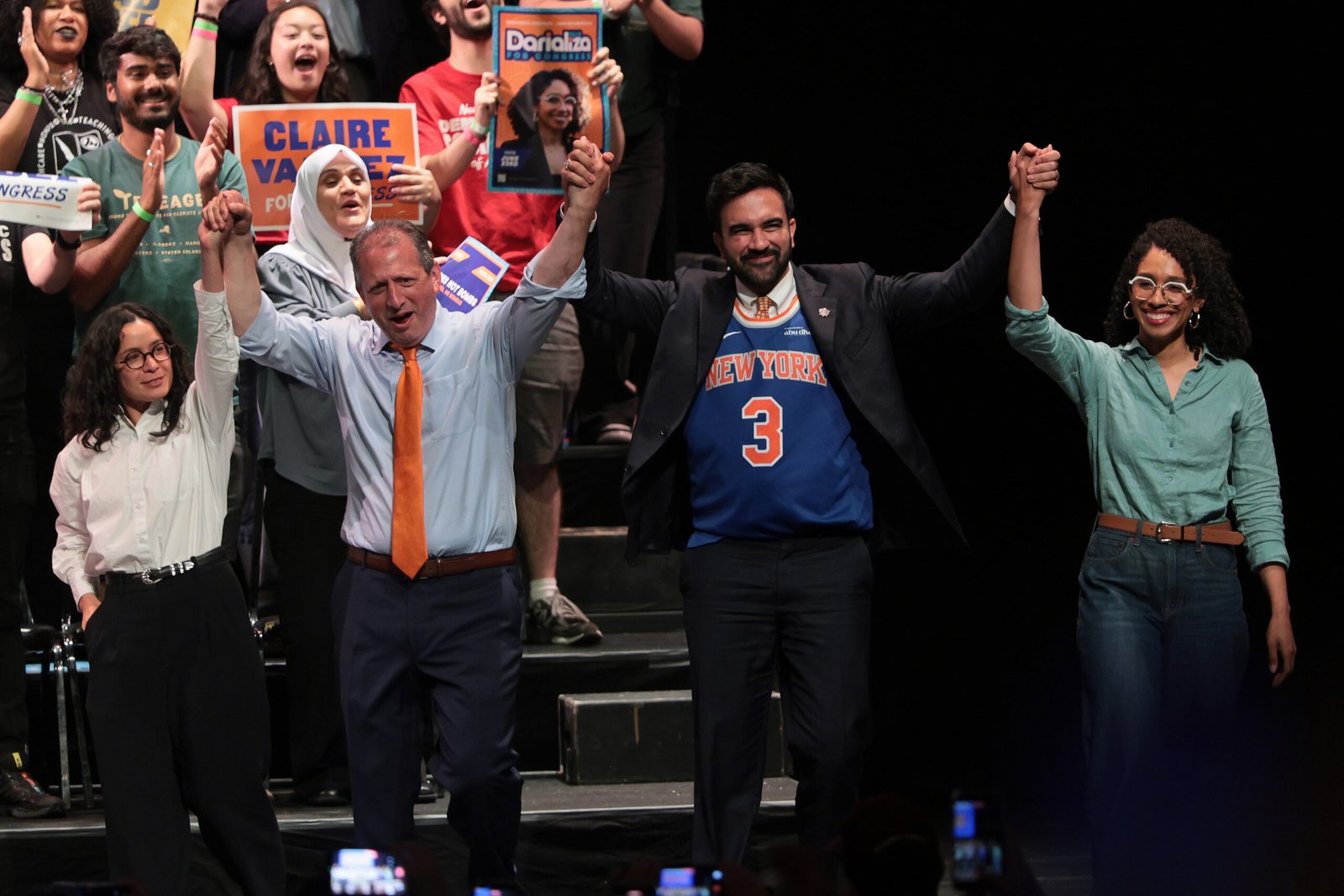
In NY-10, former city chief financial officer Brad Lander defeated incumbent Dan Goldman; in NY-13, student and activist Darializa Avila Chevalier won against incumbent Adriano Espaillat; and in NY-7, state assemblywoman Claire Valdez beat Brooklyn borough president Antonio Reynoso. All are expected to win their deep-blue districts easily in November.
Each of these candidates has ties to the hard left Democratic Socialists of America: Valdez and Reynoso are current members, while Lander was a member until 2023. And all enjoyed the support of New York City Mayor Zohran Mamdani (their opponents, meanwhile, were backed by House Minority Leader Hakeem Jeffries).
While various reasons have been given for these victories, one common thread is that the winning candidates all made intense, vociferous criticism of Israel a central part of their campaigns. Those who lost, on the other hand, pursued a softer line on Israel, more closely resembling establishment Democrats on foreign policy even while taking leftist positions on other issues.
In the NY-10 race, for example, the Democratic pollster Adam Carlson told Responsible Statecraft there was “very little daylight between Brad Lander and Dan Goldman ideologically, except when it c[ame] to Israel.” Yet Lander beat Goldman—who received significantly more funding—by a whopping 30 points.
Nor has the success of anti-Israel progressives been limited to New York. Earlier this year, similar candidates won Democratic primaries in Maine and California. And polling suggests that the issue resonates with Democrats nationwide. A June Quinnipiac poll showed that 66 percent of Democrats thought “the U.S. was too supportive of Israel,” while a May New York Times/Siena poll found that nearly three quarters of Democrats opposed U.S. aid to Israel and 60 percent of Democratic voters said they were more sympathetic to the Palestinians than to Israel. (By contrast, only 15 percent had more sympathy for Israel.)
A similar trend can be seen on the right. Just one month after President Donald Trump launched the U.S. war on Iran, slightly more than half of Republican voters answered “yes” when polled on the question of whether Israel had too much influence over American foreign policy. And although the majority of Republicans are still broadly supportive of Israel, multiple polls have shown significant drops in the country’s favorability over the past several years, particularly among younger conservatives.
There are even stirrings on Capitol Hill. Last summer, then-Rep. Marjorie Taylor Greene became the first member of the congressional GOP to call the Gaza crisis a “genocide.” And Representative Thomas Massie attracted national attention—and lost a primary—in part because of his staunch opposition to U.S. aid for Israel.
Rather than debate their critics on the merits, many in the establishments of both parties have sought to dismiss any criticism of Israel as antisemitism, pure and simple. As Sen. Ted Cruz said last month during a diatribe against the popular commentator (and noted Israel skeptic) Tucker Carlson, “We are seeing a cancer on the right. It is rising antisemitism…. Here’s the scary thing: I’ve seen more antisemitism on the right over the last 18 months than any time in my life.” Cruz went on to try to tar opposition to Israel as an inherently left-wing position, claiming it was a “gateway drug to anti-capitalism and anti-Americanism.”
Leaving aside the histrionics, the Senator from Texas is right about one thing—both the hard right and the hard left have ended up in a similar place on Israel. And for similar reasons: opposition to American vassalage, disgust with the treatment of Palestinians, skepticism of the endless regional wars, and a conviction that our resources are better spent at home.
As the independent journalist Glenn Greenwald observed of the NY-7 winner on Thursday, “Note how Claire Valdez—when asked about Israel or foreign policy generally—emphasizes the need to stop burning American resources on Israel and foreign wars and instead invest them in American communities for the American working class: a potent MAGA political message not all that long ago.”
Exactly.
Right and left will disagree, profoundly, on how to use those resources (the progressives’ aim of building socialism in this country, for example, should be vigorously opposed by everyone who calls himself a conservative). But what we can and should agree on is the notion that America’s interests must be prioritized above those of foreign nations. And in this important respect, there is a natural and important alliance to be made.
The hard left House and Senate candidates of this cycle, current Israel-skeptic lawmakers like Rep. Ro Khanna (D-CA), and journalists like Krystal Ball and Glenn Greenwald can work with America First conservatives in Congress (outgoing Representative Thomas Massie and current Senator Rand Paul, for example), in the media (Tucker Carlson, Megyn Kelly, Steve Bannon, etc.), and elsewhere. Such a partnership could speak to the majority of patriotic Americans much more effectively and authentically than either the Democratic or Republican establishments.
For the undeniable fact is that, when it comes to the U.S.-Israel relationship, most voters are ready for a new chapter. And the energy is clearly with the insurgents. This is especially true now that the administration is in peace talks with Iran. Both Trump and Vance have expressed frustration with Israel, with the latter recently articulating what few American politicians have been allowed to say openly: the two countries have different interests.
At the same time, many of our political elites are scrambling to save the pro-Israel consensus. The uniparty loves its wars, and will stoop to any low or call their political opponents any slurs in order to keep them going. Just ask Vance.
Hence the need for a left-right alliance.
Subscribe Today
Get daily emails in your inbox
We understand our differences. Conservatives will never acquiesce to wealth confiscation, abortion-on-demand, DEI, speech codes, open borders, or any of the other noxious policy priorities beloved of the left. And we certainly don’t expect our progressive counterparts to suddenly disavow their most deeply-held principles (no matter how wrong or ill-considered).
But should the America First right and the antiwar left unite to restore our national sovereignty, rein in the war machine, extricate ourselves from endless, far-off quarrels, and ensure that this country’s energies and resources are applied to its own problems?
[ad_2]
Source link
