
[ad_1]
I think that F. Scott Fitzgerald was perhaps never more wrong than when he opined that “there are no second acts in American lives”.
The trope of second chances and redemption are rather common notes in the melodies of American life, even if there is no set consensus on who deserves to sing them.
Worth bearing in mind when considering why or how a Jewish person such as myself might pen an essay in service to a man, indeed a friend, who at one time was, as I put it in my first interview with him, “America’s most notorious neo-nazi”?
Well, my friend Jeff Schoep has no intention of squandering his second act. Particularly when he considers the pains and penalties he suffered to purchase this second act.
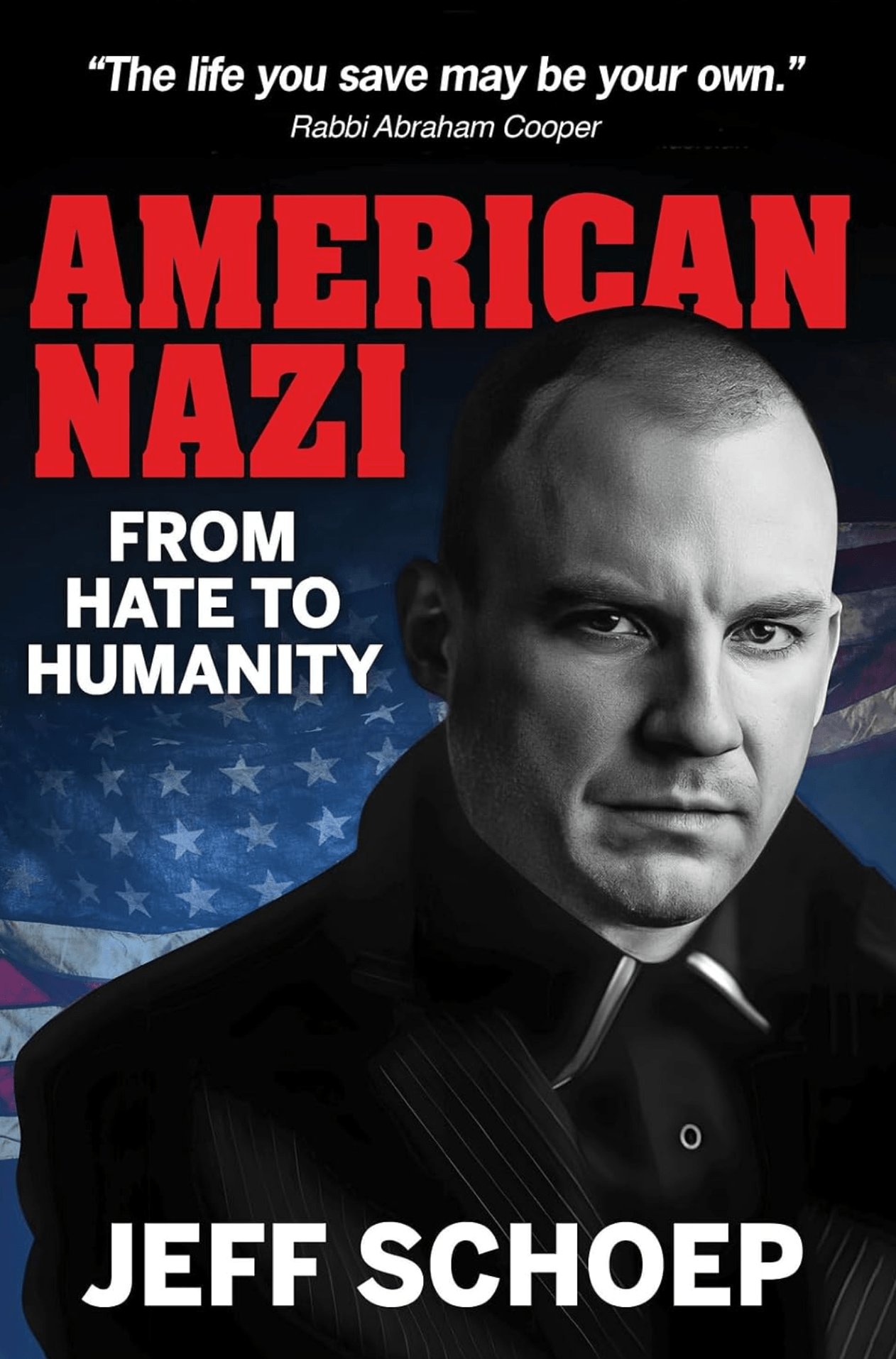
In his memoir, “American Nazi: From Hatred To Humanity”, Jeff is so vivid in his prose as to be almost terrifying. He sets the stage with no minced words by demanding his readers realize that in his early life “neo-Nazism wasn’t just an ideology, it was [his] life”.
And so the first act of Jeff’s life was one sunk in the swamp of hatred and ignorance.When all was said and done, he would, for 25 of his 27-year membership, be at the helm of the National Socialist Movement, the single largest neo-Nazi organization in the country at the time.
And the scars and bruises, both metaphorical and literal, of his old life have become just part of his great narrative once his own redemption and his own healing had begun. He even told me in one of my interviews with him that he had had people try to stab him and shoot him. He even told me that he has, “a scar across the back of [his] head from a guy who hit him with a tire iron and tried to kill [him]”.
One of Jeff’s less intellectually rigorous moments would be when he decided to wear a KKK Knight-rider-emblazoned T-shirt to a bar in a predominantly black neighborhood, which he covers in blood-soaked detail in the book.
But certainly the emotional wounds run quite deep. Forget his being doxxed live on a radio show (wait until you read that chapter) and forget the destruction it caused in his own life.
One need not consider whether Jeff Schoep’s past should be remembered. Of course it should. I refuse to be cliche here, dear reader, and echo the immortal words of Santayana on the relationship between forgetting history and being doomed to repeat it.
The real difficult question, the one that undergirds the book, is what happens after someone walks away.
Because the story of American Nazi is about much more than a man leaving an ideology. It is about a man attempting to understand the wreckage left behind by a life spent inside one. The book’s most compelling moments are not when Schoep describes his former influence or status, but when he confronts the emptiness that came after it disappeared.
Movements built on hatred often offer their followers something deceptively powerful: community, purpose, and belonging. Leaving means losing all three.
Schoep’s second act has not been easy, nor should anyone pretend it was. Redemption, when it is real, is not a costume one puts on. It is a process, perhaps a never-ending one, of accountability, humility, and rebuilding.
It is precisely that struggle, and the uncomfortable truth of changing one’s moral diet, that defines Schoep’s second act.
To complete the food metaphor, the Executive Chef who served up this smorgasbord of new ideas was Daryl Davis, a black man whose unlikely friendship with Schoep became one of the key ingredients in his transformation. Davis, musician and “Race Reconciliator”, was already famous for convincing many within the Ku Klux Klan to throw off their own shackles of hatred and ignorance and move towards the sort of freedom that only human empathy can buy. Their incredible meeting back in 2016 was captured on Davis’ acclaimed documentary, “ Accidental Courtesy: Daryl Davis, Race & America”.
Davis demonstrated there that sometimes all it takes is a conversation to close the curtain on one act and set the stage for the next.
Ultimately, the great mystery of human relationships is that we are often changed not by those who agree with us, but by those willing to challenge us without abandoning our humanity. The second act of Jeff Schoep’s life began not with a lecture, a condemnation, or a public execution of his past, but with a conversation that forced him to reconsider the story he had been telling himself.
File that under things worth remembering.
Davis, in the lovingly supplied foreword to the book, writes that Jeff has “turned his life completely around and now uses his toolkit to help others from various white supremacist groups to see through the facade of manipulations and falsehoods and also [help] others to avoid joining these types of groups”.
The second act is always available. The real question is whether the audience is willing to stay in its seat long enough to watch it unfold.
Jeff Schoep’s second act will never erase his first. Nor should it. A life spent advancing one of history’s most evil ideologies is a moral debit that cannot simply be excised from the spiritual ledger. But if we genuinely believe people are capable of moral growth, then stories like his deserve to be examined, not because they absolve, but because they illuminate. They remind us that extremism is learned, and perhaps, through enough courage, humility, and human connection, it can, indeed, be unlearned.
When I spoke with Jeff in an exclusive interview for this essay, asking what he hopes readers take away from his book, he told me that, “If there’s one thing I hope readers take away, it’s that no one is born to hate. Extremism doesn’t begin with ideology. It begins with human connection: the desire to belong, to matter, to have purpose. If we truly want to stop hatred, we have to understand how people are drawn into it in the first place. The book isn’t about excusing my past. It’s about taking responsibility for it, understanding it, and showing that even people who have gone very far down the wrong path are capable of change.”
“On a societal level,” he went on to tell me,”if the book infuses hope in our polarized society for change and for respectful dialogue over outrage, then it’s accomplished its purpose. Furthermore, if someone who is struggling with change themselves picks it up and recognizes the parallels to their own struggles, if that provides the strength and courage to make such changes themselves it was worth revisiting and sharing the darkness and past trauma for the betterment of those who seek to understand these dynamics.”
“I don’t expect readers to forgive my past”, Jeff confessed to me. “And I don’t ask them to. I hope they leave with a better understanding of how ordinary people can become radicalized, and with the belief that accountability, human connection, and honest conversation can help people find their way back. If my story prevents even one person from going down the road I did, or helps one person find the courage to leave it, then writing this book was worth it.”
Since leaving extremism behind in 2019, Jeff Schoep has dedicated his life to preventing others from following the path he once took. Working with the Simon Wiesenthal Center’s Mobile Museums of Tolerance and other organizations, he speaks to students in grades 6–12, educators, community groups, and adult audiences about the dangers of extremism, hatred, and polarization.
That is ultimately why American Nazi: From Hatred to Humanity is well worth the read. It is far from simply a memoir of a former neo-Nazi leader. It is a human character study of radicalization, deradicalization, and the extraordinary complexity of human change. Read it because it is uncomfortable. Read it because it asks difficult questions.
Most importantly, read it because our polarized age needs fewer slogans and more stories of how people can and do escape from what William Blake referred to as the “mind-forged manacles” of hateful ideology and begin their own second act.
[ad_2]
Source link
