
[ad_1]
Since March, America has been running an accidental experiment and glimpsing what the country might look like without one of its dumbest statutes. The results are in, and they embarrass a century’s worth of U.S. lawmakers and defenders.
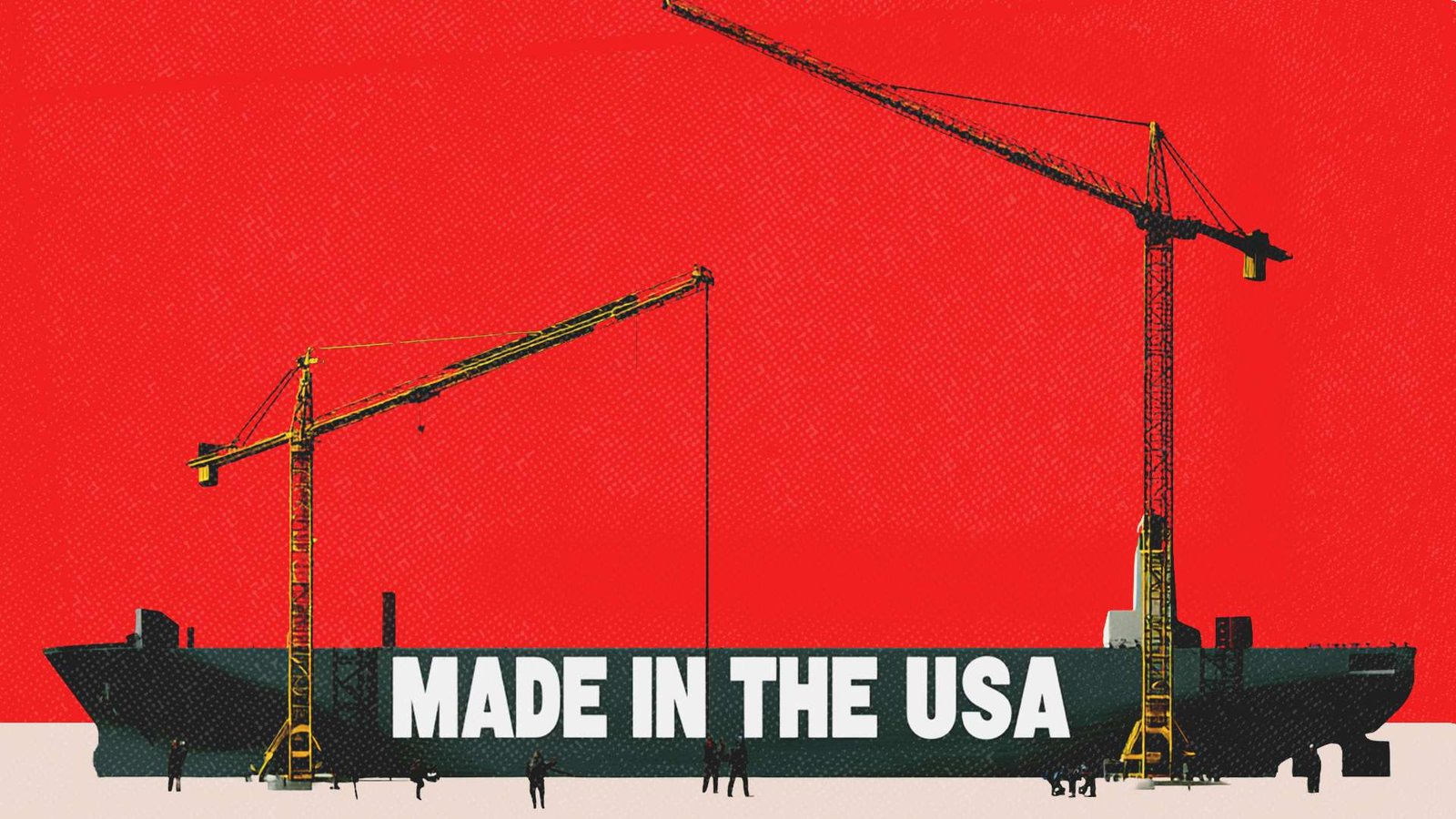
The statute is the Jones Act, passed in 1920 to rebuild and protect the U.S. merchant marine fleet after World War I disrupted American shipping capabilities. It requires that any vessel moving cargo between two American ports must be built in an American shipyard, be American-owned, and be at least three-quarters American-crewed. Miss any one of these marks and the shipper is barred from carrying a single barrel of fuel from Houston to Honolulu.
The stated justification for the act is national security. We need American ships and American sailors to fight wars. But 100 years in, it’s hard to repeat this justification with a straight face.
An American-built cargo ship costs $190 million to $250 million to build; the same vessel costs about $30 million from a foreign shipyard. U.S. shipyards now build less than 1 percent of what China and South Korea do, and roughly 300 U.S. shipyards have closed since the early 1980s. Legislation meant to sustain a merchant fleet has presided over its collapse.
Fewer than 100 oceangoing ships qualify under the Jones Act today, and the American tanker fleet is so thin that moving oil from Texas to the Northeast costs about three times what it would to ship it from Africa. Michael Bloomberg recently called the act “a national sales tax”—except that Washington never sees a dime. Instead, the premium is captured by a few U.S. shipyards and carriers operating relatively free of competition. Economist Thomas Grennes found that consumers lose more than what the statute hands to sailors, shipbuilders, and carriers.
In March, the Trump administration suspended the Jones Act for energy and fertilizer shipments. It’s not the first waiver of its kind, but it is the longest in recent history. With the waiver’s expiration looming, the administration just announced a 90-day extension along with stricter terms.
The numbers speak for themselves. The Cato Institute’s Colin Grabow documented that in under five months, Puerto Rico took in more mainland fuel than in any full year since 2015. Shipments to the West Coast, Alaska, and Hawaii hit nearly 14 million barrels, about 170 percent of the recent annual average. Whole trade routes quickly appeared: Gulf Coast fuel to Hawaii, New Jersey jet fuel to California, propane to Puerto Rico.
America’s government-protected fleet seldom served these locales. Remove a prohibition and the market pours resources where they are needed. As Grabow noted, “That’s strong evidence for the longstanding critique that the Jones Act suppresses domestic commerce by preventing economically viable trade between Americans.”
The question then becomes: Why won’t the Jones Act die? The answer, as the oldest story in political economy tells us, is that it benefits a few special interests at the cost of all the rest of us.
The handful of shipyards, carriers, and labor unions that profit from the Jones Act defend it vigorously. The average person pays just a few cents more at the pump or the register. It adds up, but not many people trace it to a statute they’re mostly unaware of. One side is lobbying. The other is you, and you’re busy.
The lobby mobilized against a limited waiver as if the republic were under siege. Grabow described a national ad campaign drawing millions of views from an account with just a few hundred subscribers, a 10-state media blitz, a form-letter-writing machine, and roughly one op-ed or letter per week, mostly written by people on the industry payroll.
Two influencers who had never mentioned shipping policy, Kaya Jones and Olivia Krolczyk, posted identical lines about “protecting 650,000 Americans” a day apart, and one disclosed a paid partnership. A commissioned study for the Transportation Institute warned, with gross exaggeration, that 100,000 jobs were “at risk.” Fifty-two House Republicans, the speaker among them, bought into the economic illiteracy and urged the White House to let the waiver die.
Such machinery does not stop at persuasion. A few years ago, documents pried from the Maritime Administration revealed that an advisory committee meeting participant suggested, probably half in jest, that every past and present Cato Institute and Mercatus Center scholar (presumably including me) be charged with treason for criticizing the Jones Act. As economist Art Carden observed, that dragnet would have to be enormous, since the critics run from free-market economists to the far-left Nobel laureate Joseph Stiglitz.
Unfortunately, the Jones Act is representative of much American legislation: a narrow group harvesting a fortune while the costs are spread across hundreds of millions of us. By design, those costs are all but invisible. Whether it’s protectionist sugar quotas, occupational licensing laws, or bespoke tariffs for connected companies, you, dear taxpayer and consumer, fund them all.
Ask yourself how many statutes you are paying for right now. It’s more than you think.
COPYRIGHT 2026 CREATORS.COM
[ad_2]
Source link
