
[ad_1]
Donald Trump saw the decay early and chose to fight it.
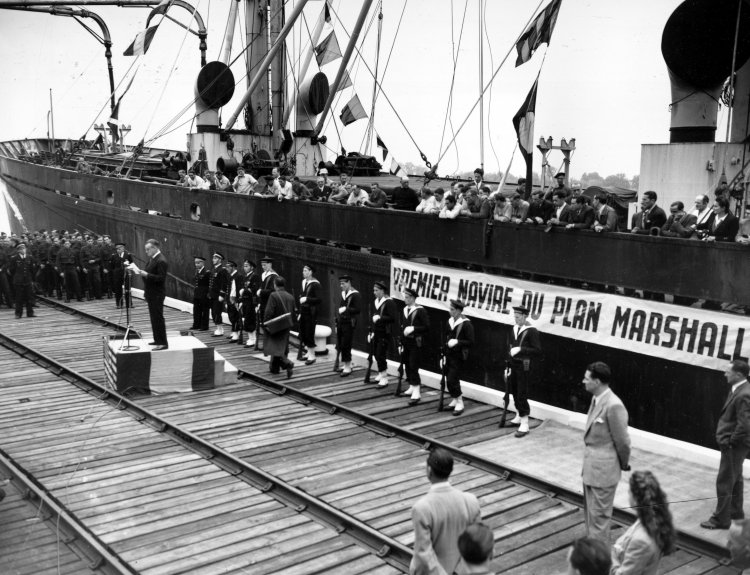
In 1945, the United States stood alone in its strength, industrial supremacy, nuclear monopoly, and no peer competitor. It chose not empire, but order. Through Bretton Woods, the Marshall Plan, and a durable security architecture, Washington did not merely defend the free world – it rebuilt it. War-torn economies were revived, trade was re-anchored, currencies stabilized, and former enemies turned into productive allies. At the height of its power, the United States exercised restraint. That restraint gave the system its legitimacy and made possible decades of shared growth under Pax Americana.
Today’s challenge is different. American power endures – roughly a quarter of global GDP, technological leadership, energy dominance, and, alongside allies, the world’s most capable military bloc. The dollar remains the global reserve. What has eroded is not capacity, but balance.
For decades, Washington expanded domestic commitments while underwriting global security, dismissing the cost of both. That posture is no longer sustainable. As Henry Kissinger warned, “Power without legitimacy tempts tests of strength. Legitimacy without power tempts empty posturing.” Strategy now requires restoring equilibrium between what the United States promises and what it can sustain.
That imbalance has a political expression. As Oswald Spengler warned, civilizations decay when faith gives way to technique, politics becomes administration, and ruling classes lose the will to defend what made their civilization worth inheriting. The European Union offers the modern template: technocracy without vigor, regulation without purpose, procedure without renewal. It manages decline; it cannot reverse it.
The United States has been moving in that direction for years: deindustrialization, porous borders, elite detachment, strategic drift, and a governing class more comfortable managing national weakening than confronting it. Donald Trump recognized that decay earlier than most – and said plainly that it was a choice. A nation cannot endure if it exports its industry, dilutes its sovereignty, and mistakes energy dependence for moral progress.
Yet America retains a resource Spengler underestimated: the American jeremiad. A tradition that treats national failure not as proof the country is a fraud, but as evidence it has betrayed a real promise, and must recover it. Trump speaks that language. His deepest offense to the caretakers of decline is simple: He refuses to treat “a more perfect Union” as a museum piece. He treats it as a mandate.
That is why the coming midterms matter. They are not an intermission between presidential contests; they are a referendum on whether reversal continues or authority returns to the managers of exhaustion. The choice is stark: Retire “a more perfect Union” to the glass case, or act as if we still intend to build it.
Since the postwar liberal consensus hardened in the 1960s and 1970s, American elites have converged on a governing model: expansive global commitments, growing domestic entitlements, tolerance of deindustrialization, and faith that technocratic management could substitute for hard power and national cohesion. Administrations changed. The trajectory did not.
Two balance sheets sustained this order: America’s fiscal capacity and the world’s excess supply. Washington could extend security guarantees, finance global recovery, and expand domestic prosperity because it could borrow cheaply, and because allied and later emerging economies produced a steady stream of low-cost goods that kept inflation contained. Credit replaced wage growth. Imports replaced production.
That model is breaking down, under the weight of excessive debt, declining living standards, and a hollowed-out industrial base, precisely the imbalances Keynes warned about at Bretton Woods. It must now be replaced with a different framework: not decoupling, but what Treasury Secretary Scott Bessent has described as “re-risking.”
For decades, Washington played universal guarantor while expanding domestic commitments and ignoring the cost. That era is ending. The task now is to restore equilibrium between commitments and capabilities.
That is why the Gulf is central, not peripheral, to any serious strategic reset.
For nearly half a century, the global economy has operated in the shadow of the 1979 Iranian Revolution: constrained supply, chronic instability, and a persistent risk premium in energy markets. Every oil shock has functioned as a hidden tax on growth and a subsidy to instability.
A durable stabilization of the Gulf, securing Hormuz, constraining proxy warfare, and integrating Iran into a more stable regional order would do more than calm a volatile region. It would remove one of the structural distortions that has shaped the global economy for decades.
The implications extend far beyond the Middle East. China depends on imported energy from unstable regions. Elevated prices and constrained supply have long amplified Beijing’s vulnerabilities while incentivizing its outward push for resource security. A more stable Gulf, underwritten by credible American power but aligned with sustainable commitments, would rebalance that equation.
Restoring order in the Gulf is not a distraction from great-power competition. It is a prerequisite for waging it from a position of strength.
This is the logic the old consensus missed. Endless commitments weakened credibility. Fiscal indiscipline weakened capacity. The result: overextension abroad, erosion at home.
What is emerging is not isolationism, but selectivity; not retrenchment, but reordering. It aligns American power with achievable objectives and sustainable commitments, prioritizing energy dominance, industrial renewal, and supply-chain resilience as the material foundations of sovereignty.
That shift is uncomfortable for a governing class raised on the assumption that management could substitute for strategy. But nations that refuse to adapt do not preserve stability, they accelerate decline.
At 250, the United States faces a decision that cannot be deferred. It can continue managing decline while the underlying structure erodes. Or it can reassert the principles that made it a republic: sovereignty, production, fiscal discipline, and strategic clarity.
Trump did not create this choice.
He exposed it.
The question is whether the country will act.
[ad_2]
Source link
