
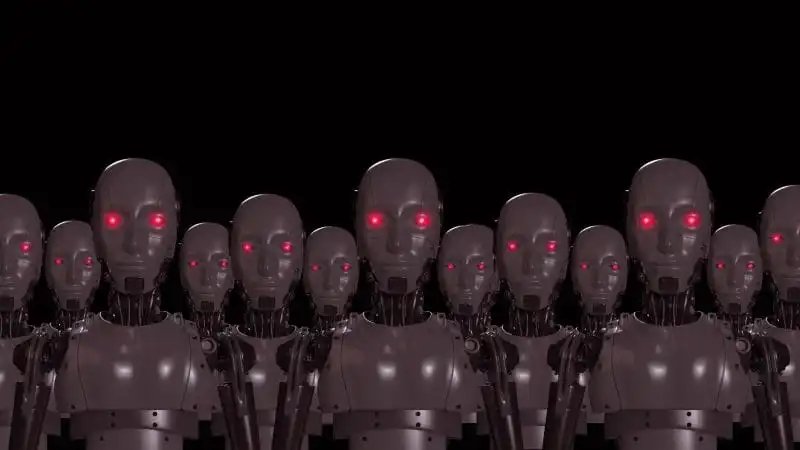
AI is everywhere. It’s getting incorporated into everything. That’s simply progress, we’re told. And therefore we need to embrace it, lest we look like a Luddite and let China win (whatever that means). Yet, simultaneously, a lot of people also are afraid because of AI. Very afraid. And sometimes, we’re told that we should be afraid too. However, in public discourse surrounding AI, there often can be a lack of detail regarding what specifically we’re supposed to be afraid of. Sometimes it is not even clear what is meant by the term “AI.”
Technically speaking, as I have touched on previously, one could argue (as some older computer scientists do) that AI is an umbrella term for a family of algorithms based in math that sometimes dates back more than a half-century.

Practically speaking, numerous programs we’ve been living with for years like Google Maps and Amazon’s recommender system can be thought of as AI despite their lack of novelty. Yet, in public discourse, the term AI tends to refer to generative AI (e.g, ChatGPT), as well as any number of hypothetical future programs that will do everything humans can do but better, will therefore both solve all our problems while also putting most of us out of work, and also eventually just might decide to go full Skynet on us unless they decide that we’re not worth the trouble.
(Sounds pretty sexy. Perhaps someone should make a series of movies about it. Perhaps people will even like two out of five of them.)
Unfortunately, though, these more hyperbolic, sci-fi depictions of the threat(s) posed by AI tend to get more attention than, and consequently distract from, more realistic and more imminent threats pertaining to privacy, freedom, autonomy, and even just a way of life many of us have come to enjoy. Automatic license plate readers, facial recognition, digital grandmothers, mandatory drunk and distracted driving detection programs, any of the technologies “grandson” was shouting about in “Autonomous Delivery Robot,” and wearable recording devices that transcribe and process in-person conversations for the anti-social and easily distracted are just of a few of the more realistic threats that come to mind. (And this by no means is a complete list).
Therefore, I tend to appreciate when members of our ruling class can take a morning to have a measured conversation about fairly well-defined threats posed by this technology (or suite of technologies), as was done at the US House of Representatives’ Cybersecurity and Infrastructure Protection Subcommittee’s June 4 meeting on the “AI Security Landscape.”
Superficially, the meeting’s discussion could probably be framed in terms of “Is the greatest threat posed by AI an external one in the form of foreign hackers looking to exploit vulnerabilities in the software controlling the United States’ critical infrastructure or an internal one born from the lack of regulation and accountability for AI’s use at home?”
From watching the discussion, however, it seemed less like a matter of “either or” and more like an uncontested response of “Yes and…”
Sandra Joyce of Google, Frontier Model Forum executive director Chris Meserole, and Corridor Security Inc. CEO and co-founder Jack Cable provided testimony regarding how AI is transforming the cybersecurity landscape as digital weapons fall into the hands of the cyber-barbarians at the gates who will use those weapons to find vulnerabilities in our critical infrastructure and/or deploy ransomware attacks.
“This technology has impacted cybersecurity in profound ways for both the defender and the attacker,” stated Joyce.
“[H]ackers have more powerful tools than ever,” Cable noted, naming Mythos and GPT-5.5 specifically.
“These models aren’t just hype,” he warned. “They are truly starting to rival or exceed humans on security tasks and do so at an unprecedented scale.”
Joyce suggested “threat actors” don’t even need something like Mythos and can be quite capable of doing a lot of damage with an older program.
Emphasizing the threats from within, Electronic Frontier Foundation senior policy analyst Matthew Guariglia stated, “The question is not how do we reign in AI, it’s how do we reign in the agencies that would unleash AI on the American public?”
In his testimony, Guariglia highlighted how the US national security state already uses a variety of tools that collect data on people without probable cause and that can make “inferences about a person’s politics, personal life, religion, and geolocation, sometimes inaccurately with major consequences.”
Furthermore, Guariglia said, “AI also has a track record of getting things wrong, from false citations on legal briefs to a major AI mistake that sent DHS recruits to the field without proper training.”
“There are likely more consequential examples that we don’t even know about because of classification that would prevent a more thorough accounting,” he added.
Similarly, Rep. Delia Ramirez (D-IL) observed, “We’re watching AI-powered monitoring systems spread to schools, to public housing, to hospitals with no transparency about how they work, no ability to challenge them, and no recourse when they’re wrong.”
In a later exchange concerning a possible scenario in which an AI program designates a city’s water supply as compromised when it is in fact fine and subsequently restricts the ability of the city’s residents to access water, Guariglia and Ramirez suggested that within the confines of current US law, transparency about how the problem occurred would likely be left up to the discretion of the city implementing the system while the question of who can be held accountable is a rather nebulous one.
Despite not quite being as sexy as battling T-800s in the streets for our lives and our livelihoods, more ransomware attacks, a further erosion of our privacy, and a lack of required transparency and accountability when HAL makes an oopsy and shuts off everyone’s water all sound pretty serious even if these things don’t quite warrant mass hysteria or a movie franchise. Perhaps they are even sufficient for reasonable concerns over the current zeitgeist to incorporate AI into everything. And maybe, just maybe, they provide reason to make us rethink our decision to connect everything in modern life to the internet.
[ad_2]
Source link
