
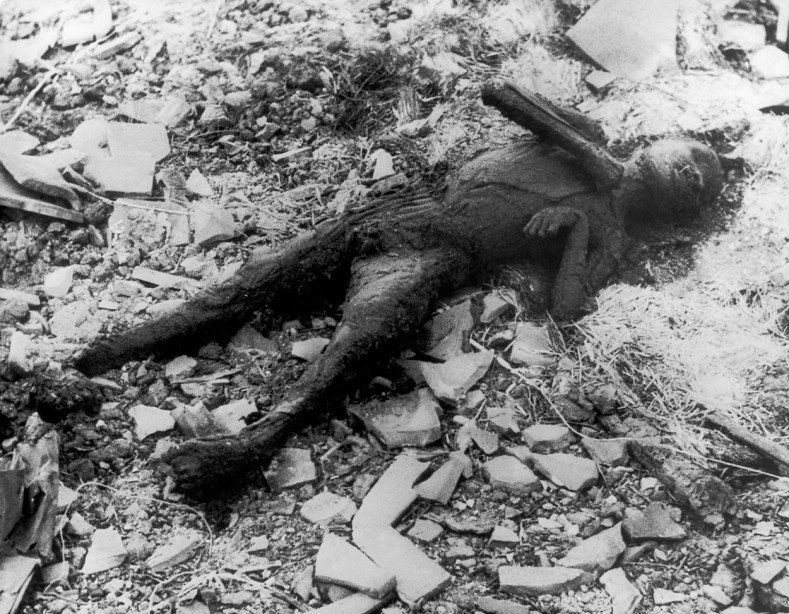
A child burned to death in the bombing of Nagasaki. This photo, and others like it, were banned from publication by the US military until 1952. Photo: Yōsuke Yamahata. Public domain.
Not everything that is faced can be changed, but nothing can be changed until it is faced.
– James Baldwin
You cannot understand the twentieth century without Hiroshima.
– Robert J. Lifton and Greg Mitchell
Every day we scroll past photographs of burned children, bombed-out neighborhoods, families clawing through rubble with their bare hands, and parents carrying the bodies of sons and daughters killed beneath collapsing concrete. Such images seldom unsettle our conscience, provoke outrage, and awaken a demand for justice. Increasingly, they do none of these things. They register briefly before dissolving into another statistic, another headline, another passing image in the endless digital stream. Violence has become familiar, suffering routine, and genocide itself is in danger of becoming just another image consumed and forgotten..
This is not merely a political development; it is one of the great moral and cultural disasters of our age. We have not simply become accustomed to living amid unprecedented violence, we have been educated to accommodate it. Cruelty no longer confronts us as an ethical rupture demanding judgment and action. It has been absorbed into the rhythms of everyday life, stripped of its capacity to shock, and transformed into yet another spectacle competing for our distracted attention. As Susan Sontag suggested in her analysis of fascist aesthetics, violence increasingly becomes aestheticized—organized as spectacle, invested with the pleasures of domination, and detached from the suffering of its victims.
Under such conditions, the dehumanization of others is inseparable from the transformation of the machinery of death into a spectacle consumed with fascination rather than horror. The deepest victory of authoritarian politics in the twenty-first century lies not only in its capacity to produce immense suffering, pain, and death, but in its ability to cultivate moral indifference while making violence appear seductive, entertaining, or inevitable. When people cease to feel the pain of others, violence no longer requires widespread consent; it needs only widespread indifference.
As the anniversaries of Hiroshima and Nagasaki return once again, they do so largely eclipsed by the Trump administration’s transformation of the nation’s two hundred and fiftieth anniversary into a spectacle of militarized patriotism, historical mythmaking, and American triumphalism. The pageantry celebrates a narrative of national innocence while eclipsing one of the twentieth century’s greatest atrocities committed in its name. The more urgent question, therefore, is not simply what happened in August 1945. It is what has become of a society whose formative institutions increasingly educate people to accommodate violence rather than resist it.
The answer lies in more than what Gore Vidal once described as America’s cultivated historical amnesia. Under gangster capitalism, forgetting has become a governing principle of power. We inhabit a regime of organized forgettingthat erases bodies from public consciousness even as it erases historical memory itself. It teaches us to look without seeing, to witness without feeling, and to consume the suffering of others as another spectacle in an endless cycle of distraction, entertainment, and forgetting. Such regimes are not abstractions. They become visible whenever policies capable of producing immense human suffering disappear beneath the noise of political spectacle—as in the Trump administration’s dismantling of the United States Agency for International Development, a policy that recent analyses estimate has already contributed to “an estimated 700,000 deaths worldwide.”
How else are we to understand a world in which more than sixty-four thousand Palestinian children have been killed or injured in Gaza since October 2023 while their suffering disappears almost as quickly as the headlines that briefly acknowledge it? How else do we explain the reported deaths of more than one hundred children in the bombing of a girls’ school in Iran, an event that barely registered before it was displaced by the next manufactured spectacle? These are not isolated tragedies. They reveal a broader cultural condition in which atrocity is consumed, circulated, and forgotten with astonishing speed.
This is the deepest wound inflicted by authoritarian culture. It does not merely normalize violence; it reorganizes consciousness. It severs suffering from compassion, history from responsibility, and death from mourning. When the victims disappear from memory almost as quickly as they disappear from life, power secures one of its greatest triumphs: it destroys not only bodies but the public capacity to recognize their loss. In that moment, forgetting becomes the final act of violence, completing in consciousness what bombs, prisons, armies, and occupations begin in history. This cultural condition has been analyzed most powerfully by Robert Jay Lifton.
Robert Jay Lifton gave this condition a name: psychic numbing. He used the phrase to describe the diminished capacity to feel in the face of overwhelming violence. What begins as a psychological defense against unbearable suffering can become a cultural and political condition. Entire societies learn to look without seeing, to witness without feeling, and eventually to forget. This condition is not merely an individual affliction, or type of “impaired mourning”; it is a form of public pedagogy. It is cultivated by schools disparagment of critical thought, historical consciousness, and civic purpose; it is produced by media cultures organized around spectacle, digital platforms that reward distraction, a culture of immediacy, and political narratives that teach us to accommodate cruelty rather than confront it. Against this pedagogy of forgetting stands the difficult and necessarily troubling work of historical memory.
These questions matter because remembrance is not the same as historical memory. Official rituals of remembrance often console us by confining catastrophe safely to the past. As Eddie S. Glaude Jr. notes in America, U.S.A., historical memory performs a very different task. It returns us to unfinished histories whose consequences continue to inhabit the present. It unsettles rather than reassures. It refuses the comfort of distance and insists that the past is never truly past when the conditions that produced it survive in altered forms. Historical memory does not ask us simply to remember what happened. It demands that we recognize how the logics that made catastrophe possible continue to shape the present.
Hiroshima and Nagasaki belong to precisely this kind of historical memory because they remind us that atrocities begin long before the first bomb falls. They begin when language is removed from moral responsibility, when history is erased or rewritten through the vocabulary of conquest and colonization, and when entire populations are rendered disposable before they are destroyed. Every genocide is first a crisis of language, memory, and moral imagination. By the time the machinery of death is set in motion, the deeper work has already been done: compassion has been weakened, historical consciousness has been dismantled, and violence has been normalized as common sense. Hiroshima and Nagasaki stand not only as symbols of unprecedented destruction but also as warnings about the political culture that makes such destruction imaginable. Few have expressed this truth more forcefully than the late Howard Zinn:
What means could be more horrible than the burning, mutilation, blinding, irradiation of hundreds of thousands of Japanese men, women, children? And yet it is absolutely essential for our political leaders to defend the bombing because if Americans can be induced to accept that, then they can accept any war, any means, so long as the warmakers can supply a reason. And there are always plausible reasons delivered from on high as from Moses on the Mount.
The atomic bombings were not merely military events that concluded the Second World War. They inaugurated a new historical formation in which scientific achievement became inseparable from industrialized killing, technological rationality overwhelmed ethical judgment, and civilian annihilation could be justified through the sanitized language of military necessity, national security, and historical inevitability. Long before the bombs incinerated cities, another devastation had already taken place. Human beings had been transformed into abstractions, dehumanized through racist slurs, strategic calculations, and collateral damage.
The bomb exploded first in consciousness. As Ngũgĩ wa Thiong’o reminds us, “Language as culture is the collective memory bank of a people’s experience in history.” When language is colonized, memory itself becomes vulnerable to conquest—capturing consciousness long before it captures territory. Long before Hiroshima and Nagasaki were reduced to ash, language had already been emptied of moral responsibility, memory had been rewritten in the service of empire, and entire populations had been rendered disposable.
That moral rupture did not disappear with the mushroom clouds rising over Hiroshima and Nagasaki. It became embedded in institutions, policies, cultural narratives, and educational practices that normalized militarism while celebrating technological mastery divorced from ethical restraint. The bomb was transformed into a symbol of national virtue rather than a warning about the abyss into which modern civilization had descended. As Robert Jay Lifton and Greg Mitchell observed, American political culture constructed an official narrative that sought not to confront the moral catastrophe of Hiroshima but to redeem it, converting an act of unprecedented destruction into a story of national innocence and salvation. That narrative did more than justify the bomb. It reorganized moral consciousness.
Lifton argued that Hiroshima did not wound only its victims; it also left a profound mark on the American imagination, fostering a culture of denial, moral justification, and emotional numbing. Yet he never regarded Hiroshima solely as a source of despair. He insisted that confronting its moral legacy honestly could foster resilience, renewal, and what he called “survivor wisdom,” restoring the historical memory and moral imagination necessary to resist future catastrophes. That insight is even more urgent today because the habits of denial and indifference he identified have escaped the nuclear age and become defining features of contemporary political culture.
Among survivors of Hiroshima, this diminished capacity to feel initially functioned as a tragic form of psychological survival. Faced with scenes too horrific to absorb, many found themselves emotionally paralyzed, temporarily incapable of responding to the landscape of death surrounding them. But Lifton extended the concept much further. He argued that the same condition also characterized those who designed the bomb, authorized its use, justified its necessity, and later defended its moral legitimacy. What began as an emergency psychological defense gradually became a cultural condition.
This insight reaches far beyond Hiroshima. What begins as a defense against unbearable suffering can evolve into a political culture organized around indifference. A society that learns not to feel one atrocity gradually acquires the capacity to ignore others. Lifton warned that once Americans constructed what he called a “cordon sanitaire” around Hiroshima—a barrier protecting them from confronting its moral implications—that habit of avoidance spread to other forms of collective suffering. The numbing did not stop with Hiroshima. It became a way of inhabiting the world.
Nothing could better describe our present historical moment. We inhabit societies saturated with images of catastrophe. Yet rather than enlarging our ethical imagination, this relentless exposure often produces exhaustion, indifference, and resignation.
Even more troubling, it feeds a resurgent war culture that glorifies domination, celebrates militarized masculinity, and equates physical strength with moral worth. As Susan Sontag argued in her classic essay on fascist aesthetics, authoritarian culture does more than justify violence; it aestheticizes it. Domination becomes seductive, hierarchy beautiful, submission desirable, and the spectacle of power detached from the suffering it produces. Violence no longer appears as a moral catastrophe but as an exhilarating display of strength, discipline, virility, and national renewal. U.S. Defense Secretary Pete Hegseth’s celebration of militarized masculinity is not simply a political posture; it is the contemporary expression of this fascist aesthetic. It transforms domination into virtue, physical force into moral authority, misogyny into masculine authenticity, and violence into the highest expression of citizenship. In doing so, it redefines citizenship itself, replacing democratic responsibility with militarized obedience, civic courage with warrior masculinity, and public life with a theater of force.
In such a culture, violence becomes another genre of entertainment, another spectacle in the economy of distraction. The constant circulation of suffering no longer enlarges compassion; it erodes it, teaching people not simply to witness violence but increasingly to admire, consume, and normalize it.
Lifton anticipated this transformation with extraordinary clarity. As this moral desensitization spreads, he argued, people require ever greater spectacles of violence simply to feel anything at all. Disaster becomes normalized, and ordinary suffering loses its capacity to disturb us.
Here the legacy of Hiroshima converges with the digital culture of the twenty-first century.
Algorithms reward outrage while discouraging reflection. Social media platforms monetize fear, resentment, and humiliation. Corporate news reduces war to spectacle, compressing unbearable histories into disposable images. Artificial intelligence accelerates the circulation of propaganda, conspiracy, and racial mythology while diminishing the time necessary for thoughtful judgment. We increasingly encounter suffering not as fellow human beings but as data, content, or scrolling images. Distance becomes permanent. Responsibility evaporates.
This is not simply a technological crisis. It is a pedagogical one.
Every culture teaches people how to see, what to value, whose lives matter, and whose deaths may be ignored. The most powerful educational institutions today are no longer schools alone. They are digital platforms, corporate media, entertainment industries, and algorithmic systems that organize attention itself. These institutions do more than distribute information. They shape consciousness, organize attention, and cultivate habits of feeling. They manufacture forms of identification while teaching indifference toward others.
Under such conditions, fascism no longer requires spectacular rallies or uniforms to reproduce itself. It works more quietly and, for that reason, often more effectively. It reshapes perception, colonizes language, erodes historical memory, and teaches people to regard entire populations as invaders, parasites, criminals, terrorists, or demographic threats rather than as fellow human beings. By the time the machinery of violence is set in motion, its deepest victory has already been won: the democratic imagination has been hollowed out, compassion has yielded to fear, and disposability has become common sense.
Today this pedagogy of dehumanization is once again becoming normalized. Calls for mass deportation, fantasies of ethnic purification disguised as “remigration,” attacks on immigrants, racial conspiracy theories, and genocidal rhetoric directed at Palestinians all depend upon a prior educational achievement: teaching people to regard certain lives as disposable.
That is why figures such as Elon Musk matter. They matter not because they are uniquely evil but because they occupy commanding positions within the cultural apparatuses that now educate hundreds of millions of people. When racist conspiracies, demographic panic, and authoritarian fantasies are amplified through platforms reaching much of the globe, white supremacist propaganda is transformed into common sense. Hatred becomes normalized precisely because it is repeated, circulated, rewarded, and stripped of its historical genealogy.
As Jamelle Bouie has argued, Musk’s rhetoric is no longer confined to coded insinuations or internet provocation. It increasingly echoes themes drawn from the contemporary white nationalist imagination: affirming slogans such as “First the traitors, then the invaders”; declaring that “anyone who opposes remigration is a traitor”; amplifying demographic panic over declining white birthrates; and normalizing the language of racial replacement and ethnic cleansing. Bouie also notes the disturbing resonance between this rhetoric and the political imaginary of The Turner Diaries, where “traitors” who defend a multiracial democracy are marked for elimination before the campaign against supposed “invaders” begins. This should not be dismissed merely as inflammatory rhetoric. Language of this kind does not simply describe the world; it prepares people to inhabit one in which exclusion, racial purification, and political violence appear not only legitimate but necessary.
Yet we should resist the temptation to describe figures such as Elon Musk, Donald Trump, Benjamin Netanyahu, or Stephen Miller simply as monsters. As Jorge Gonzalez Arocha observes, the language of monstrosity may satisfy our moral outrage, but it ultimately obscures the deeper workings of power. Monsters exist outside history. They are imagined as aberrations, exceptions to ordinary life. Fascism is neither. It is produced within history, cultivated through institutions, sustained by bureaucracies, legitimized by law, amplified by media, and normalized through the everyday pedagogies of schools, digital platforms, entertainment industries, and political culture. When we imagine authoritarianism as the work of monsters, we mistake symptoms for causes, overlooking the social relations, institutional arrangements, and cultural forces that make such politics possible.
The enduring lesson of Hiroshima is not that monsters occasionally seize power. It is that educated people, respected institutions, celebrated scientists, compliant journalists, and ordinary citizens can become participants in systems that separate technical intelligence from moral responsibility. The bureaucrats who planned Hiroshima were not monsters. The scientists who perfected the bomb were not monsters. The journalists who celebrated it were not monsters. They were products of institutions that transformed mass death into administrative necessity and moral obligation. The greatest crimes of modernity are rarely committed outside civilization; they are committed in its name.
The political danger of the language of monstrosity is that it individualizes what is fundamentally systemic. It encourages us to search for evil personalities rather than authoritarian cultures, for pathological leaders rather than the pedagogical apparatuses that educate people into accepting cruelty, disposability, and organized forgetting. Remove one authoritarian leader and another will take his place so long as the institutions, economic interests, media ecosystems, and educational forces that manufacture authoritarian consciousness remain intact. That is the enduring lesson of Hiroshima, and it remains the central political lesson of our own time.
History never repeats itself mechanically. Gaza is not Hiroshima. Nagasaki is not Gaza. Their histories are different, their contexts distinct. But they reveal a recurring political logic: civilian populations rendered disposable, overwhelming violence justified as necessity, bureaucratic language replacing ethical judgment, and technological superiority mistaken for moral legitimacy. Whenever human beings become abstractions rather than persons, the conditions for atrocity are already present.
This is why remembering Nagasaki matters. Historical comparison is valuable not because it erases difference but because it reveals recurring political logics.
Historical memory breaks the spell of moral indifference. It restores the connection between feeling and judgment, conscience and politics. It reminds us that every genocide begins not with the machinery of death but with the pedagogy of dehumanization. Long before bodies are destroyed, language is corrupted, history is erased, compassion is ridiculed, and entire populations are taught to disappear morally before they disappear physically.
Lifton believed that confronting Hiroshima could become a source of renewal because it enabled us to recover our moral imagination, relearn how to feel, and reconnect ourselves to the broader human project. That may be the most important lesson Nagasaki offers today.
The struggle against fascism begins not only by resisting authoritarian institutions but by refusing the moral indifference upon which they depend. Against organized forgetting and manufacture illiteracy and amnesia, we must recover historical memory. Against the politics of disposability, we must insist upon the irreducible dignity of every human life. Against the seductive myths of technological omnipotence and permanent war, we must reclaim a language capable of naming both truth and justice.
The authoritarian abyss is no longer a distant possibility. It has entered the present. It appears wherever democracy yields to militarism, wherever cruelty is celebrated as strength, wherever historical memory is erased, and wherever entire peoples are stripped of their humanity in the name of security, racial purity, or national destiny. The forces that produced Hiroshima and Nagasaki have not disappeared; they have assumed new languages, new technologies, and new justifications.
The question is no longer whether we remember Hiroshima and Nagasaki. The question is whether we can recover the moral urgency necessary to prevent their logic from becoming the defining political grammar of the twenty-first century. Historical memory is no longer simply an act of remembrance; it has become a condition of survival. To remember is to resist. But memory cannot remain a sanctuary for conscience; it must become a catalyst for collective struggle. Its highest purpose is not simply to preserve the past but to interrupt/rupture/transform the present. Only when remembrance gives rise to solidarity, organized resistance, and the struggle to create a more just world does it honor those whose lives history has tried to erase.
