
[ad_1]

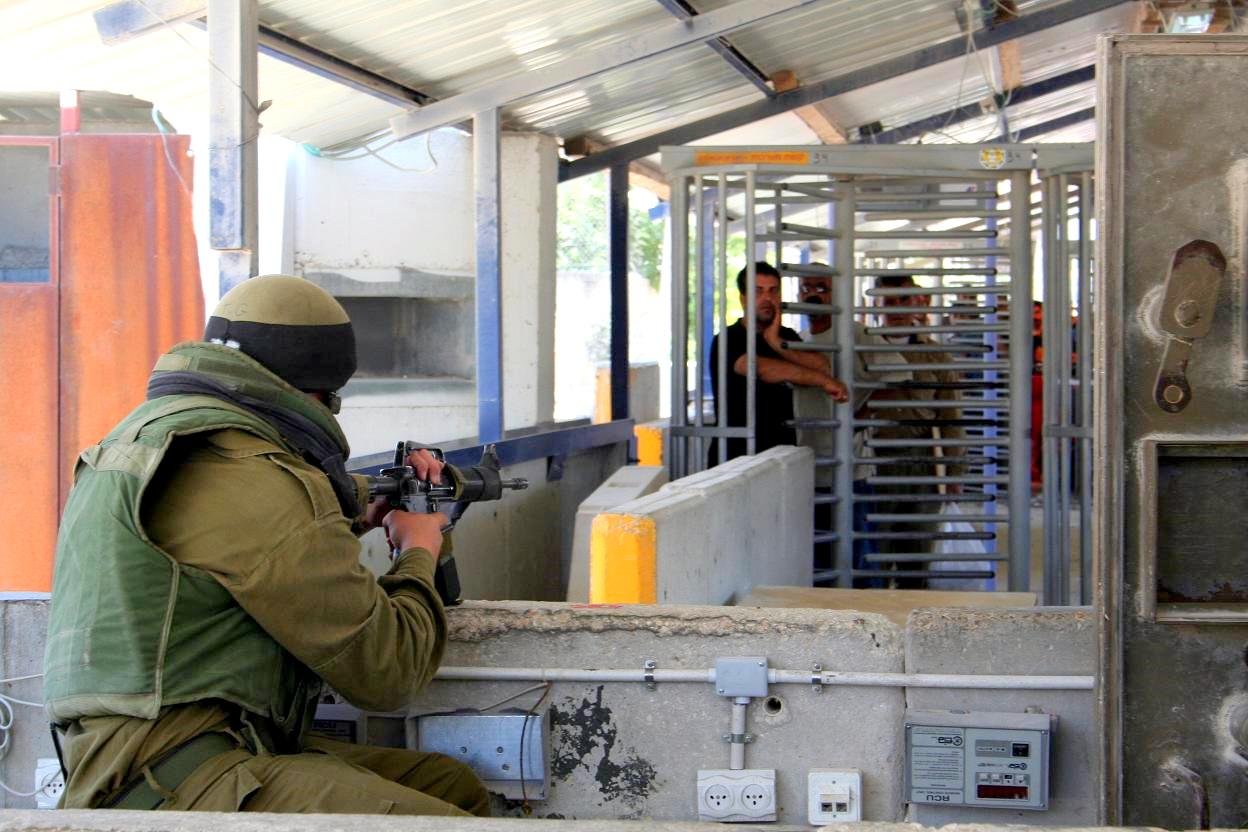
Israeli soldier faces Palestinians waiting at the Huwara checkpoint, at the entrance to Nablus, in the occupied West Bank – CC BY-SA 3.0
“President Trump and I often say: peace through strength – first comes strength then comes peace.”
– PM Benjamin Netanyahu, 22/06/2025
Settler colonialism is a fairly common phenomenon, both ancient and modern, as the unhappy history of the indigenous people of Palestine testifies. The first Israelite settler invasion of their country occurred some 3500 years ago.[1] “When you have crossed the Jordan into the land of Canaan,” God commands Moses to instruct the people of Israel, “you shall drive out all the inhabitants of the land from before you…; you shall dispossess the inhabitants of the land and dwell in it, for I have given you the land to possess” (Numbers 33-50-53). The latest invasion, Zionists would claim by the same people “returning home,” began at the turn of the twentieth century and is ongoing.
Nonetheless, settler colonialism is not an easy enterprise to pursue, justify or maintain, let alone to normalize permanently. Native populations always resist their colonization, their very physical and cultural erasure. The ancient Israelites and modern Zionists shared a common goal: to transform Canaanite/Arab Palestine into the Jewish Land of Israel. They both conquered and settled Palestine, and each established state-level governance. But each also faced prolonged resistance from local peoples and never succeeded in eliminating them altogether.[2] Israelite/Judean/Jewish rule lasted only about 450 of the roughly 5000 years since the emergence of Canaanite civilization. True, the pervasiveness of the biblical account of God’s “giving” the Land of Israel to Abraham in the Western and wider Christian worlds makes the claim of Zionist Jews to reasonable if not self-evident, and that has proven a great boon for promoting Zionist colonization. But Zionism’s end-game, to “establish such a society in Palestine that Palestine shall be as Jewish as England is English, or America American,” as Chaim Weizmann told the Versailles Conference in 1919, has proven elusive.
And this is the problem that preoccupies Israel today. Zionism achieved its national goal: establishing a Jewish state in a de-Arabized Palestine. It failed, however, to normalize that achievement, making the Jewish state of Israel “as Jewish as England is English” in the words of Chaim Weizmann, thus foreclosing a Palestinian liberation struggle and securing its status as a legitimate state, regionally as well as internationally. The Israeli authorities had three opportunities to do so. First, by taking advantage of their secret contacts with the Egyptians in the mid-1950s, including an agreement by Gamal Abdel Nasser in 1954 to hold high-level talks, perhaps even a face-to-face meeting with Israeli Prime Minister Moshe Sharett, which Sharett called off.[3] Second, during the Madrid Peace Conference of 1991 and the Oslo peace process, both preceded by the PLO’s acceptance of the two-state solution and its recognition of “the right of the State of Israel to exist in peace and security,” which Israel never negotiated in good faith, doubling its settlements during the course of the negotiations.
From 1967 on, but particularly during the Oslo process when a “Jewish” state of Israel could have won universal recognition in return for a Palestinian state in the Occupied Territories and the return of a limited number of refugees by mutual consent – an offer repeated in the Arab Peace Initiative of 2002 to which the Sharon government never even deigned to reply, the third lost opportunity – it became clear that the Zionist project required all of historic Palestine.
The question of how to normalize a “Greater” Israel receives the same answer as did the efforts to normalize the pre-1967 Israel or normalizing Zionism’s pre-state colonization itself: “normalization through strength” combined with a security politics based on “serving the hegemons.” In terms of the Palestinians, to erect an “Iron Wall” as Ze’ev Jabotinsky described it in his seminal essay of 1923.[4] As the concept has evolved until today, the doctrine contends that an Iron Wall comprised of political, military, economic and technological domination will so overwhelm and exhaust the Palestinians that they will despair of an Arab Palestine and submit. As for the Arab world, the Iron Wall has catapulted Israel into the role of the region’s military hegemon, leaving the Arab states with no choice but to normalize relations, informally if not officially.[5]
This paper examines Israeli security politics but with an agenda: not only to evaluate its effectiveness over time, its limitations and perhaps, since the 1982 invasion of Lebanon, its counter-productivity, but to ask whether Israel’s reliance on hard military power opens opportunities for the Palestinians to resist and ultimately overcome Zionist colonization. Recent events, combined with longer-term geopolitical developments and emerging political and economic realignments in the region, have led to circumstances potentially more favorable to their struggle, if strategically exploited.
Israeli Security Politics: “Serving the Hegemons”
Every settler colonial movement needs a metropolitan sponsor, especially since it inevitably faces stiff local and sometimes regional resistance. The Zionists initial metropole came from the organized Jewish community of Western and Central Europe; the World Zionist Organization (WZO) was founded in Basle in 1897 as a political and diplomatic instrument for colonizing Palestine. Since it was not a state body, it had to establish its own institutions to finance land acquisition and settlement, as well as a functional government, the Jewish Agency, mandated by the League of Nations Mandate in 1922 “to secure the co-operation of all Jews who are willing to assist in the establishment of the Jewish national home.”
The WZO lost no time in offering its services to the hegemon who could advance the Zionist project. Already in 1898, the Second Zionist Congress endorsed diplomatic efforts to acquire a Charter from the Ottoman Empire for Jewish settlement in the Holy Land in return for relieving much of the Empire’s external debt.[6] While that initial attempt failed, serving the next power to rule Palestine, the British, succeeded beyond the Zionists’ wildest dreams. Not only did they obtain a virtual charter to Palestine in the form of the Balfour Declaration, but the League of Nations Mandate reaffirmed that “The Mandatory [the British] shall be responsible for placing the country under such political, administrative and economic conditions as will secure the establishment of the Jewish national home.” By 1947 Britain had allowed the Zionists to acquire strategic lands and establish a functional governmental authority (the Jewish Agency and other “national institutions”) fortified with a trained military. The crushing of the Arab Revolt by combined British and Jewish forces between 1936-39 fatally weakened the Palestinians ability to resist the Zionist take-over in 1947-48.[7]
“Serving the hegemons” requires a quid pro quo, of course. For the Ottomans it was financial; for the British a mixture of manipulating the religious sensibilities of the Christian Zionists who made up a key part of the British Establishment, exaggerating the political benefits world Jewry could bring to the British and placing Zionist resources at the disposal of the British authorities in their attempts to control Palestinian resistance. Israeli independence, however, posed a major dilemma. Although having succeeded in obtaining the status of a sovereign state recognized by the UN, Israel was still an extension of Zionist settler colonialism. For the Palestinians, the Arab and Muslim peoples just emerging from their own anti-colonial struggle or still embroiled in them, as well as for much of the Global South, Israel represented a colonial entity from which the colonized Palestinians must be freed. Zionism still needed metropolitan protectors. But as a small settler state in a geopolitical region crucial for Western imperial interests and energy, what quid pro quo could it offer a metropolitan power willing to support it?
David Ben-Gurion addressed this issue immediately. He identified five sources of Israeli leverage: (1) a qualitative edge in conventional means of warfare; (2) the threat of nuclear deterrence; (3) technological and economic superiority; (4) national resilience based on Jewish immigration, settlement and hasbara (public relations) playing on Jewish victimhood and religious sensibilities – all leading to (5) a special relationship with a superpower in which Israel has its quid pro quo: making its prowess in the areas of weapons development and deployment, counterinsurgency and counter-terrorism, surveillance and domestic securitization, as well as cutting-edge technology, available to the metropole – in which Israel is more than happy to act as its regional enforcer.[8]
That strategy soon paid off. In the early 1950s, Britain, which viewed Israel as a counterweight to Russian efforts to push it out of the Middle East, began supplying it with heavy weaponry, as did the US and West Germany. France, however, became Israel’s major metropolitan support. Not only did it supply Israel with sophisticated arms, but it provided weapons technologies which allowed Israel to rapidly develop an arms industry of its own. By the mid-1950s Israel was taken seriously enough as a military power that in 1956 it joined in the French and British attack on Egypt, the French providing Israel with a massive shipment of Mystère IV jets, Super-Sherman tanks and tank transports, trucks, armored personnel carrier, ammunition and other sophisticated armaments.[9] France, it must be noted, also provided Israel the foundations of its nuclear weapons program, inaugurated in 1952.[10]
The alliance with France lasted until 1967 when, post-Algeria France began seeking renewed influence in the Middle East, finally breaking with Israel during the 1967 War. The shift to the next and current hegemonic protector, the United States, began in the early years of the Kennedy Administration, when the decision to sell the Hawk surface-to-air missile system opened the way to the transfer of other sophisticated weapons to Israel and eventually the virtual incorporation of the Israeli weapons industry into that of the Americans. (For a detailed exploration of this relationship, see my book War Against the People: Israel, the Palestinians and Global Pacification (2015).
The Political Logic and Success of Israel’s Security Politics in the Region: “Normalization Through Strength”
If “serving the hegemons” requires Israel to identify a quid pro quo that addresses a prospective ally’s strategic interests, the quid pro quo going in its own direction has been unwavering and fixated on one national goal over the decades. “Normalization through strength” means enabling Israel to complete its colonization of Palestine by, on the one hand, making “Greater” Israel itself impregnable and, on the other, forging transactional ties with potential adversaries that override ideological objections.
Judged by Israel’s evolving relations with Arab and Muslim countries, its security politics has had impressive, if often fluctuating, accomplishments. The political benefits of formally recognizing Israel, or at least not confronting it directly, were apparent to the countries of the region early on. Both Turkey and Iran voted against the Partition Plan in 1947, yet the former established diplomatic relations with Israel in early 1949, the latter a year later, and for largely similar reasons. In the context of the Cold War, recognition of Israel signaled alignment with the West as Turkey sought NATO membership and Iran economic and military aid – Israel acting as a conduit to the American administration, Congress and Jewish organizations able to influence American foreign becoming a vital part of its security politics. As non-Arab countries, Turkey and Iran also shared Israel’s concern over radical Arab nationalism and Soviet influence spreading throughout the region.[11] Both countries became key components in Israel’s Alliance of the Periphery, establish alliances with a series of states and peoples circling the hostile Arab core.
In 1957, soon after the Shah of Iran established with the help of the CIA the notorious internal security force SAVAK, its head, General Taimur Bakhtiar, invited the Mossad to become actively involved in its affairs, which soon blossomed into open and much wider military and intelligence cooperation, including the sale of Uzis and other weapons to the Imperial National Guard. In 1958 the Mossad signed formal letters of cooperation with the National Intelligence Organization of Turkey and with the Iranian SAVAK. The tripartite agreement was named Trident, or “Ultra-Watt.”[12]In 1963, Israel helped advise Iran’s counterinsurgency operation against dissident tribes in the south.[13] By the 1970s American interests and Israeli security politics had converged in the Nixon Doctrine, in which Israel and the Shah’s Iran were considered America’s two top cops in the region. In return for being one of the first states in the region to recognize it, Israel played a key role in organizing, training and equipping the SAVAK, the Shah’s dreaded security apparatus, which also became an important source of intelligence information and a partner, with Turkey’s security services as well, in operations serving all these countries and their American patron.[14]
The fall of the Shah in the Islamic Revolution of 1979 did not end Israeli military ties with Iran. The Revolution left Iran in possession of American arms but no spare parts; moreover, the Israeli government attempted to maintain discrete contacts with the Iranian military, with which it had worked closely and which it supported over the Iraqis in their 1980-88 war, in the hopes of eventually overthrowing (or at least moderating) Khomeini. When the war with Iraq broke out in the 1980s, Israel discreetly supplied more than $30 million in military equipment and parts to the Khomeini regime, in clear violation of the American arms embargo. The Israeli-Iranian channel subsequently proved useful to the Americans when, in what became known as the Iran-Contra scandal of 1986, Israel, at the behest of the Reagan Administration, secretly supplied arms and spare parts to Iran out of its own stocks, which the US promised to replenish, in an attempt to free the American hostages. The proceeds from that sale were then used to by-pass a congressional ban on funding the Contras, using Israel as a surrogate. Indeed, after Congress finally forced the Reagan Administration to end its involvement with the Contras, Israeli advisors supplying training and Israeli weapons replaced the Americans.[15]
By the 1990s, Israel and Turkey were drawing closer, now united by common concerns over Iran and its ally Syria and both key players in Washington’s Middle East order after the end of the Cold War and the outbreak of the First Gulf War of 1991. Moreover – and this is a recurrent theme in Israeli security politics – Israel could provide military technology that the West was reluctant to sell to Turkey because of its war against the Kurdish insurgency. In 1992 Turkey upgraded its diplomatic relations with Israel to the ambassadorial level and in 1996 the two countries signed a formal military pact.[16]
“We are going to say to the Americans,” said Ya’akov Meridor, the chief economic coordinator in the Israeli cabinet at that time, “‘Don’t compete with us in [apartheid] South Africa, don’t compete with us in the Caribbean or in any other country where you can’t operate in the open. Let us do it.’ I even use the expression, ‘You sell the ammunition and equipment by proxy. Israel will be your proxy,’ and this would be worked out with a certain agreement with the United States where we will have certain markets…which will be left for us.”[17] Israel, in fact, continued to supply the Khomeini regime with military equipment and ammunition at least until 1987.[18]
As to the Arab world, in terms of Israeli security politics the notion of an Israeli-Arab conflict appears less bi-polar and uncompromising than it was perceived. While the Arab League rejected any diplomatic ties with Israel after the 1967 war (the famous “Three Noes” of Khartoum), in fact Israel and most members of the Arab League shared concern over Soviet influence, pan-Arabism, radical Islam, liberation movements and even uprisings demanding democratic reform, as did France, Britain and the US. Israel, as the trusted ally (or surrogate) of the West, became the main conduit for American and European military aid and intervention in the region. And so, only a decade (and two wars) after the Khartoum conference, Israel signed a formal peace treaty with Egypt (1979), following by Jordan (1994) during in the Oslo peace process, and on to the Abraham Accords, an impending security treaty with Syria and the ongoing peace negotiations with Lebanon. Normalization with Saudi Arabia, de facto or de jure, represents the final jewel in the crown. Still, that can wait. As we have seen, security cooperation between the two countries has existed for years, much of it siphoned through the American Central Command (Centrom), especially concerning threats from Iran and radical Islamic movements.
Israel has also regularly intervened to protect conservative Arab regimes from both external and internal threats. Just to give a few examples: in the 1950s and ‘60s Israel trained the security services of the Moroccan king, enabling him to consolidate his position as ruler;[19] during the 1962-70 Yemeni civil war, it joined with Saudi Arabia and Iran in supporting the royalists against the Nasser-backed republicans;[20] during the 1970s Israel assisted Sultan Qaboos ibn Said’s totalitarian regime in Oman in its battle with insurgents in Dhofar province[21] and in the same year came to the rescue of Jordan when it faced a possible Syrian invasion during Black September.[22] In 1976 Israel created the South Lebanon Army and invested more than $150 million in military supplies and training for the (fascist) Christian Maronite Phalange militia in anticipation of the 1982 Lebanon War.[23] More recently, Israel sold weapons to the Saleh regime against which the Yemeni people had been rebelling since 2011,[24] entered into active collusion with the Saudis over a possible attack Iran,[25] helped the Egyptian military overthrow Morsi in 2013[26] and has carried out hundreds of air strikes against ISIS in Sinai, with Egypt’s consent.[27]
Another key component of Israel’s security politics to the Arab states (and to Muslim and other states far beyond the region) must be noted; that is, the crucial role played by Israel’s securocratic technologies in keeping the autocratic regimes afloat – labelled “Pegasus diplomacy” by Arab activists because of the central role played by Israeli-made Pegasus spyware and other Israeli surveillance technologies, some developed, deployed and marketed by joint Arab-Israeli ventures.[28] Israeli doctrines of asymmetrical warfare, counterinsurgency and counter-terrorism aimed at external Islamic threats now inform Arab homeland security and police approaches to militarized securitization. The repressive nature of virtually all Arab governments presents Israel with a securocratic niche that, if not creating a dependency on Israeli security technologies, then at least preserves the conditions for some form of normalization.
It is here that the “Palestine laboratory” plays a strategic role.[29] The low-intensity warfare that Zionism has been waging against the Palestinian people for almost a century has provided Israel with a virtual laboratory for developing and testing in real-world conditions conventional military weaponry, surveillance systems and technologies of population-control on a people with absolutely no protections, Israel ignoring with impunity the Fourth Geneva Convention and other human rights covenants, knowing full well it will not face legal sanctions or significant political opposition. Its model of securocratic control has transformed the Occupied Palestinian Territory into one of the most monitored, controlled and militarized place on earth, a genuine laboratory through Israel supplies technologies of control to the Arab states: cyber-surveillance and spyware; biometric and facial recognition systems integrated into city- or country-wide surveillance grids,; deep packet inspection (DPI) technology for tracking internet communications and tracing online dissidents; AI-driven social media monitoring tools that feed into repressive “predictive” policing; drones and robotics for domestic policing; “non-lethal” crowd control systems and materials; military weapons adapted to domestic policing – all the products of the Palestinian Laboratory. What’s more, Israel exports a full-fledged model of a Security State, a kind of totalitarian police state based on its occupation regime, perfectly attuned to the Arab elite’s need to protect their own fragile, unpopular regimes from the same incessant pressure that Palestinian resistance imposes on Israel.[30]
All this buttressed Israel’s rise as the “protector” of Sunni regimes and a regional military power. The very point of Israeli security politics, however, is to convert these surreptitious ties into outright diplomatic relations, normalizing its place in the region. For, to return to our original point, security politics has to do with “serving the hegemons,” local, regional and international, a strategy which leads to normalization – “normalization through strength” – which is how Zionist settler colonialism ultimately prevails. For normalization represents two crucial Zionist/Israeli objectives.
First, acceptance of the colonization of Palestine. Despite lip-service to “credible pathways to a Palestinian state,” it is clear that normalization extends not only to Israel “proper” but to its settlement enterprise as well, since there is no conceivable path to returning Israel to the 1967 borders. The international demand for a “two-state solution” could be satisfied by the establishment of a Palestinian “state”-cum-Bantustan on around 10-15 percent of historic Palestine, on parts of Areas A, B and Gaza. Even if this falls far short of the formulation put forward by the Arab Group – “peace requir[ing] that Palestinians exercise their ‘legitimate and inalienable rights,’ foremost an independent state on the 1967 borders with East Jerusalem as its capital”[31] – in the view of the Israeli government, military and all the Jewish political parties is that the continued colonization, pacification and incorporation of the West Bank poses no threat to the process of normalization. Israel is simply too powerful to boycott and too useful in terms of its contributions to Arab countries’ domestic security to shun – and the Palestinian issue too marginal to have any determining sway.
Thus, whether or not the Arab states establish diplomatic relations as Lebanon is currently exploring or enter into security agreements as Syria is posed to do or merely continue the informal and discrete type of normalization that has characterized relations with Saudi Arabi these past decades, the crucial consideration for Israel is maintaining its ability to complete the Judaization of Palestine. Any of these forms of normalization achieves that. Only actual warfare or genuine diplomatic confrontation pose a threat to Zionist colonization – and Israel has little to fear from those fronts. Besides the recent attacks on Israel by Iran by its proxies, in which support of the Palestinians during the Gaza genocide played a role, the last Arab military operation against Israel was in 1973. And while Israel has been hauled before the ICJ, its Prime Minister and former Minister of Defense indicted for war crimes by the ICC, Israel’s violations of human rights and international law condemned in UN resolutions and the EU threatening but not intending to impose mild sanctions, it knows that an enabling form of conflict management will prevail, justified by the desire not to interfere with diplomacy. Indeed, the very process of normalization has become an instrument of conflict management, leaving Israel free to pursue its colonial project.[32]
Second, normalization not only confines Palestinians to enclaves on around 10-15 percent of their homeland – parts of Areas A, B and Gaza, a non-sovereign, non-viable Bantustan that could nevertheless be sold as a Palestinian “state” in order to satisfy the international demand for a two-state solution – it also signifies closure on the Palestinian struggle. In the past Arab countries had always conditioned the signing of peace agreements on territorial withdrawals by Israel and progress on the Palestinian track. The Arab Peace Initiative formulated by the Saudis and approved unanimously by the Arab League at its meeting in Beirut in March 2002 offered Israel peace, recognition, security and full integration into the region in return for the establishment of a Palestinian state in the Occupied Territories and acceptance of the refugees’ right of return although in numbers agreed upon by “mutual consent.”) As an early expression of Israel’s faith in “normalization through strength,” the Sharon government did not even reply to the Initiative; it simply ignored it. Now, a quarter century later, normalization through strength appears to have proven itself. In what he calls his “outside-in” strategy, Netanyahu argues that the Arab states will not sacrifice their collective interests for the Palestinian cause, and therefore it can be functionally delinked from the process of regional integration. “According to the Palestinians,” he explained,[33] peace cannot be achieved without us surrendering to the Palestinians’ demands, including the uprooting of settlements, the division of Jerusalem, and a withdrawal to the ’67 lines. This mistaken perception gave the Palestinians a practical veto on achieving peace between Israel and the Arab states. It held Israel and the Arab world hostage to the most extreme Palestinian demands, which put Israel in real existential danger…. Well, not anymore. For years, many believed that Israeli-Palestinian peace would promote broader reconciliation between Israel and the Arab world. However, these days I think that peace will be achieved in the opposite way: it is precisely the broadening of reconciliation between Israel and the Arab world that may promote Israeli-Palestinian peace.
Israeli security politics, then, still builds upon the time-tested strategy of “serving the [regional] hegemons” as the path to “normalization through strength.” While it began with Turkey and Iran, Israel’s strategy of identifying and filling key “niches” in its clients’ military or domestic security needs has given it the political agility to assemble and integrate into a coalition of Sunni governments.[34]
The Limits of Security Politics – An Opening for the Palestinians?
According to the logic of normalization by strength, the political opportunities that arose on October 7th and the seeming attainability of normalization, the moment of Zionist triumph had arrived. The conquest and Judaization of Palestine had been completed. All that was necessary to achieve regional integration was pacification, the final crushing of all resistance, whether Palestinian or external, specifically the neutralizing of Iran and its proxies as regional threats. October 7th enabled Israel, in Trump’s words, to “open the gates of hell,” to finish the job once and for all, with no fear of sanctions no matter how violent, illegal or even genocidal its actions were. That, in turn, would convince the Sunni Arab states that under the Israeli military umbrella they could get on with their business in peace. A “Greater Israel” was assured, the Palestinian issue disappeared.
Instead, the logic of security politics that had seemed to serve Israel so well in the past, one which enabled Israel to continue its colonization of Palestine while still conducting quiet relations with the Arab world, seemed to go wildly wrong just at the moment when Israel expected it to deliver. Since October 7th, Israel’s security politics has taken a radical turn, now assuming that military force alone can reshape political reality, rendering diplomacy marginal or even irrelevant.[35] Israel’s power, now brutally released in all directions, did not achieve any of its ends. While Palestinian resistance suffered a setback – Hamas has been weakened militarily and political initiatives of Palestinian civil society experience unprecedented suppression – the Gazan slaughter has enflamed public opinion in the Arab and Muslim world as well as internationally, turning the Palestinian “issue” into one that cannot be avoided or disregarded. More significantly for Israeli security politics, Israel’s emboldened and unrestrained aggressiveness across the region has dragged the Arab states into disastrous conflict.
Yet the very of prospect of “normalization through strength” has given Israel an inflated sense of regional entitlement. “Israel’s already entrenched belief that military strength is not only essential for security, but also a viable pathway to regional integration and normalization,” write al-Ghashian and Ishai, [36] “reinforced by the Abraham Accords and further radicalized by post–October 7 dynamics, rests on the assumption that demonstrations of force can deter adversaries, compel accommodation, and ultimately substitute for diplomatic compromise.”
Post October 7th, however, Israel feels entitled to unleash its military might against any target in the region or beyond without fear of sanctions. Citing such existential threats such as Iran and Hezbollah, or presenting threats as existential in order to justify wholly disproportionate responses, such as the Gaza genocide and the violent ethnic cleansing it is conducting in the West Bank, Israel perceives the political moment as its opportunity to assert its dominance as the region’s unchallenged military hegemon while eliminating the Palestinian issue altogether. Military prowess, al-Ghashian and Ishai contend,[37] “increasingly came to be seen as capable of… rebuilding deterrence, reasserting dominance, reshaping regional alignments, compelling moderation among adversaries, and incentivizing cooperation and normalization among Arab states.”
Precisely because of its power, but power decoupled from restraint, diplomacy, and credible political horizons – most notably regarding the Palestinian issue – Israel has become a source of risk and instability to Saudi Arabia and the other Arab states that prioritize stability, predictability and territorial integrity. As al-Ghashian and Ishai put it:[38]
From the Israeli vantage point, the logic of normalization through strength appeared internally coherent. Israel sought to demonstrate resolve, eliminate threats, and position itself as a pillar of a new regional security architecture. Yet this logic underestimated how Israeli actions were perceived beyond its borders – particularly in Saudi Arabia and other moderate Sunni Arab states such as Egypt, Jordan, and the UAE, whose overriding concern is regime stability and regional predictability.
Israeli policymakers often assumed that Arab partners would interpret Israel’s military activism as a shared asset against common enemies. In practice, many of these states perceived the same behaviour as deeply destabilizing…. Rather than anchoring a regional coalition, Israel increasingly appeared as a source of risk. While Saudi Arabia and other moderate Arab states pursued de-escalation, mediation, and reconstruction efforts – in Gaza, Lebanon, and Syria – Israel remained committed to operational maintenance and tactical dominance…. As a result, Israel – once seen by some as a stabilizing regional actor – has increasingly been perceived as an agent of chaos: powerful yet unpredictable, capable yet risky to be closely associated with.
Despite persisting sectarian divisions and different political orientations and interests, the states the region are beginning to realize that a multipolar system in which Global South connections protect their assets and secure trade better than reliance on a single dominant hegemon, in their case an overbearing and quixotic United States whose commitment to Israel overshadows all else. The Mecca Agreement, a trilateral defense pact signed recently between Turkey, Pakistan and Saudi Arabia represents a direct response to the destabilization precipitated by the US and Israel, but it arises out of deeper realignments. The emergence of the BRICS Bloc has certainly played a role. Egypt, the UAE and Iran have all joined (Saudi Arabia being halfway in), attracted particular by its goals of loosening the G-7’s control over global economic institutions and alternative providing Global South alternatives such as the New Development Bank.
One concrete manifestation of this shift is the Chinese-sponsored Belt and Road Initiative, whose maritime route passes from the east through India, Pakistan, Iran, the Gulf States, Saudi Arabia and Egypt on the way to Europe, though the inter-regional trade on the way is of more consequence than merely reaching European markets. By the same token, the Belt and Road’s overland route enters Europe through Iran and Turkey. Both notably by-pass Israel. Similarly, the STEP project involving Saudi Arabia, Turkish. Egyptian, Pakistani routes trade through that corridor, also by-passing Israel but with a spur into Egypt and hubs integrating it with the Belt and Road project. Tellingly, the US-backed India-Middle East Corridor (IMEC) has Haifa as its major inter-regional hub.
Al-Ghashian and Ishai[39] conclude that Israel must “recalibrate” its path toward normalization.” While military prowess remains salient, “normalization through strength” alone is inadequate, even counterproductive. Normalization cannot be a byproduct of dominance, but an outcome of sustained political engagement, reciprocity, and predictability. Military power must be subordinated to diplomacy. An Israeli analyst puts it more bluntly: After October 7th, writes M,[40] the dangers of grounding Israeli strategy solely in military might are evident on every front.
In normalization efforts, Israel’s power paradoxically undermines diplomacy: Arab states may acknowledge its strength, but they also see it as destabilizing — radioactive in political terms. In Syria and Lebanon, the absence of follow-up diplomacy has squandered a rare chance to transform former enemies into potential partners. And in Gaza, the obsessive pursuit of a “decisive victory” has become the pretext for a horrific and aimless war — one that jeopardizes Israel’s moral legitimacy and the very possibility of resolving the Israeli–Palestinian conflict.
Never has the choice between diplomacy and militarism been so stark — or so consequential — for Israel’s long-term security and resilience. The nation now stands at a crossroads: between a potential diplomatic breakthrough — ending the war in Gaza, forging internationally backed limits on Iran’s nuclear program, and advancing normalization with the Arab world — or a messianic march into a spartan future, condemned to live by the sword and on the sword.
Have Israel’s security politics faltered? Is there an opening the Palestinians might exploit? The questions are posed, the political circumstances well understood and analyzed. The time has come for coordinated, Big Picture, Palestinian-led strategy and action.
References
[1] Pekka Pitkänen, A Commentary on Numbers: Narrative, Ritual, and Colonialism. Taylor & Francis, 2017.
[2] Masalha, Nur, The Bible and Zionism: Invented Traditions, Archaeology and Post-Colonialism in Palestine-Israel. Vol. 1. Zed Books, 2007.
[3] Avi Shlaim, The Iron Wall: Israel and the Arab World. Norton, 2001, pp. 128-129.
[4] Vladimir Ze’ev Jabotinsky, V. The Iron Wall (1923). Retrieved at: https://israeled.org/wp-content/uploads/2025/06/1923.-11-Jabotinskys-Iron-Wall-text-pdf.pdf
[5] Shalim, Iron Wall, pp. 13-16, 626-627.
[6] Howard M. Sacher, A History of Israel from the Rise of Zionism to Our Time. New York: Alfred A. Knopf, 1981, pp. 47-48; Tom Segev, A State at Any Cost: The Life of David Ben-Gurion. Farrar, Straus and Giroux, 2019, p. 309.
[7] Matthew Hughes, Britain’s Pacification of Palestine: The British Army, the Colonial State, and the Arab Revolt, 1936-1939. Cambridge University Press, 2019.
[8] Shay Shabtai, Israel’s National Security Concept: New Basic Terms in the Military-Security Sphere, Strategic Assessment 13:2 (2011), pp. 7-18.
[9] Stewart Reiser, The Israeli Arms Industry: Foreign Policy, Arms, Transfers, and Military Doctrine of a Small State. Holmes & Meier, 1989, pp. 45-77.
[10] Avner Cohen, Israel and the Bomb. Columbia University Press, 1998.
[11] Jean-Loup Samaan, Israel s Foreign Policy Beyond the Arab World: Engaging the Periphery. Routledge, 2018.
[12] Benjamin Beit-Hallahmi, The Israeli Connection: Whom Israel Arms and Why. Pantheon, 1987, pp. 9-11; Alexander Murinson, The Ties Between Israel and Azerbaijan. Begin-Sadat Center for Strategic Studies, 2014, p. 13. Retrieved at: besacenter.org/wp-content/uploads/2014/10/MSPS110-web.pdf.
[13] IJAN, Repression. Retrieved at: http://israelglobalrepression.files.wordpress.com/2012/12/israels-worldwide-role-in-repression-footnotes-finalized.pdf.
[14] Shlaim, Iron Wall, p. 196; Omid Voqoufi, The US, Israel and the Foundation of SAVAK. Islamic Revolution Document Center, Tehran, 2012. Retrieved at: http://www.irdc.ir/en/content/18727/default.aspx.
[15] Feinstein, Shadow World, pp. 378-382; Goldfield, Garrison, pp. 19-20).
[16] Shlaim, Iron Wall, pp.195-196; Ephraim Inbar, The Deterioration in Israeli-Turkish Relations and Its International Ramifications. Begin-Sadat (BESA) Center for Strategic Studies, 2011, pp. 2-3. Retrieved at: http://www.biu.ac.il/Besa/MSPS89.pdf.
[17] Jane Hunter, Israeli Foreign Policy: South Africa and Central America. Boston: South End Press, 1987; SIPRI Military Expenditure, 2014.
[18] Beit-Hallahmi, Connection, pp. 13-15.
[19] Bruce Maddy-Weitzman, Israel and Morocco: A Special Relationship. The Maghreb Review 21:1-2 (1996), pp. 36-48. Retrieved at: https://dayan.org/content/israel-and-morocco-special-relationship-maghreb-review.
[20] Asher Orkaby, Beyond the Arab Cold War: The International History of the Yemen Civil War, 1962-68. Oxford University Press, 2017, pp. 169-177).
[21] Yossi Melman, The ‘Oman File’: Inside the Mossad’s Alliance with Muscat, Israel’s Window into Iran. Ha’aretz, November 26, 2020. Retrieved at: www.haaretz.com/israel-news/2020-01-23/ty-article/.premium/the-oman-file-inside-the-mossads-alliance-with-muscat-israels-window-into-iran/0000017f-db4a-d856-a37f-ffcafaef0000.
[22] Ziv Rubinovitz, Blue and White ‘Black September’: Israel’s Role in the Jordan Crisis of 1970. The International History Review 32(4), 687-706.
[23] Beit-Hallahmi, Connection, pp. 9-21.
[24] Jimmy Johnson, Israeli Arms Sales to Rwandan Genocidaires Should Not Be Surprising. Jadaliyya, 2012. Retrieved at: www.jadaliyya.com/Details/26418.
[25] Elizabeth Blade, The Unspoken Alliance: Israel and the House of Saud. Israel Today, 2012. Part 1. Retrieved at: http://www.israeltoday.co.il/NewsItem/tabid/178/nid/23416/Default.aspx; Part 2. Retrieved at: http://www.israeltoday.co.il/NewsItem/tabid/178/nid/23420/Default.aspx.
[26] Middle East Monitor MEMO), Israel General: Israel was Behind Coup Against Egypt’s Morsi, April 3, 2019. Retrieved at: www.middleeastmonitor.com/20190403-israel-general-israel-was-behind-coup-against-egypts-morsi.
[27] David Kirkpatrick, Secret Alliance: Israel Carries Out Airstrikes in Egypt, with Cairo’s O.K. The New York Times, February 3, 2018. Retrieved at: www.nytimes.com/2018/02/03/world/middleeast/israel-airstrikes-sinai-egypt.html.
[28] Lauren McMillen,The Outsized Role of Surveillance Technology in the Israel-UAE Abraham Accords. Dawn (2025). Retrieved at https://dawnmena.org/the-outsized-role-of-surveillance-technology-in-the-israel-uae-abraham-accords.
[29] Feldman, Yotam. The Lab (2013). Retrieved at: https://www.youtube.com/watch?v=yWo1SrIyFKI; Jeff Halper, War Against the People: Israel, the Palestinians and Global Pacification. Pluto Press, 2015; Antony Loewenstein, The Palestine Laboratory: How Israel Exports the Technology of Occupation Around the World. Verso, 2023.
[30] Jeff Halper, Israelizing the American Police, Palestinianizing the American People. The Link 53:5 (2020), pp. 2-15. Retrieved at: http://www.ameu.org/PDF-Archives/vol53_issue5_2020.aspx
[31] Ephrem Kossaify (2026). Saudi Envoy Tells UN Security Council Two-State Solution Only Path to Lasting Mideast Peace, Eurasia Review (August 20). Retrieved at: https://www.eurasiareview.com/19062026-saudi-envoy-tells-un-security-council-two-state-solution-only-path-to-lasting-mideast-peace
[32] Yuval Benziman, Netanyahu’s Attempt to Delink Israel-Arab Relations from the Palestinian Issue, Mitvim (April. 2018). Retrieved at: https://mitvim.org.il/wp-content/uploads/Yuval_Benziman_-_Netanyahus_Attempt_to_De-Link_Israel-Arab_Relations_from_the_Palestinian_Issue_-_April_2018-1.pdf; Gil Murciano, Leveraging Friction: Using Israel’s Tensions with Normalization Countries to Engage Them in Israeli-Palestinian Peace-Making,” Mitvim (April, 2025). Retrieved at: https://mitvim.org.il/wp-content/uploads/2023/04/Leveraging-friction-Gil-Murciano.docx.pdf.
[33] Anna Barsky, Netanyahu: “Just as They Didn’t Believe I Would Bring a Peace Agreement – I Will Also Bring Sovereignty,” Ma’ariv, August 16, 2020 (Hebrew). Retrieved at: https://www.maariv.co.il/news/politics/article-78416
[34] Halper, War, pp. 67-85.
[35] Gil Murciano, Peace Through Strength – Israel’s Version: Abandoning Diplomacy for a Military-Only Strategy. Mitvim (August, 2025), p. 2. Retrieved at: https://mitvim.org.il/wp-content/uploads/2025/08/Peace-Through-Strength-Gil-Murciano-August-2025.pdf
[36] Aziz al-Ghashian and Eric Ishai, Normalization Through Strength? A Dual Israeli-Saudi Examination of Power, Perception, and the Limits of Military-Centric Regional Strategy, Mitvim, April, 2026, p. 1. Retrieved at: https://mitvim.org.il/wp-content/uploads/2026/04/Al-Gashian-and-Ishai-A-Dual-Israeli%E2%80%93Saudi-Examination-of-Power-Perception-and-the-Limits-of-Military-Centric-Regional-Strategy.pdf
[37] al-Ghashian and Ishai, Normalization, p. 3.
[38] al-Ghashian and Ishai, Normalization, pp. 7-8.
[39] al-Ghashian and Ishai, Normalization, pp. 9-10.
[40] Murciano, Peace, p. 5.
[ad_2]
Source link
