
[ad_1]
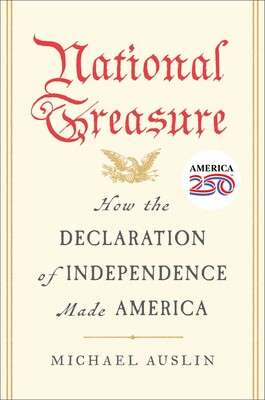
[This post is excerpted from the new book, National Treasure: How the Declaration of Independence Made America (Avid Reader Press/Simon & Schuster).]
To the delegates of the Continental Congress, the Declaration of Independence did not reflect abstract ideas. To begin with, it was a pressing piece of administrative business after the vote for Independence on July 2, necessary for legitimizing the American struggle against King and Parliament, as well as a means of garnering foreign support, primarily from France. Yet it also was a covenant invoking the Creator and identifying a people that it hoped to unite. This covenant was instituted to defend against tyranny and maintain a specific political community in its traditional rights. Its sanction came from a righteous cause, and as Congress began to edit Thomas Jefferson’s draft on July 2 and 3, it found itself not only tightening his argument, but also making more explicit the divine sanction that underpinned the document.
Grounded in natural rights theory, English common law, classical thought, and Judeo-Christian theology, the Declaration expressed the specific kinds of liberty and equality understood by eighteenth-century men of property and learning. It eloquently asserted the traditional liberties of Englishmen, drawing the distinction between positive rights granted by governments and natural rights derived from God. This was a defense of man “in virtue of his nature,” as later expressed by the political philosopher Harry Jaffa. The Declaration described rights that could not be “alienated” or surrendered to any person or government, especially one failing to uphold its responsibilities to the people it sought to control.
A document so radical as to indict a king and declare all men equal was also extremely conservative. Liberty seemed a straightforward idea, but equality was a far more complicated concept than Jefferson’s famous phrase expressed. Equality was not an end in itself, but was a feature of liberty, in the sense that humans had equal rights that had to be protected. In the political sphere, equality was necessary to the preservation of those God-given liberties that were both individual and communal.
Such arguments in favor of equality were not absolute, especially when it came to the question of slavery. The most passionate section in Jefferson’s draft was a long condemnation of the slave trade, though not of slavery itself, but with undeniable moral tones. Chattel slavery was deplored as both a political and a moral evil by almost all the Founding Fathers, including slaveholders like George Mason, who in 1765 had written that it was the cause of the “destruction” of the Roman republic, being “an Evil very pathetically described by Roman historians.” Jefferson himself had written in his Summary View of the Rights of British America that “the abolition of domestic slavery is the great object of desire in those colonies where it was unhappily introduced in their infant state.” The hypocrisy of a slaveowning society demanding its own freedom had long been commented on in the colonies, often from the pulpit. It was well understood that holding fellow humans in bondage degraded both the enslaved and the enslaver, and Patrick Henry hoped for the time when the colonists would “abolish this lamentable evil.”
Such laudable sentiments were not followed by action, nor did they spare the Americans from the barbed criticism of foreigners like the great Samuel Johnson, who famously asked, “how is it that we hear the loudest yelps for liberty among the drivers of negroes?” Yet in the interests of colonial unity, this passage was cut, to Jefferson’s disgust. In cutting Jefferson’s critique of the slave trade, Congress revealed the moral failing that would bedevil the new nation and eventually threaten its very survival.
What later generations would see as the silences, errors, or hypocrisy of the Declaration cannot detract from its bold, indeed revolutionary, nature. Jefferson’s broad vision, largely unaltered by Congress, pointed toward freedoms not entirely brought into focus, but never lost sight of. In condemning the King, the Declaration condemned any who would trample on the liberty of others, even if it did not—could not—yet follow its own logic to the inevitable end. It thus served a double role: first, in making explicit the rights and claims of the political community in whose name it had been created; second, in providing a transcendent vision of both individual and communal life that would inspire groups and people who did not yet partake of all (or any) of the freedoms enumerated in the document. This “open door,” so to speak, is what ultimately gave the Declaration its capaciousness and greatness, keeping it a living document in the minds of Americans of future generations.
Seen in its totality, the Declaration of Independence was audacious yet prudent, visionary yet sober. It was infused with a “spirit of pragmatic idealism,” to borrow the words of the great historian Bernard Bailyn. Though a compromise among different regions and interests, the Declaration was far from reflecting the lowest common denominator. It expressed the mind of a growing society more dynamic than the mother country and the moral certitude of those who refused to accept subordination.
[ad_2]
Source link
