
[ad_1]
New York state and New York City legislators are seeking to address high-profile cases of protestors harassing worshippers by considering laws establishing no-protest buffer zones around such locations.
Following protests outside synagogues, a New York City measure establishing such zones around houses of worship is slated to go into force in late May. It comes even as Mayor Zohran Mamdani vetoed another buffer zone measure relating to schools, arguing it would unreasonably curb speech and protest rights.
A separate and pending New York state effort would create a 25-foot protest buffer zone around places of worship and reproductive health centers. Democratic Gov. Kathy Hochul says she supports the measure, even as it has met with divided support within her party. U.S. Rep. Tom Suozzi, D-N.Y., is backing a similar effort in Congress.
Democratic state Sen. Sam Sutton of Brooklyn advocated for the idea at a March 11 rally.
“Hate crimes in New York City increased by 152% this January from last January,” he said. “We cannot ignore what is happening at the very doors of the places that should feel safest. No one should have to walk through a crowd of harassment just to be able to practice their faith.”
Have hate crimes in New York City increased by that much in the space of a year?
Data supports the figure. Sutton’s office told PolitiFact New York that the number came directly from the New York Police Department’s monthly crime data releases.
A Feb. 2 press release reported the number of bias incidents, which New York State law defines as “any offense or unlawful act that is motivated in whole or substantial part by a person’s, a group’s or a place’s identification with a particular race, color, religion, ethnicity, gender, age, disability, ancestry, national origin, or sexual orientation … as determined by the commanding officer of the Hate Crimes Task Force.”
The release reported the number of cases investigated by the NYPD’s Hate Crimes Task Force between January 2025 and January 2026, finding that such incidents increased by 152%. It also reported that anti-Jewish hate crimes increased by an even larger percentage — 182%.
Brendan Lantz, an associate professor and director of the Hate Crime Research and Policy Institute at Florida State University’s College of Criminology and Criminal Justice, urged caution when interpreting the data.
Hate crimes tend to spike in response to specific conflicts, he said, “so month-to-month comparisons can sometimes be quite volatile and may not always necessarily reflect” longer-term trends. “Looking at longer time frames tends to produce a more reliable picture.”
Brian Levin, an emeritus professor of criminal justice and founder of California State University-San Bernardino’s Center for the Study of Hate and Extremism, agreed.
“January 2025 appears to be an anomalous month for NYPD — far below the mean — making that statistic dramatic, but not the most illuminating,” Levin said. For instance, he said that hate crimes in New York City for the first quarter of 2026 were 11.7% higher than in the first quarter of 2025 — a less dramatic increase.
NYPD data shows the number of hate crimes dropped between February 2025 and February 2026 and between March 2025 and March 2026.
Lantz also said the NYPD figures refer to reported incidents that can be “shaped by variation in victim reporting and police classification practices, not just underlying behavior.” Increases in reported incidents, for instance, can be attributed to increased willingness to report to the police and increased police identification efforts, he said.
A recent NYPD action acknowledged the challenge of counting incidents: Starting in March 2026, the department said it would count confirmed cases, rather than those under investigation, arguing that this would “provide a more accurate representation.” Experts have also said that hate crimes are often under-reported.
Our ruling
Sutton said that from January 2025 to January 2026, “hate crimes in New York City increased by 152%.”
This aligns with official New York Police Department data. However, experts caution against using large percentage increases to draw broad conclusions. The trends may be volatile, affected by policies on how data is collected and reported. In New York City, comparisons of recent periods have sometimes shown decreases, not increases.
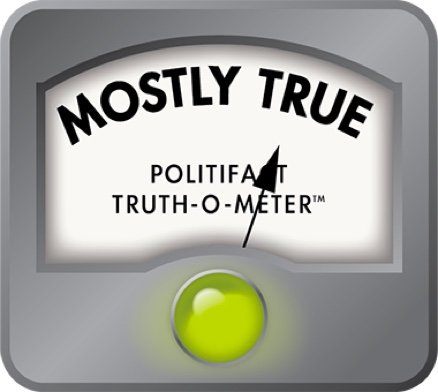
The statement is accurate but needs additional context, so we rate it Mostly True.
[ad_2]
Source link
