
[ad_1]
I want to tell you a story that most Americans have never been told.
Not because the information is hidden. Because no one has connected the dots in a way that makes the consequences visible.
It is a story about trust. About prosperity. About what happens when a country trusts the United States. And about what every other government in the world learned from watching what happened next.
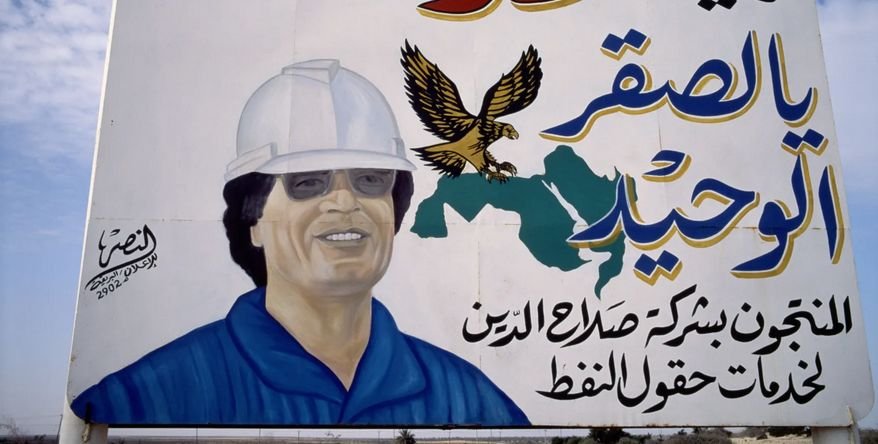
The man’s name was Muammar Gaddafi.
He ruled Libya for forty-two years. He was an authoritarian. He was responsible for serious abuses of his own people. He sponsored terrorism. None of that is in dispute.
But before we talk about how he died, I want to tell you what Libya looked like while he was alive.
Because that part of the story is almost never told.
Under Gaddafi, Libya had the highest per capita income in Africa. Education was free. Healthcare was free. Having a home was considered a human right. Fuel was nearly free. Libya ranked second on the Human Development Index for the entire African continent, behind only Mauritius.
The country had built the Great Man-Made River – the largest irrigation system in the world – bringing water from deep desert aquifers to the cities and the coast. Gaddafi called it the eighth wonder of the world. Whether you admired him or despised him, it was an extraordinary engineering achievement that served millions of people.
Libya had its own oil. Its own water. Its own food supply. Its own state bank. Its own currency. It was, by the measures that matter to ordinary people, one of the most prosperous nations on the African continent.
I am not telling you this to defend him. I am telling you this so you understand what was destroyed.
Now let me tell you what Gaddafi was building beyond Libya’s borders.
He had a vision for African economic independence. He was financing an African Monetary Fund. An African Investment Bank. And most significantly – an African Central Bank that would issue a gold-backed currency. A Pan-African currency that would allow African nations to trade with each other and with the world without dependence on the US dollar, the IMF, or the French African franc.
For fifty years, African nations had been held in economic dependence through their currencies and their debt. Gaddafi was trying to change that. He had the oil wealth to back it. He had the political relationships across the continent to build it.
That ambition made him dangerous to people who had nothing to do with human rights.
Now let me tell you what happened in 2003.
Gaddafi made a decision. He watched what the United States did to Saddam Hussein. He watched the invasion of Iraq. He watched the stated justification – weapons of mass destruction. And he decided he did not want to be next.
So he did what American officials had been asking him to do for years.
He surrendered his weapons of mass destruction program. Completely. He opened his nuclear facilities to international inspectors. He cooperated with the war on terror. He paid reparations to the families of the Lockerbie bombing. He normalized relations with the West.
He disarmed. He complied. He trusted.
The Bush administration celebrated. Condoleezza Rice flew to Tripoli. Gaddafi was welcomed back into the community of nations. The sanctions came off. Western oil companies returned. It was held up as a model. A proof of concept. This is what happens when rogue states cooperate.
Eight years later NATO bombed Libya.
The intervention was authorized by the UN Security Council to protect civilians. A no-fly zone. A humanitarian mission.
That was the story told to the public.
Here is what the evidence shows.
The British parliament investigated the intervention in 2016. Its conclusion was direct. The UK government had failed to identify that the threat to civilians was overstated. Early press reports had exaggerated the death toll by a factor of ten. Human Rights Watch later documented 233 deaths across all of Libya in the early days of the uprising. Western media had reported thousands. The humanitarian justification was built on numbers that were not true.
And the no-fly zone authorized to protect civilians became a regime change operation within weeks. NATO struck Gaddafi’s forces not just defensively but offensively. It provided weapons, training, and covert troops to rebel forces. It continued bombing even when Gaddafi’s government offered a ceasefire that could have ended the violence. The ceasefire was rejected.
The mission was not to protect civilians. The mission was to remove Gaddafi.
But there is more.
In 2016, Hillary Clinton’s emails were made public. What they revealed was not primarily about the humanitarian situation in Libya. What they revealed was a second reason for the intervention that had never been stated publicly.
France, according to those documents, had specific motivations. Preferential access to Libyan oil. The reassertion of French influence in North Africa. And critically – the prevention of Gaddafi’s gold-backed African currency.
The emails documented that Gaddafi had accumulated significant gold and silver reserves – estimated at the time at 143 tons of gold – specifically to back a Pan-African currency that would challenge the dollar and the French African franc. That currency would have allowed African nations to escape the financial structures that had kept them dependent on Western institutions for decades.
That project died with Gaddafi.
His government collapsed. He was found hiding in a drainage pipe. A mob pulled him out and killed him in the street. His body was put on public display. No autopsy was permitted. No independent investigation was conducted. He was buried in a secret grave in the desert.
Hillary Clinton, then Secretary of State, was shown a video of his death on her phone. Her response, caught on camera, was: we came, we saw, he died.
That statement was heard around the world.
Not as candor. As a message.
The message was this. Compliance does not protect you. Cooperation does not protect you. Surrendering your weapons does not protect you. If we decide your government needs to go, it will go.
Now I want you to ask yourself a question.
If you were the leadership of Iran, watching all of this, what would you conclude?
If you were in North Korea, watching all of this, what would you conclude?
If you were any government that the United States had labeled a threat, watching all of this, what would you conclude?
The conclusion is not difficult to reach. The only thing that deters regime change is the capability to make regime change costly. Gaddafi had that capability. He surrendered it. And eight years later he was dead in a drainage pipe.
The people who negotiated the Iran nuclear deal in 2015 – the JCPOA – were asking Iran to do exactly what Gaddafi did. Surrender the program. Open to inspectors. Trust the process. In exchange for sanctions relief and normalized relations.
Iran complied. The IAEA certified compliance repeatedly.
Three years later the United States walked away from the agreement.
Not because Iran violated it. Because a new administration decided it was inconvenient.
Now we are at war.
Now let me tell you what Libya looks like today.
The free healthcare is gone. The free education is gone. The housing guarantee is gone. The Great Man-Made River was bombed. The African currency project died with its architect. The country that had the highest per capita income in Africa now has two competing governments, neither of which controls the full territory, more than a thousand armed militias operating across the country, and an open slave market that emerged after 2011 in which African migrants are bought and sold.
The promise was freedom. The reality is that Libya has been a failed state for fourteen years, a playground for foreign powers, a trafficking corridor, and a warning that no serious analyst can ignore.
I am not here to defend the Iranian government. I am not here to defend Gaddafi. Both were and are authoritarian regimes that have caused genuine suffering.
I am here to ask Americans to look honestly at the cause and effect of what their government has done.
We told Gaddafi: disarm and you will be safe. He disarmed. He was not safe.
We told Iran: comply with the nuclear agreement and we will honor our commitments. They complied. We did not honor our commitments.
We destroyed a country that had the highest living standard in Africa and replaced it with chaos, slavery, and permanent conflict.
We are now asking the world to trust American assurances. To believe that cooperation will be rewarded. To believe that the rules apply to everyone equally.
But the precedent we set says otherwise.
The precedent we set says that the rules apply to the weak. That compliance is for countries that cannot defend themselves. That American commitments last only until the next administration decides they are inconvenient. And that prosperity built outside the approved financial architecture will be targeted regardless of what justification is offered publicly.
This is not the America the founders designed.
The founders designed a republic with a government constrained by law. A government whose commitments meant something because they were backed by institutions and not just by the goodwill of whoever happened to be in power.
What we did to Gaddafi, and what we did to the Iran agreement, is not a foreign policy failure. It is a credibility failure. And credibility, once lost, is not recovered by rhetoric. It is only recovered by behavior over time.
Every government in the world that watched what happened to Gaddafi drew the same lesson.
Get the bomb. Or be Gaddafi.
That is the lesson American foreign policy taught.
Not because anyone intended to teach it. Because that is what the actions communicated regardless of what the words said.
And now we are in a war with Iran.
A war that did not begin last month. A war whose seeds were planted the day we watched Gaddafi trust us, disarm, and die in a drainage pipe.
Americans deserve to understand that sequence.
Not so we can relitigate the past.
So we can make better decisions about the future.
Because the next country watching what we do is already drawing its conclusions.
And the lesson they are learning is the same one Gaddafi learned.
Not when he disarmed.
When he died.
Jeffrey Wernick is a Partner at BitChute and co-host of The Fein Print podcast with constitutional attorney Bruce Fein. An early Bitcoin advocate with a background in economics, he writes on constitutional law, executive war powers, Austrian economics, and the architecture of free speech. He can be reached at jeffreywernick@icloud.com.
[ad_2]
Source link
