
[ad_1]
In the thick of the 1979 New York City winter, Isaac Asimov sat at his typewriter to reflect on what he considered America’s “cult of ignorance.” In the “My Turn” section of Newsweek, where Asimov eventually published the essay, he was credited as a biochemistry professor at Boston University School of Medicine, though the title was honorary by that point; he’d been a full-time writer for years, and with more than 200 books to his name, I imagine the words flowed from his mind like an open faucet. When the essay appeared on January 21, 1980, the world learned what one of its sharpest minds thought about America’s “growing strain of anti-intellectualism.” Asimov predicted, with eerie precision, how “expertise” would become shorthand for “elitism” and distilled democracy’s epistemic failure into what would become one of our most-quoted idioms: “My ignorance is just as good as your knowledge” (Asimov 1980).
In the nearly five decades since, the internet and social media have allowed the subjects of Asimov’s fears to multiply and speciate; misinformation has become the norm, society has celebrated the death of expertise, and the anti-intellectual strain he described has outgrown its American roots to become a worldwide burden. And when those pathologies extended into science and medicine, pseudoscience moved swiftly to capitalize.
Pseudoscience isn’t just fake science. An Armaani handbag and a three-dollar bill are both fake, but we don’t speak of pseudofashion or pseudomoney. Pseudoscience is both the imitation of science and its subversion. It borrows all of science’s aesthetics—the jargon, the studies, and the white coats—but rejects the safeguards and protocols that validate the whole institution. Asimov knew the con hinged on public uncertainty and insecurity: inspect any piece of pseudoscience closely, he wrote, and you’ll find a crutch, “a security blanket, a thumb to suck, a skirt to hold” (Asimov 1987).
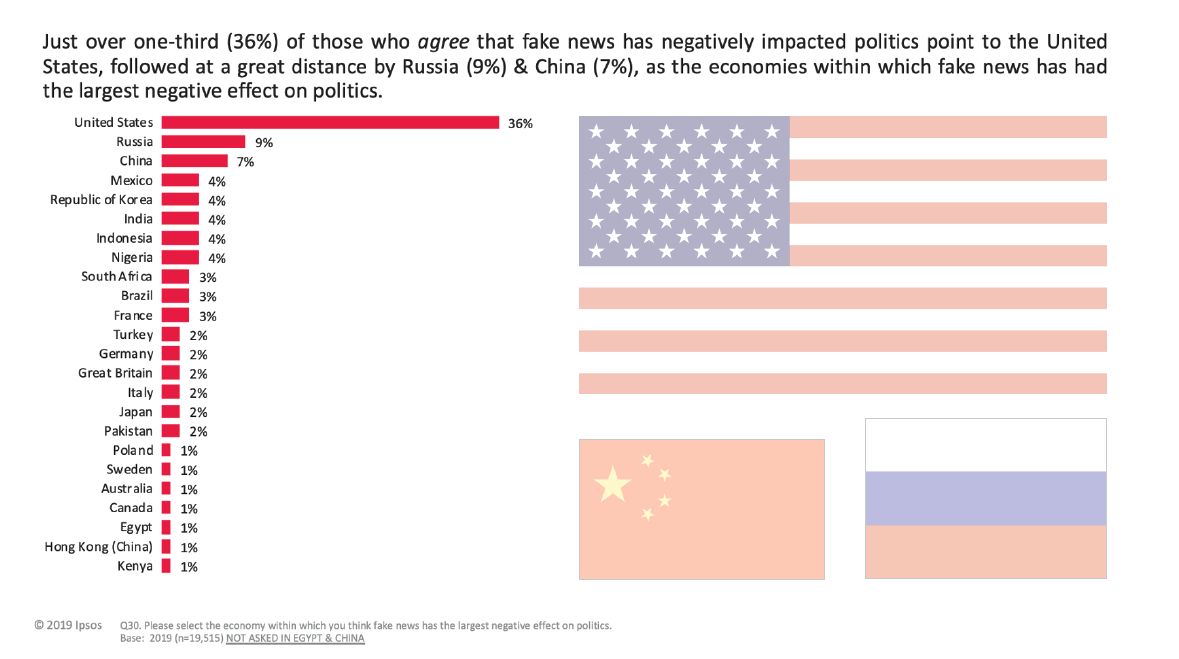
Just like wealth, education, and healthcare, pseudoscience isn’t evenly distributed; some cultures tolerate it, some generate it, and others distribute it with astounding efficiency. And the world considers the United States a major exporter. In a pre-COVID-19 survey of respondents from twenty-five economies, the United States ranked highest among countries blamed for the “disruptive effect” of misinformation, receiving 35 percent of the vote; Russia received 12 percent and China 9 percent (Ipsos Public Affairs 2019). Public health experts voice similar concerns about misinformation propagated by the United States, warning of a “domino effect” that could spill across borders into hospitals, clinics, and labs worldwide (Mahase 2025). Environmental science shows the same pattern, with reports of American-style climate denial being exported overseas and taken up by far-right politicians seeking to weaken or derail green legislation in the European Union (Horton et al. 2025).
To the rest of the world, then, America is a place where pseudoscience levels up: where anti-vaccine stories become movements, fringe wellness interventions become brands, and anti-science rhetoric becomes ideology. The hypothesis isn’t simply that America is more predisposed to pseudoscience but that America may be better at generating and broadcasting it.
Stress Testing the Perception
But it’s just that: a hypothesis. If we invoke Feynman’s “first rule” and set aside perceptions and optics, what do the data say about the United States being especially prone to pseudoscience? A country with a strong predilection for pseudoscience would presumably have a disproportionately large associated workforce. Yet the labor statistics tell a different story. Consider chiropractic, a vocation unequivocally associated with pseudoscience by any skeptical definition, with an evidence-to-popularity discrepancy as large as I’ve seen for any intervention. There are at least 57,000 chiropractors in the country as of 2024 (Bureau of Labor Statistics 2025)—more than all the McDonald’s and Starbucks stores combined. It’s a lot, to be sure, but it’s only thirty-four chiropractors per 100,000 jobs, the same as Australia and lower than Canada with forty-eight. It’s the same story for homeopathy (Dossett et al. 2016), for which the United States expresses a relative interest similar to that of other developed nations. As for psychic services, Pew Research from 2024 shows 9 percent of Americans “regularly and seriously” use psychics, astrologers, and tarot-card readers, compared to 8 percent in the United Kingdom, 11 percent in Australia, 13 percent in France, and 19–20 percent in Japan, Singapore, and South Korea (Evans et al. 2025; Le 2025). Perhaps supply and demand aren’t clean measures of national predisposition because both are distorted by price, access, insurance coverage, and stigma. Or perhaps the United States’ appetite for pseudoscience merely looks modest because these are just three items in the country’s vast bullshit buffet.
What about interest? Google Trends provides an “interest by region” metric—how prominent a term is within a country’s searches. Several pseudoscientific labels register strongly in the United States but not in a way that makes it appear exceptional. America ranks first in detox searches, meaning the term accounts for a larger share of searches there than anywhere else. But it ranks fourth for toxins,1 eighth for chakras, and fifth for healing crystals (for which the United Kingdom, oddly enough, is top).
Even broader measures of “trust in science” undermine public perceptions. In an international survey with nearly 72,000 responses, Viktoria Cologna and colleagues (2025) constructed a trust-in-science index, where 1 indicates very low trust and 5 indicates very high trust. The United States scored 3.86, above the global average of 3.62 and in the same neighborhood as the United Kingdom (3.82), Canada (3.81), and Australia (3.91). Based on these metrics, it would be disingenuous to describe America as uniquely pseudoscientific or uniquely distrustful of mainstream science.
The Divided States of America
My doctoral supervisor was a committed proponent of the scientific method. He was also patient, exacting, and impossibly attentive to small things. He had a line for moments like this: “The devil is in the detail, Nick.” On first pass, the numbers above are unremarkable, other than contradicting a stubborn public intuition. But the devil is in the detail; averages are seductively misleading because they conceal inconvenient truths. Politicians and many researchers love them for this reason; you can hoist an average in the air and parade it around like a champion gladiator, hoping nobody will examine what’s going on behind the pageantry. Two countries can be nothing alike—one packed with moderates, the other carved into multiple extremes—and still share the same average.
This “bimodality” is precisely what we see in the United States. The country isn’t uniformly more pseudoscientific, as the data above will attest. But among developed nations, it’s uniquely divided. These political, religious, and socioeconomic divisions shape values, beliefs, and the ways people interpret expertise (Cologna et al. 2025).
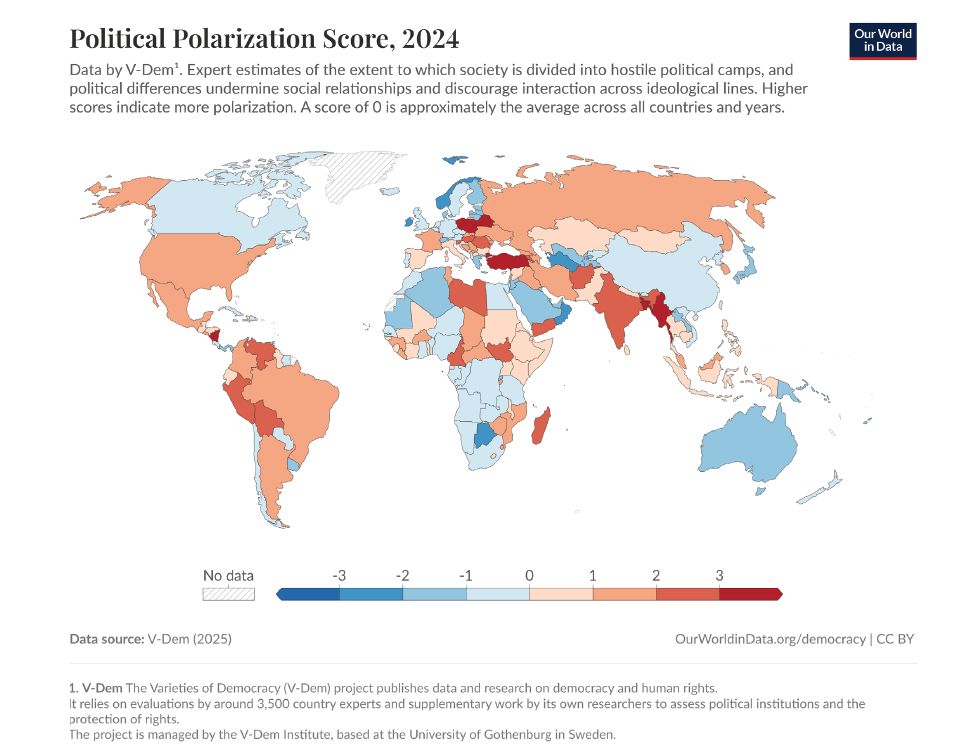
Take political division, for example. According to the V-Dem political polarization index—an expert-coded scale from -4 (low polarization) to +4 (high polarization) that captures how far a society is fractured into hostile camps—the United States exhibits more intense political division than most high-income nations. The United States ranks twenty-eighth worldwide, with a polarization score of +1.79. That’s higher than Canada (−0.39), the United Kingdom (−0.24), China (-0.1), Russia (+1.44), and Brazil (+1.69), and it soars over the European average of +0.23. What’s striking is the recency of the shift: 2008 was the hinge point, when the United States moved from below zero (predominantly neutral) to above zero (divided).
While trust in science is skewed liberal (Kennedy and Kikuchi 2026), the problem is bipartisan. Neither side holds a monopoly on science denial or conspiracy thinking; it’s just that the left and right favor different falsehoods (Enders et al. 2023). The right tends to oppose climate policies (favoring fossil fuels), public health measures, and vaccines (especially post-COVID-19), and they have lower trust in scientists and experts. The left, by contrast, exhibits greater moralized “naturalness,” encompassing detox culture, moral panic surrounding chemicals, and a preference for “natural” remedies that can extend to vaccine hesitancy and GMO opposition, where beliefs converge with the right. Move far enough in either direction, and science and reason become the enemy.
Adding complexity, it’s not simply a left-versus-right issue. Compared with citizens of peer high-income countries, Americans remain unusually religious; more Americans are likely to say religion is “very important” in their lives (Fahmy 2018). But it’s also increasingly divided on religious opinion, with a growing number of young people religiously unaffiliated, precipitating an age gap in religiosity that’s never been wider (Smith 2025). Economically, too, the United States is an outlier. On the Gini coefficient of income inequality, America ranks seventy-fifth among 206 countries—higher (worse) than the United Kingdom, Germany, France, Sweden, Canada, Australia, Japan, Switzerland, the Netherlands, Norway, and Denmark, among others (World Population Review 2026). These political, religious, and economic divides do more than sort people into distinct voting blocs; they independently predict conspiracy beliefs and trust in scientists (Kennedy and Kikuchi 2026; Frenken et al. 2023; Wellcome Global Monitor 2018).
So, while Americans aren’t uniquely credulous, they are uniquely divided—into ever finer shards of a shattered Venn diagram, each with its own information ecosystem, values, authorities, identity labels, and institutional trust. Division is an ideal growth medium for bad ideas. Pseudoscience thrives in the United States because of its multiple isolated subgroups, each reinforced by shared identity, insulated from corrective messaging, and easy to target and manipulate for profit or power. This isn’t the United States of Pseudoscience; it’s the Divided States of America.
Markets, Memes, and Misinformation
Is it plausible that a few overlapping subgroups can propagate a country’s worth of pseudoscience? They may be numerically small, but in a system designed to monetize attention, they can exert disproportionate influence. Capitalism is the first ingredient. In spring 1792, after a financial scare spooked the public into pulling money from the banks, twenty-four New York stockbrokers met, supposedly under a buttonwood tree on Wall Street, and drafted the Buttonwood Agreement: a pact designed to bring order to a noisy, reputation-driven trade. By establishing common terms and restricting dealings to known parties, it helped secure the market and restore public trust.
That modest agreement foreshadowed America’s modern capitalist machine—one that, by many measures, outperforms its peers. That system rewards competition and productivity, strengthens the economy, and raises living standards for many. It provides consumers with greater choice and stigmatizes them less for indulging in it. But there’s no such thing as a free lunch; capitalism weakens guardrails against fraud, unsafe products, and misleading advertising. It financially rewards persuasive claims rather than true ones. And wellness markets, for instance, are free to specialize in credence goods—products whose value is hard to verify even after purchase. The best storytellers and the boldest claims tend to prosper in industries where sellers can stack the deck (like Tarot reading). Capitalism doesn’t create pseudoscience, but it reliably creates the conditions that allow it to thrive.
Just as important is what capitalism did for export. Rules, contracts, and commissions lower the costs (and risks) of doing business with strangers, allowing markets to expand beyond face-to-face interactions. Over time, American commerce moved abroad with newfound confidence. The New York Stock Exchange now lists hundreds of international firms across dozens of countries, and capital crosses borders in the time it takes for a screen to refresh. We live in what Kenichi Ohmae called a “borderless world”—a global economy with the free flow of goods. And a system as powerful as America’s, which can scale and export markets, can do the same with values and ideas, including bad ones.
This brings us to the second ingredient: bad ideas spread fast. Pseudoscience succeeds because it satisfies human appetites—certainty, outrage, hope, and tribal loyalty. It compresses the complexity of vaccines, climate change, and the pursuit of wellness into a series of simple, shareable stories and memes. And in today’s attention economy, those ideas spread like cultural contagions: replicating fast and moving at the speed of light through a frictionless ether that rewards novelty over nuance. It’s why fake news reaches up to 100 times as many people as the truth in every category (Vosoughi et al. 2018). Reality, by contrast, tends to be cautious, technical, and slow; a lie will travel twice around the world before the truth has tied its shoes. In our borderless world, digital networks have done for pseudoscience what shipping lanes and air travel once did for bacon, bread, and beaver skins.
The Counter Export
The good news is that the United States isn’t just spreading pseudoscientific narratives internationally; it’s also deployed the single most influential effort to combat them. In 1976, amid rising public fascination with mysticism, UFOs, conspiracies, and the paranormal, philosopher Paul Kurtz convened a Suicide Squad of scientists and thinkers to apply the tools of inquiry to extraordinary claims. Alongside Asimov were the often imitated, never duplicated Carl Sagan, James “The Amazing” Randi, and the formidable skeptic trio of Skinner, Gardner, and Hyman. They stood together against a deluge of nonsense—the “growing strain” that threatened America’s place in the global knowledge economy. Over the decades, as spoon bending and séances gave way to wellness grifts and algorithmic misinformation, the Committee for the Scientific Investigation of Claims of the Paranormal (CSICOP), evolved into the Committee for Skeptical Inquiry (CSI) to meet society’s growing need for skepticism in a digital age. And if America exports pseudoscience, it also exports some of its loudest correctives: a long roster of tireless skeptics and science communicators.
As we mark the organization’s fiftieth anniversary, it’s easy to feel dejected at the current state of pseudoscience in America and beyond. But the more useful question is the counterfactual: What would the landscape look like without the past fifty years of organized skepticism—without the scientists, writers, investigators, and educators doing the often thankless work; without the founding visionaries and the generations of skeptics they inspired? Because while misinformation is emboldened by every baseless claim, every quack remedy, and every piece of divisive public-health legislation, so too is the countermovement; we grow stronger with every seed of doubt, every myth debunked, and every new skeptic willing to stare down the cult of ignorance.
Note
Zambia tops the list. Their interest isn’t driven by a thriving detox economy but rather by catastrophe; almost a century of unregulated mining and smelting has left Kabwe, the capital of Zambia’s Central Province, with some of the world’s worst lead contamination.
References
Asimov, Isaac. 1980. A cult of ignorance. Newsweek (January 21): 19.
———. 1987. Past, Present, and Future. Buffalo, NY: Prometheus Books.
Bureau of Labor Statistics. 2025. Occupational projections and worker characteristics. Online at https://www.bls.gov/emp/tables/occupational-projections-and-characteristics.htm.
Cologna, Viktoria, Niels G. Mede, Sebastian Berger, et al. 2025. Trust in scientists and their role in society across 68 countries. Nature Human Behaviour 9(4): 713–730.
Dossett, Michelle L., Roger B. Davis, Ted J. Kaptchuk, et al. 2016. Homeopathy use by US adults: Results of a national survey. American Journal of Public Health 106(4): 743–745.
Enders, Adam, Christina Farhart, Joanne Miller, et al. 2023. Are republicans and conservatives more likely to believe conspiracy theories? Political Behavior 45(4): 2001–2024.
Evans, Jonathan, Kirsten Lesage, William Miner, et al. 2025. Believing in spirits and life after death is common around the world. Pew Research Center (May 6). Online at https://www.pewresearch.org/religion/2025/05/06/believing-in-spirits-and-life-after-death-is-common-around-the-world/.
Fahmy, Dalia. 2018. Americans are far more religious than adults in other wealthy nations. Pew Research Center (July 31). Online at https://www.pewresearch.org/short-reads/2018/07/31/americans-are-far-more-religious-than-adults-in-other-wealthy-nations/.
Frenken, Marius, Michał Bilewicz, and Roland Imhoff. 2023. On the relation between religiosity and the endorsement of conspiracy theories: The role of political orientation. Political Psychology 44(1): 139–156.
Horton, Helena, Sam Bright, and Clare Carlile. 2025. Revealed: US climate denial group working with European far-right parties. The Guardian (January 22).
Ipsos Public Affairs. 2019. 2019 CIGI-Ipsos Global Survey – Part 3 Social Media, Fake News & Algorithms. Online at https://www.cigionline.org/sites/default/files/documents/2019%20CIGI-Ipsos%20Global%20Survey%20-%20Part%203%20Social%20Media%2C%20Fake%20News%20%26%20Algorithms.pdf.
Kennedy, Brian, and Emma Kikuchi. 2026. Do Americans think the country is losing or gaining ground in science? Pew Research (January 15). Online at https://www.pewresearch.org/science/2026/01/15/do-americans-think-the-country-is-losing-or-gaining-ground-in-science/.
Le, Valerie. 2025. Psychic Services in the US Industry Analysis. Online at https://www.ibisworld.com/united-states/industry/psychic-services/4413/.
Mahase, Elisabeth. 2025. US vaccine misinformation is having “frightening” ripple effect in Europe, leaders warn. British Medical Journal 391: r2167.
Our World in Data. 2025. Data: Political polarization score—V-Dem. Online at https://ourworldindata.org/grapher/political-polarization-score.
Smith, Gregory A. 2025. Religion holds steady in America. Pew Research Center (December 8). Online at https://www.pewresearch.org/religion/2025/12/08/religion-holds-steady-in-america/.
Vosoughi, S., D. Roy, and S. Aral. 2018. The spread of true and false news online. Science 359(6380): 1146–1151.
Wellcome Global Monitor. 2018. Chapter 3: Trust in science and health professionals. Online at https://wellcome.org/insights/reports/wellcome-global-monitor/2018/chapter-3-trust-science-and-health-professionals.
World Population Review. 2026. Wealth Inequality by Country 2026. Online at https://worldpopulationreview.com/country-rankings/wealth-inequality-by-country.
[ad_2]
Source link
