
[ad_1]
In one of the scariest moments in modern history, we're doing our best at ScheerPost to pierce the fog of lies that conceal it but we need some help to pay our writers and staff. Please consider a tax-deductible donation.
Joshua Scheer
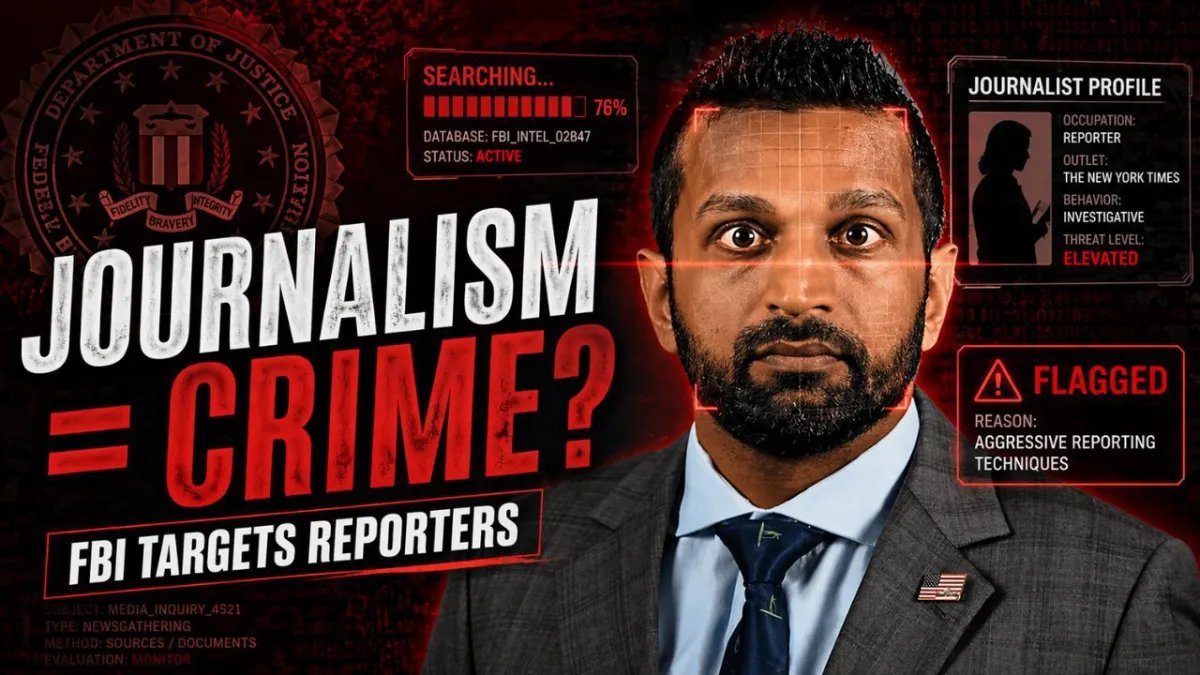
The Associated Press has surfaced yet another episode in the ongoing normalization of federal power being turned inward—this time aimed not at activists, whistleblowers, or dissidents, but at a reporter doing her job. According to the AP’s account, The New York Times learned that the FBI opened an inquiry into whether Times reporter Elizabeth Williamson had violated “laws against stalking” after she published a February story examining the use of federal agents assigned to protect and chauffeur FBI Director Kash Patel’s girlfriend, country singer Alexis Wilkins.
Let’s pause on that. A reporter investigates the use of federal resources for personal benefit—a classic accountability story—and the response inside the nation’s top law‑enforcement agency is to search federal databases for information on the journalist herself. The Times’ executive editor called it “alarming,” “unconstitutional,” and “wrong.” Those are unusually blunt words from an institution that rarely breaks decorum unless something has gone seriously off the rails.
The AP notes that FBI agents interviewed Wilkins after she expressed concern about a death threat she received following publication of the story. But the key detail is what happened next: internal recommendations to “pursue it further” were reportedly blocked by the Justice Department. In other words, someone inside the FBI believed a reporter’s routine newsgathering warranted criminal scrutiny.
This is not an isolated data point. As the AP also reports, Patel recently filed a $250 million defamation lawsuit against The Atlantic over reporting he disliked. The pattern is familiar: public officials using the machinery of the state—or the threat of litigation—to chill scrutiny. What’s new is the brazenness.
And this isn’t the first time Kash Patel’s FBI has turned its power against the press. As the Committee to Protect Journalists documented earlier this year, federal agents raided the home of Washington Post reporter Hannah Natanson, seizing her electronic devices in what press‑freedom groups called an extraordinary and legally dubious intrusion. More than 30 civil‑liberties and media organizations condemned the search, warning that such an aggressive move against a journalist is “exceedingly rare” and demands immediate transparency. A separate coalition letter urged Attorney General Pamela Bondi and Patel to halt all investigations tied to Natanson’s reporting until the legal basis for the raid is made public. Taken together, these episodes form a pattern: the nation’s top law‑enforcement office repeatedly reaching for tools of state power when confronted with reporting it does not like.
Also “On Tuesday, a federal judge in Houston dismissed a lawsuit by Patel against former FBI official Frank Figliuzzi, who joked during an appearance on MS NOW that Patel spent more time in nightclubs than at the bureau’s headquarters.”
Williamson’s original reporting focused on the use of four federal agents assigned full‑time to Wilkins, ferrying her to appearances in Britain, Illinois, and Nashville. Whether one sees that as a misuse of government resources or a legitimate security measure is a matter of public debate. But the right to investigate it is not.
When the FBI treats “aggressive reporting techniques” as potential criminal conduct, it signals a shift in posture: journalism becomes a threat vector, not a democratic safeguard. And when that instinct emerges from the office of the FBI director himself, the implications extend far beyond one reporter, one article, or one celebrity relationship.
The AP story ends with uncertainty about whether the Times has any recourse beyond asking an inspector general to review the matter. That ambiguity is the real warning. If the only check on federal overreach is whether someone inside the government decides to pump the brakes, then the First Amendment becomes a courtesy, not a guarantee.
Of course, this country isn’t yet killing journalists or targeting them with the brazenness seen elsewhere, but look at our partner in what many fear could become World War III—Israel, where such abuses have been widely documented. The writing is on the wall about where this trajectory leads.
The pattern is unmistakable. as we have reported journalists in Gaza and Lebanon are being killed “at a pace and scale that should shock the conscience of the world,” with CPJ identifying cases that appear to be deliberate targeting, not battlefield accidents. The article cites CPJ’s finding that Israel was responsible for roughly two‑thirds of all journalist killings worldwide in 2025, including 47 reporters “killed specifically because of their work.” These are not abstractions but named individuals—local reporters who became the world’s only witnesses once foreign media were barred. The report describes journalists being “identified, tracked, and struck,” sometimes by precision drones, and emphasizes that no one has been held accountable for any of these killings. This documented record of targeting and impunity is exactly why comparisons matter: it shows how quickly the line between press scrutiny and state retaliation can erode.
If this is the direction the United States is drifting—toward surveillance of reporters, raids on journalists’ homes, and the quiet criminalization of routine newsgathering—then we should look closely at what has already happened to our closest military partner. The CPJ data, the names, the patterns of targeting in Gaza and Lebanon: they are not distant tragedies. They are warnings. They show what becomes possible when governments discover they can silence witnesses without consequence.
But this trajectory is not inevitable. There are things people can do—things that matter.
We can support the organizations documenting these abuses, from CPJ to local press‑freedom groups that fight every day to keep journalists safe. We can demand that Congress strengthen shield laws, restrict the government’s ability to seize reporters’ devices, and require full transparency whenever federal agencies investigate members of the press. We can refuse to let targeted killings abroad or retaliatory investigations at home fade into the background noise of endless crises. And we can support independent outlets—those not owned by billionaires or captured by political interests—because without them, the truth becomes whatever the powerful say it is.
The stakes are not abstract. When journalists are targeted, democracy is targeted. When the press becomes a threat to be managed rather than a check on power, the public loses its last line of defense. The writing is on the wall, yes—but it is not yet carved in stone. What happens next depends on whether people treat these warnings as distant tragedies or as the early chapters of a story they still have the power to change.
Editor’s Note: At a moment when the once vaunted model of responsible journalism is overwhelmingly the play thing of self-serving billionaires and their corporate scribes, alternatives of integrity are desperately needed, and ScheerPost is one of them. Please support our independent journalism by contributing to our online donation platform, Network for Good, or send a check to our new PO Box. We can’t thank you enough, and promise to keep bringing you this kind of vital news.
You can also make a donation to our PayPal or subscribe to our Patreon.
Please share this story and help us grow our network!
[ad_2]
Source link
