
[ad_1]
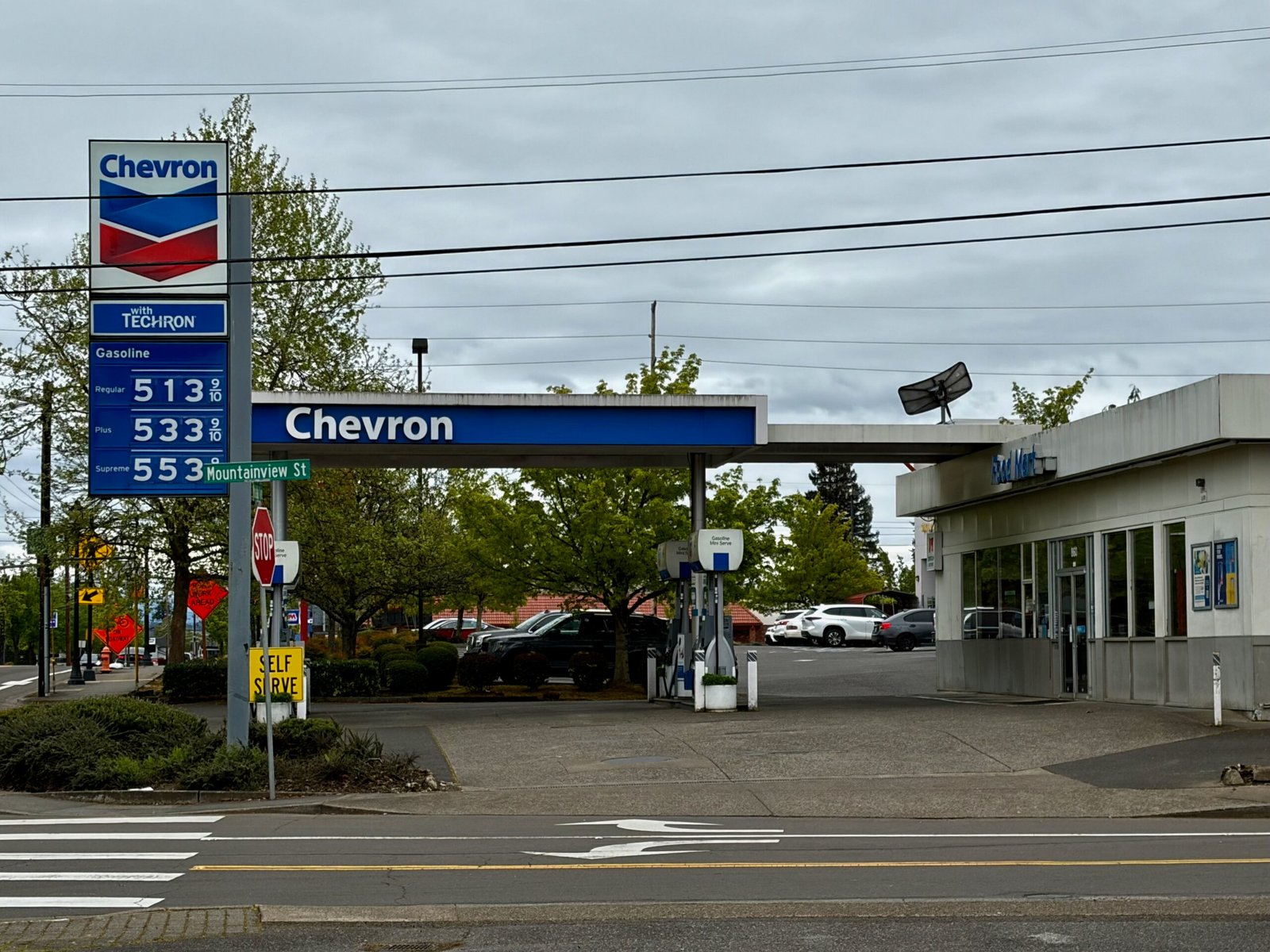
Chevron station, Portland metro area, mid-April, 2026. Photo: Jeffrey St. Clair.
The market for oil is global, which is why events like the war in Iran affect oil prices – and prices of the wide range of products made from oil – literally everywhere. Federal data shows that the price at the primary crude oil hub in the U.S. was US$66 a barrel in late February 2026 – before the U.S. and Israel attacked Iran – and $101 a barrel on April 13. Similar price increases have reverberated around the globe.
As an energy economist and an international trade economist, we field a lot of questions during such episodes, because when oil prices go up, manufacturers, businesses and ultimately consumers pay more.
Some basic economics
Crude oil may be the most important commodity in the global economic system.
It’s a literal fuel for the industrial economy. It powers the engines that drive transportation and paves the roads vehicles drive on. It’s a source for plastics from which the world’s products get made and packaged, and a key ingredient at some point in almost every supply chain. Even fertilizers that boost the food supply are made from it. In short, it is difficult to imagine modern life without oil and its derivatives.
And when its supply changes, its price changes. Economists explain this using a fundamental model of our field: the supply-demand diagram. When there’s less of something to go around, competition among consumers who want it and companies that need it can drive the price up.

Matthew E. Oliver and Tibor Besedeš, CC BY-NC-ND
Sometimes this process can play out over time, allowing people to adjust their purchasing or activities to dampen price shocks. But when a significant source of the world’s oil is effectively blocked without much advance notice, such as when the the U.S. and Israeli attacks on Iran closed the Strait of Hormuz, prices can rise sharply in a short period of time.
A natural question many people ask when oil prices spike is: Where does all that additional money go, and who benefits from it?
Some people have written entire books dissecting all the places that money goes when it leaves consumers’ pockets. But ultimately, the bulk of the money heads in the direction of the source of the oil itself – the oil companies.
What they do with the money varies widely, depending on where in the world an oil company is operating and who owns it. What also matters is the business environment – the set of laws and regulations – in which the company operates.
Middle East faces danger
Oil producers in the Middle East face significant new risk because of the war in Iran, including threats to production, processing locations and shipping routes. These risks raise their costs for insurance, security and transportation.
But production costs in the region are relatively low, so higher global oil prices typically still translate into strong profits.
For a major exporter such as Saudi Arabia, the government owns and controls nearly all oil production, so high prices generally benefit the government’s finances and investments, even during a war. In Saudi Arabia, oil revenue has historically been used to fund public spending.
West Texas gets a windfall
The Permian Basin, the largest oil field in the U.S., is a long way from the Persian Gulf. When global oil prices rise because of the war in Iran, oil companies operating in West Texas effectively get a windfall gain: Prices rise more quickly than costs, at least in the short run.
The immediate effect is more income from higher prices. The money largely goes to company owners – meaning shareholders – through dividends, debt reduction, company-backed purchases of its own stock, and reinvestment in drilling and production. Over time, companies may decide to spend some of that windfall on building more production capacity or pipelines to get more oil and gas to market.
North Sea boosts government revenue
In the North Sea, between the island of Great Britain and Scandinavia, a mix of multinational and government-owned companies produce most of the oil.
In the U.K., private shareholders are the primary beneficiaries of higher profits from increased oil prices, though an additional tax on oil and gas companies’ profits means the government also collects a significant share of the money, which it uses to help pay public expenses.
In Norway, oil revenues flow into the Government Pension Fund Global, the world’s largest sovereign wealth fund, valued at over $2 trillion. Laws govern how much, and for what purposes, money can be withdrawn from the fund, supporting public spending and preserving wealth for future generations. This is a similar model to Alaska’s state-owned program, funded by oil revenue, that pays for government services and sends an annual dividend to every permanent resident.
Russian oligarchs get rich
Russian oil is subject to stringent economic sanctions imposed by major industrial countries as a response to the Russian invasion and occupation of parts of Ukraine. While the U.S. cannot control how much Russia charges for its oil, it can control services needed to move Russian oil around the world. Under current price sanctions, Western shipping, insurance and financing can be used to ship and sell Russian crude oil only if the price is below $60 per barrel.
Russia’s oil industry is dominated by government-controlled companies whose leaders maintain close ties to President Vladimir Putin. The dealings of those shadowy figures are often shrouded in secrecy, but it is likely that they and Putin’s military-industrial complex – not the Russian people – are the main beneficiaries of high oil prices.
What this means for you
Everyday U.S. consumers may not like the idea of their hard-earned cash going into the already deep pockets of any of these groups. But in the short run, there’s not much to do but pay the price. For the long run, however, people around the world are already thinking and talking about, and opting for, sources of energy that don’t depend on fossil fuels.
This article is republished from The Conversation under a Creative Commons license. Read the original article.
[ad_2]
Source link
