
[ad_1]
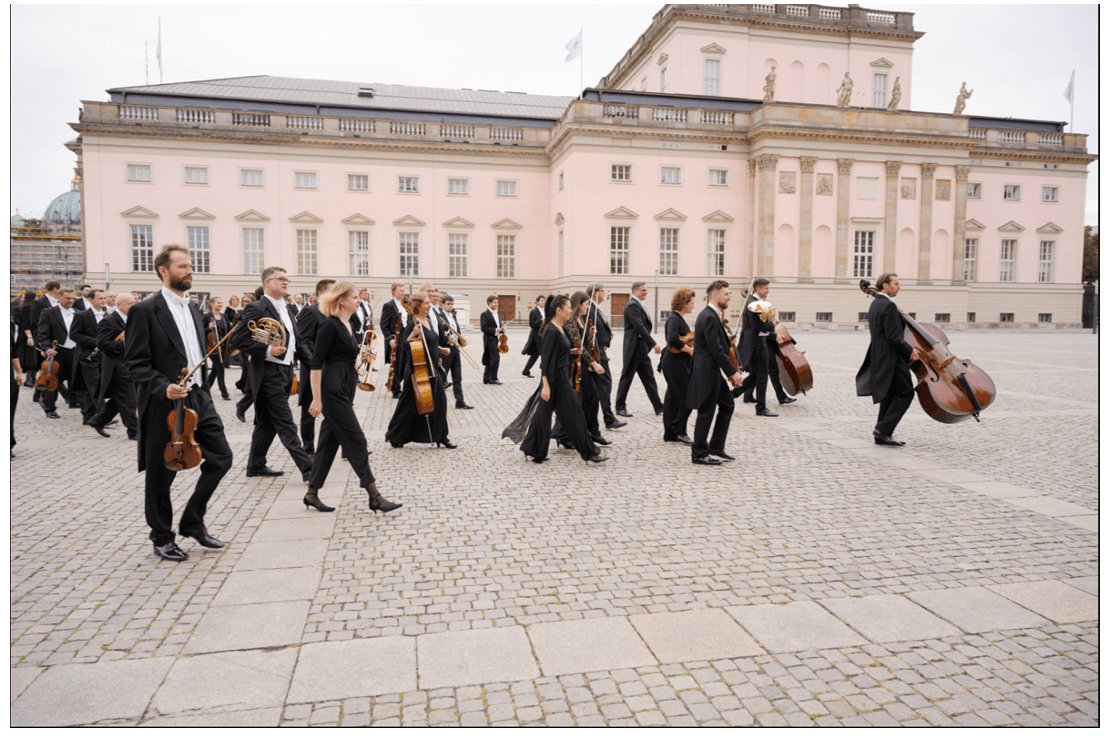
Staatskapelle Berlin. Photo: Peter Adamik.
The Pierre Boulez Saal in central Berlin, which opened in 2017, hosts concerts with music and ideas from the ancient to the modern. Designed by Frank Gehry, the hall forsakes right angles and rigidity in favor of curves and adaptability. The interior’s oval shape has the dimensions of a spacious 18th-century royal chapel, the kind of space in which music of all kinds can flourish acoustically, visually, and socially. The musicians play on the ground floor close to the half dozen steeply raked rows of seats and can be eavesdropped on and spied on from almost directly above by those in the gently undulating balcony. The arrangement of chamber groups, soloists, orchestras, choirs, and dancers is not fixed but can be radically rearranged, even in the course of a single concert, and adjusted as if one were in a large living room or an elegant salon of grand proportions.
The hall is named after the celebrated composer Pierre Boulez, whose photographic portrait, etched with wrinkles leavened by the hint of a grin, welcomes concertgoers, if inscrutably, in the foyer. Boulez conducted many legendary performances at the adjacent Berlin State Opera. The building containing the new concert hall formerly stored the sets and costumes for the opera, but now, besides the Boulez Saal, it is home to the Barenboim-Said-Akademie, a music school that offers nearly a hundred places to students from the Middle East and North Africa.
Many of those students were present—gratis—among the mostly gray-haired audience this past Wednesday evening for a concert presented by the Staatskapelle (the Orchestra of the State Opera). Two of the four works on the program explored the cross-pollination of Turkish and European music, though that distinction was and is often a cumbersome, not to say arbitrary, one.
Music has long been crucial to military morale and organization, from Istanbul to London. The elite troops of the Ottoman army, the janissaries, were initially made up of Christians converted to Islam. Their bands were often at the center of the battle, inspiring courage in their own troops and terror in the enemy. The Ottoman sultans were feared and admired, fought against and allied with by European monarchs in their endless wars against each other. Turkish shawms and drums made their way into Western instrumental arsenals. The Saxon Elector, August the Strong, who was also King in Poland in the first decades of the 18th century, had a janissary band as well as one of the finest “European” orchestras on the continent.
A 14th-century miniature now in the Topkapi Palace Museum in Istanbul depicts a janissary ensemble of trumpets, bass drum, kettledrum, and cymbals. This is essentially the percussion contingent Mozart introduced into his orchestra for the 1782 Singspiel, Die Entführung aus dem Serail (The Abduction from the Seraglio), to add topical and geographical spice to a tale which ultimately seeks to foster understanding between cultures. Wednesday’s Boulez Saal program began with the overture to this Orientalist fantasy, a triangle joining the janissary instruments and adding its magic to the crisp crash of the cymbal, the thunder of the bass drum, and blasts from the timpani.
Backed by these forces, the oboes, clarinets, and bassoons took on the thrill of “exotic” shawms. Under the direction of the young, commanding Tim Fluch, the talented assistant to the State Opera’s music director, Christian Thielemann, the Staatskapelle played with precision but perhaps too little panache—too much pomp and not enough romp. Like Fluch, the men in the orchestra played in white tie and tails, the women in dark dresses and trousers. Perhaps oversensitive to the close confines of the hall, the conductor seemed more buttoned up musically than his group. I sat a few feet behind the janissary percussionist in this theatre-in-the-oval, and even at close range would have hoped for more thrill and even menace. The conscientious and charismatic Fluch did eventually let the group gather steam and then blow it off in the rushing, syncopated oom-pahs and brass volleys of the rowdy finish.
Carl Maria von Weber’s E-flat Concerto for Clarinet and Orchestra filled out the first half of the program. Tibor Reman, clarinet soloist of the Staatskapelle since 2010, gamboled effortlessly through the fabulous obstacle course of runs and arpeggios traversing his entire range. He spanned the yawning leaps with a winning combination of nonchalance and humor. The magic emanating from his instrument seemed to enchant him and was all the more enthralling for his audience. It was the force of his conjury that seemed occasionally to turn his body toward the orchestra, and those in the audience on the other side of the hall, as if Reman were captivated by Weber’s arabesques and long-held high notes, as much breath as tone. The composer knew how to get a great variety of effects and moods from the still relatively new and quickly evolving instrument. Reman imbued the long operatic lines and recitations with the character of love declarations that lingered in the hall’s wooden interior, then were chased away by Weber’s irrepressible exuberance.
The audience loved Reman, and his colleagues in the orchestra did too, demanding an encore. I don’t know what he played, alone, but I will not forget it. After the Romantic effusions and madcap antics of the Weber, Reman suddenly got serious. An awakening figure that seemed ghosted by Stravinsky’s Rite of Spring wandered tentatively into the serpentine contours and shifting colors, then searched out, at the visionary close, a mystical stillness—a final note so quiet and perfect one could have almost believed it only imagined.
After the intermission came Effaced Figures by young Turkish composer Ege Gür, who avowedly pursues intercultural synthesis in his music. During the pause, the orchestra’s chairs had been turned toward our side of the oval, the conductor’s podium moved as well, so that his back now faced us. In this ruminative work, Gür sought a different sort of stillness than that of Reman’s encore. After a unison was agreed upon, epigrammatic murmurings drifted around an augmented second, a characteristic interval of Turkish music. A sonic landscape emerged, shimmered, expanded, then vanished.
Compared to this poised, even hesitant approach to orchestral sonority and motion, Mozart’s Prague Symphony, which closed the concert, was a sonic kaleidoscope of invention and action, contrapuntal dexterity and thematic contrast. As if emerging from a dream, the orchestra came to life.
Here again, one might have asked for more contrast, more risks, even a greater differentiation between strong and weak notes in the melodic lines. The broader dynamic campaign could have been animated at the granular level.
But what a joy it was to hear this wonderful band just in front of me, seated, as I was, like a king for the symphony’s three movements spreading across some thirty minutes. From my vantage point I could see and hear every expression—both facial and musical: the flash of a half-smile from the riveting first cellist; the conspiratorial looks he exchanged with his stand partner and the first violinist, the violist to his left, and other members of the group; the raised eyebrows of the veteran second violinist, suddenly animated and a decade younger; the resolute nod of the timpanist. Every instrument and player was audible in the miraculous hall, yet the group blended—symphony, as true chamber music. Mozart’s instrumentation did not include the janissary percussion, but after Gür’s explorations and the trendy Turkishisms of the opening overture, European Classicism seemed to free itself from confining geographic and aesthetic borders.
Currently at the Kupferstichkabinett (Print Gallery) at Berlin’s Kulturforum, a mile to the west and running until the end of May, is an exhibition entitled Bosporus Beats: Views of Istanbul from 1500 to 1800. Many of the show’s masterfully executed prints and drawings by skilled Western European artists traffic in clichés, rumors, fears, and Orientalist fantasies. Others embody deep understanding and appreciation. The entrance into Berlin of the Ottoman emissary Achmet Effendi on November 19, 1763, was documented firsthand in the exhibition by leading Berlin artists, especially Daniel Chodowiecki. Turkish musicians are seen throughout the exhibition’s images, as in a drawing—both realistic and romanticizing—of two Turkish violinists by the French artist Jean-Étienne Liotard, who lived in Istanbul between 1738 and 1742. The duo sits facing each other, cross-legged in their big, baggy trousers (salvars).
Next time the Staatskapelle plays in the Boulez Saal, I say ditch the tails and loosen the collars, kick off the patent leather shoes and let the band run.
[ad_2]
Source link
