
[ad_1]
In one of the scariest moments in modern history, we're doing our best at ScheerPost to pierce the fog of lies that conceal it but we need some help to pay our writers and staff. Please consider a tax-deductible donation.
By Dr. Joakim Kulin and Dr. Ekaterina Rhodes , DeSmog.
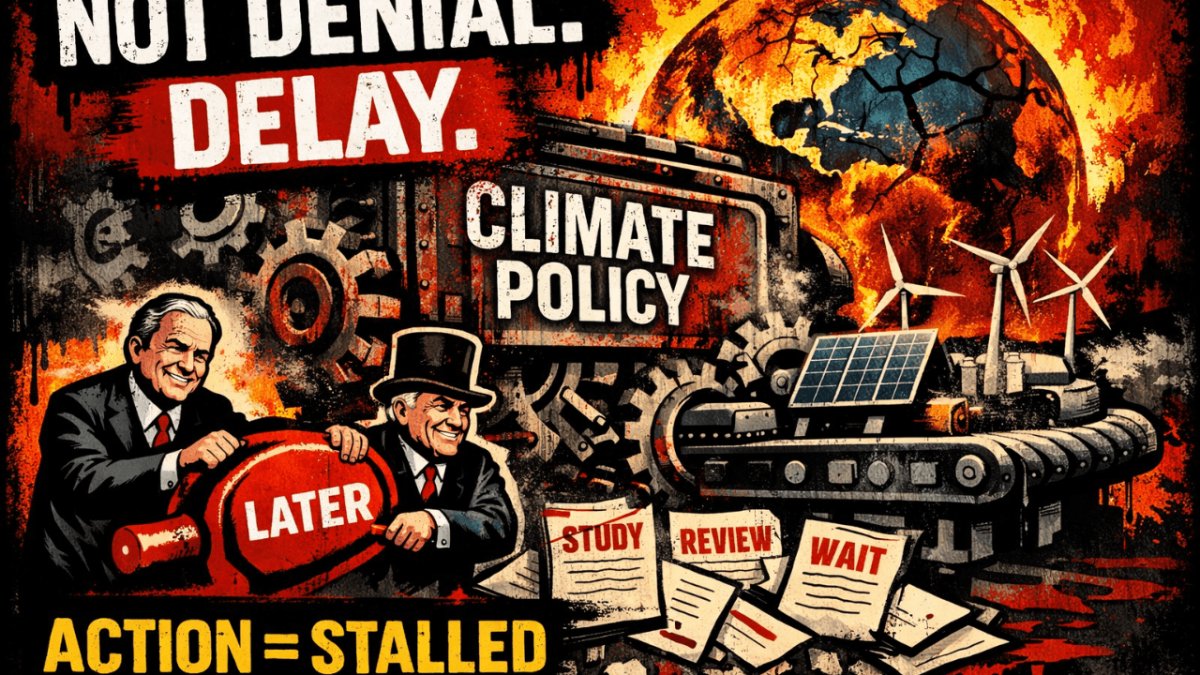
Belief in climate change is rising, but action stalls.
New research reveals how subtle narratives are slowing policy – and how to fight back.
Under Donald Trump’s renewed push to expand fossil fuel production — including plans to ramp up oil and gas drilling and roll back climate regulations — climate politics in the United States is entering a new phase. Although Trump’s climate agenda is very much aligned with outright denial, it has become less central in mainstream climate action debate. Instead, opposition to policies such as carbon pricing, emissions standards, and fossil fuel phaseouts remains strong.
At the same time, the impacts of climate change are becoming harder to ignore. When the devastating wildfires tore through Los Angeles in January 2025, causing over $60 billion in destruction, millions of Americans glimpsed what climate change looks like up close. Across the country — as in many parts of the world — the signs are multiplying: insurers abandoning coastal areas, deadly heatwaves breaking records, and entire communities facing floods or drought. Understandably, the proportion of Americans who believe global warming is happening has increased over time, rising from about 57 percent in 2010 to over 70 percent in recent years, according to the Yale Climate Opinion Map of 2024.
Yet, despite this growing awareness, the politics of climate action remain stuck.
The old strategy of obstructionists — denying climate change outright — has largely lost credibility among scientists and the public at large. The scientific consensus on human-caused climate change is overwhelming, and its impacts are increasingly visible. But the departure of denial has not meant the arrival of decisive action.
Instead, something more subtle has taken its place: climate delay.
Scholars have increasingly warned about this shift. In 2020, William Lamb and colleagues identified a set of arguments that acknowledge climate change but still justify postponing meaningful action. These “discourses of climate delay” include familiar claims that action would hurt the economy, that technology will solve the problem later, or that responsibility lies with someone else.
Building on this framework, we conducted a nationwide survey of more than 1,500 Americans in 2024 to examine how widespread these narratives have become among the public — and how they might shape support for climate policy. Our findings show that large segments of the U.S. public hold beliefs that align with these narratives.
And they are everywhere: in political speeches, cable news debates, and everyday conversations.
Listen closely to climate debates today, and you’ll hear them constantly:
Yes, climate change is real — but why should we act if China doesn’t?
Yes, it’s real — but regulations will hurt ordinary people.
Yes, it’s real — but technology will solve it eventually.
These arguments sound reasonable. Many contain a kernel of truth. But together they add up to the same conclusion: not now.
Our research suggests that some of these narratives are particularly powerful in undermining support for climate policy. And it is not necessarily the most widespread ones that are most problematic.
The most influential narrative is what is often called “whataboutism,” which only about a third of our respondents subscribed to. This argument shifts responsibility for climate change elsewhere — usually toward other nations — while downplaying one’s own emissions. Americans hear it constantly: Why should the United States cut emissions if China is building coal plants? Unless other countries act, why should we?
In our survey, people who agreed with this line of argument were significantly less likely to support climate policies or demand government action.
It’s an argument that resonates politically because it taps into familiar themes of fairness and national competition. But it also misunderstands the nature of global cooperation. If every country waits for someone else to act first, no one moves.
‘No Sticks, Just Carrots’
Another powerful narrative insists that climate policy must rely only on voluntary action — what can be described as “no sticks, just carrots.” Subsidies for clean energy? Fine. But regulations, bans, or carbon taxes? Off the table.
This framing is politically convenient because it allows leaders to appear supportive of climate goals while avoiding the policies most likely to reduce emissions. But it also undermines support for the kinds of measures that actually work — from carbon pricing and emissions standards to restrictions on fossil fuels.
A third potent narrative exploits genuine concerns about fairness. Many people worry that climate policies will raise energy prices or hurt working-class communities. These concerns are understandable and occasionally real, as badly designed policies can indeed impose unfair costs — underscoring the importance of ensuring that the transition away from fossil fuels is fair and equitable.
But when these concerns are used to block climate action entirely or strategically deployed to obstruct it, then they become another form of delay. In our study, framing climate policy primarily as a threat to social justice significantly reduced support for government climate action.
Under Donald Trump’s first term, climate denial was still common. Today, it has been re-energized at the political level — with figures in the current administration engaging with climate denial networks and rolling back environmental protections. At the same time, familiar delay tactics remain central: acknowledging climate change while shifting responsibility to others or downplaying the need for urgent action. The result is not a replacement of denial with delay, but a more dangerous combination of the two — one that risks further entrenching resistance to meaningful climate policy. This helps explain why, even as most Americans now accept that climate change is real, many remain uncertain or divided over the policies needed to address it.
Our survey was conducted in May 2024, in the run-up to the U.S. election and under a different political context, when major climate policies such as the Inflation Reduction Act were still in place, and before a renewed push for fossil fuel expansion. If anything, this suggests that the dynamics we identify may be even more pronounced today.
At the same time, there is also an important distinction between elite rhetoric and public opinion. While political leaders — including the current president — may still promote more overt forms of climate denial, our findings suggest that the broader public is more likely to engage with subtler delay narratives that acknowledge climate change but question the urgency or fairness of acting. This disconnect matters, because it means that even as denial still persists at the top, delay discourses may be more influential in shaping everyday attitudes toward climate policy.
Our results constitute a peculiar political paradox: Many citizens accept the reality of climate change, yet remain skeptical of the policies needed to address it.
How to Fight Back
But our research also points toward solutions.
Not all climate narratives weaken support for policy. In fact, some of the beliefs often associated with climate delay can be reframed to strengthen public demand for action.
One example is technological optimism — the belief that innovation will play a central role in solving climate change. A majority of respondents expressed this view, and they were actually more likely to support climate policies, perhaps because they see public investment as essential to accelerating new technologies.
Similarly, a sense of individual responsibility and convictions that voluntary individual behaviors are key to climate mitigation are widespread views that can reinforce support for collective action. People who believe that mitigation hinges on individuals voluntarily reducing their carbon footprints are also more supportive of climate policy, perhaps because they see government policy as helping society move in the same direction.
These findings offer an important lesson for climate communication.
Too often, climate debates focus on correcting misinformation or presenting more scientific evidence. But the real battle increasingly revolves around narratives — stories about responsibility, fairness, and “what is possible.”
If delay narratives are holding climate policy back, the answer is not simply to rebut them one by one. It is to replace them with more compelling counter-stories.
Instead of allowing delay narratives to dominate the debate, policymakers can emphasize the economic and strategic benefits of leading the clean energy transition. Rather than framing climate policy purely as sacrifice, they can highlight tangible gains — cleaner air, new industries, more secure energy systems, and long-term cost-effective solutions.
When whataboutism enters the debate, we must counter it by reminding people that waiting for others is not a climate strategy but a recipe for paralysis. Countries that have the capacity to act also have a responsibility to do so — not only because leadership can spur others to follow, but because acting now brings tangible national benefits, from lesser oil industry dependence and lower energy bills to renewable industry leadership and greater societal resilience.
And when concerns about fairness arise, governments must address them directly by designing policies that protect vulnerable communities and share the benefits of the transition. At the same time, our research suggests it is just as important to distinguish genuine concerns about fairness from bad-faith arguments that invoke fairness as a pretext for delay.
In other words, how we think and talk about climate action can matter as much as the policies themselves.
Our study shows that certain delay narratives consistently weaken support for climate policy. Identifying them is the first step toward neutralizing their influence.
Because the most dangerous climate argument today is no longer that climate change is a hoax.
It is the quieter claim that action should always come later — after the technology improves, after other countries move first, after someone else solves the problem for us.
But climate change does not wait for political convenience.
And neither can we.
Dr. Joakim Kulin is an associate professor in the Department of Sociology at Umeå University, Sweden. His research mainly focuses on how political ideology and institutional and cultural contexts shape public beliefs and attitudes towards climate change and climate policy.

Dr. Ekaterina Rhodes is an associate professor in the School of Public Administration at the University of Victoria, where she leads research on climate policy design and obstruction. She serves as a lead author on IPCC AR7 WGIII Chapter 5 on enablers and barriers to climate change mitigation.
Editor’s Note: At a moment when the once vaunted model of responsible journalism is overwhelmingly the play thing of self-serving billionaires and their corporate scribes, alternatives of integrity are desperately needed, and ScheerPost is one of them. Please support our independent journalism by contributing to our online donation platform, Network for Good, or send a check to our new PO Box. We can’t thank you enough, and promise to keep bringing you this kind of vital news.
You can also make a donation to our PayPal or subscribe to our Patreon.
Please share this story and help us grow our network!
[ad_2]
Source link
