
[ad_1]
Pakistan has been in the news recently, for reasons that would have seemed improbable a few years ago. It has become an intermediary between the United States and Iran, while also forging new strategic ties with Saudi Arabia and Turkey through the Mecca Defense Pact. Yet for all the attention garnered by its geopolitical moves, Pakistan—the real Pakistan—remains a country about which most Americans know little. To find that Pakistan, you have to go to Karachi.
Karachi is Pakistan’s largest city, its commercial capital, and its busiest port. It is also where the country’s religious minorities are most visible—not just as victims in headlines, but as communities that helped build the city and remain part of its life.
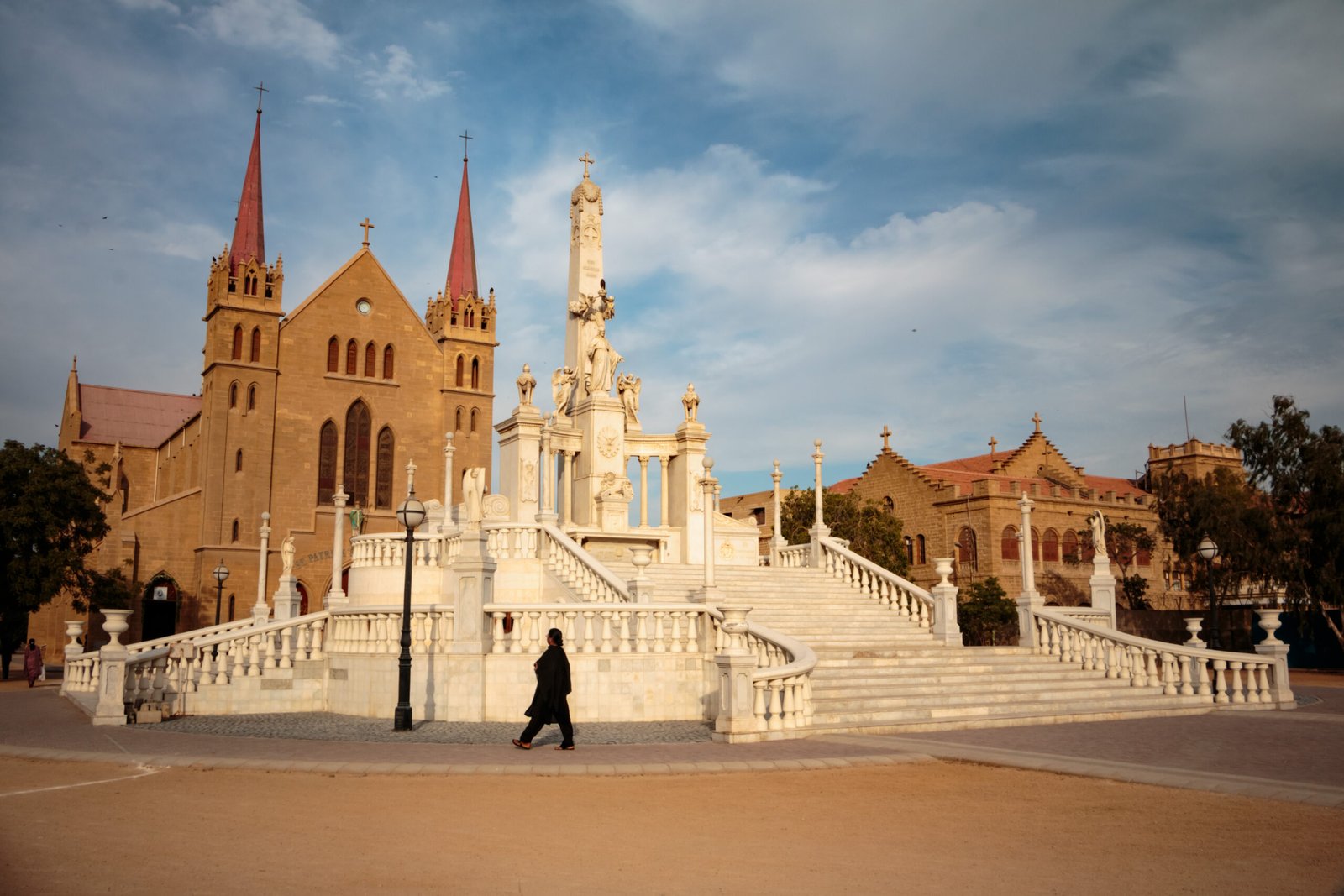
The first thing that struck me on my arrival in Karachi was a building that seemed to belong elsewhere. St. Patrick’s Cathedral rises above Saddar, the downtown area, in warm-colored stone. Its Gothic arches and soaring spires look more like something out of Ireland or England than a building on the Arabian Sea. Completed in 1881, it remains a working Catholic cathedral. Its very presence is a reminder that Karachi’s religious history is more complicated than the image of Pakistan most often conveyed abroad.
Of course, that history should not be romanticized, and the Western picture of Pakistan is not entirely wrong. Christians face occasional mob violence and blasphemy accusations. The Jaranwala attacks of 2023, when mobs torched churches and Christian homes after allegations of blasphemy, were a stark reminder of this reality. Pakistan has strict laws against blasphemy, and Human Rights Watch has documented how these are often exploited for blackmail, extortion, and land grabs (the U.S. Commission on International Religious Freedom has likewise highlighted Pakistan’s blasphemy laws as a major impediment to religious liberty).
But the response to such abuses is also part of the story. After Jaranwala, police arrested the alleged perpetrators and opened criminal cases, although justice is still far from being delivered fully. Pakistan’s then–chief justice, Qazi Faez Isa, personally visited the devastated Christian community.
The response has also become institutional. Pakistan established a national committee to bring together religious leaders, including those of non-Muslim communities, to promote interfaith harmony, counter sectarian and extremist rhetoric, and reinforce constitutional equality. And in December 2025, Field Marshal Asim Munir, Pakistan’s army chief, attended Christmas celebrations at Christ Church in Rawalpindi. Invoking the commitment of Pakistan’s founding father, Muhammad Ali Jinnah, to religious tolerance, Marshal Munir characterized the protection of minority rights as a cornerstone of Pakistani national identity, and praised the contributions of the country’s Christians to national development and security.
None of this means that Pakistan has solved its problems with religious freedom. Arrests, committees, and speeches matter only insofar as they translate into effective protection and fair treatment. Implementation is the test. But the direction of official policy increasingly seems to be toward treating religious minorities not as outsiders, but as full members of the Pakistani nation.
That distinction became much more tangible to me once I left the realm of official statements and encountered Karachi itself.
The history of Christianity in Karachi is inseparable from the city’s transformation from a small port into a commercial center. Scottish Presbyterians established St. Andrew’s Kirk. Goan Catholics from Portuguese India became prominent in professional life as teachers, clerks, lawyers, and doctors.
They built churches and schools. St. Patrick’s High School, founded in 1861, educated generations of students from different faiths, while Holy Family Hospital became a critical part of Karachi’s healthcare system.
But the Christian presence I encountered was not confined to churches and history books. At the Beach Luxury Hotel, an all-Christian Pakistani jazz band provided the music at a French National Day reception organized by the French Consulate General. At one point, a saxophonist delivered a masterful rendition of “La Marseillaise.”
The setting added another layer to the scene. In the 1960s and ’70s, when the city was widely regarded (alongside Beirut) as one of the region’s great hubs of culture and cosmopolitanism, the Beach Luxury was one of the places where Karachi’s famous nightlife unfolded. Some things have changed since then, no doubt, but there was a pleasing continuity.
The jazz band was not appearing as a relic of a vanished past, but as living proof that Pakistani Christians pursue careers, sustain institutions and cultural lives, and have a firm place in the international networks that have long been part of Karachi.
The Christian story becomes even more revealing when considered alongside those of Karachi’s other minorities.
Parsis, or Zoroastrians, arrived early, and built many of the city’s hospitals, schools, houses, and commercial and philanthropic institutions. Jamshed Nusserwanjee Mehta, a Parsi and Karachi’s first elected mayor, helped shape civic and infrastructural initiatives whose influence outlived his time in office. The Parsi community is tiny today—around 3,000 people—but its influence was anything but.
During my visit, I went to Dar-e-Meher, the Zoroastrian fire temple in the heart of Saddar. But my most memorable encounter with Karachi’s Parsis took place not there but at the Parsi Institute, where I was taken into what might be called the inner sanctum of Parsi social life: the communal swimming pool. And I was offered a beer.
It was a wonderfully incongruous moment. Here was a tiny Zoroastrian community, in a city of some 20 million people, maintaining its own institutions and social world with a considerably more relaxed air than the solemn phrase “religious minority” might suggest.
The same principle is visible in Karachi’s Hindu community, whose active temples, such as Swaminarayan Mandir and Panchmukhi Hanuman Mandir and neighborhood networks are additional reminders that the city’s diversity is not merely historical.
Subscribe Today
Get daily emails in your inbox
And then there was Karachi after dark. I spent evenings at the Sindh Club, the grand Raj-era institution established in 1871. One of Asia’s oldest and finest clubs, it was founded for British Army officers, civilian professionals, and other Europeans, and has since evolved into a fully fledged Pakistani institution, while retaining much of its original Victorian character.
Sitting there in the evening, I reflected on a broader political lesson in Karachi’s history. The city’s churches, schools, and temples are monuments not only to religious communities, but also to the movement of people and capital that made the city what it is. Commercial cities create practical incentives for tolerance—not because governments decree it, but because commerce, migration, and everyday economic life require people of different faiths and customs to coexist and cooperate with one another.
The minorities of Karachi are not interlopers or relics, but part of the stubbornly plural fabric of one of the world’s great cities, which—like the nation it anchors—resists easy categorization.
[ad_2]
Source link
