
[ad_1]

Read more from WSJ: The Path to Zero: How the War in Afghanistan Ended
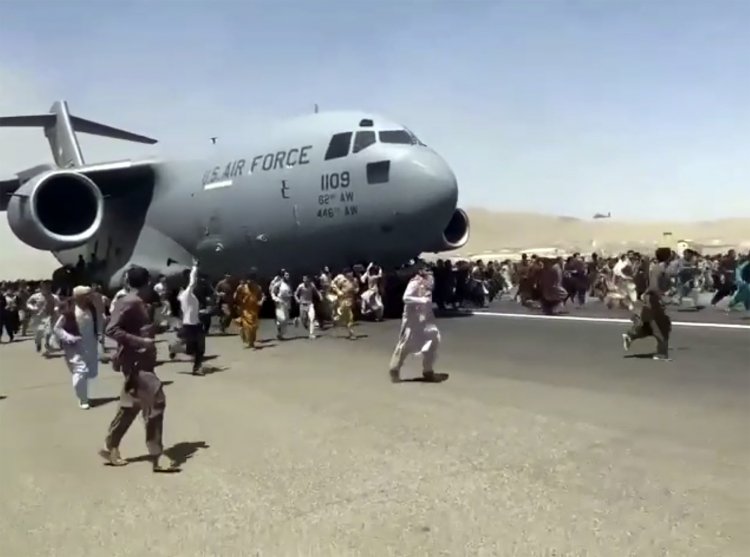
It recounts a chain of strategic and political decisions in August 2021 that culminated in the shocking scenes the world witnessed at Kabul Airport and the bombing of Abbey Gate, where 13 U.S. troops and hundreds of Afghan civilians died as the final American planes left the country and the Taliban retook the capital.
President Biden ordered the military to withdraw completely before September 11, 2021 — 20 years after the 9/11 attacks — while many military officials suggested keeping control of Bagram Airfield.
“I called it the big red blob,” retired Col. Seth Krummrich said about the growth of Taliban control as the U.S. withdrew. “You would watch the tracker. We had the map of Afghanistan up in our operation center, and the Taliban, their front line and their locations were captured in red. And from February, where they had 78 districts, once the announcement goes out, by mid-June they have 100 districts. So moderate growth, but a month later they had 200 districts. It was doubling at this incredible rate. You could walk in the op center and see it. It was this big red blob that was just gobbling up terrain.”
As the Taliban advanced toward the capital, they liberated two prisons and released thousands of fighters, including alleged members of terrorist groups. Retired Rear Admiral Peter Vasley characterized it as “seven or eight thousand of the worst of the worst advancing on Kabul.”
The military asked for a NEO (“noncombatant evacuation operation”) for some who had worked with the U.S., but the State Department delayed, hoping they could keep the embassy open and work with the new government to maintain order.
Vasley says a senior administration official told him in the first week of August: “We’re not going to do a NEO; to do a NEO would be to admit failure.”
The civilian evacuation began August 14 after the Taliban took Kandahar. “The call I got on the morning of the 15th from General Alizai was: My forces have capitulated at the gates. The Taliban have a clear shot into Kabul,” Vasley said.
The Afghan president fled the country, and the Taliban took Kabul later that day. “I was surprised he left so quickly,” Vasley said. “Like get-up-and-walk-out-and-not-tell-anyone quickly.” Kabul fell to the Taliban on August 15, 2021; Abbey Gate was bombed on August 26; the final U.S. military flight departed on August 30.
“A rumor spread around Afghanistan that anyone who could make it to the airport in Kabul could go to the U.S., so there was a rush from the countryside to the airport,” retired ambassador Zalmay Khalilzad said.
Troops describe deciding who could enter and who had to be sent back toward the Taliban. Some Afghans allegedly begged Marines to shoot them rather than turn them away. They also claim to have witnessed some of the people they turned away being beaten or executed.
Multiple Marines allege they witnessed Afghan special forces trained and funded by the CIA, “Zero Units,” “committing atrocities,” including killing civilians with guns and cars, trying to clear the path to the airport for their own families.
“They straight up executed people,” retired Marine Edward Gonzalez says. “I literally saw trucks running over people. I’m not surprised they deny it.”
The documentary says roughly 30,000 of the 124,000 people the U.S. eventually evacuated were Zero Unit members and their families.
During the chaos, reports came in that ISIS-K was planning to attack the airport as U.S. forces scrambled to leave. Raw footage captures confusion, blood, injuries, and chaos in the aftermath of the bombing of the security station at Abbey Gate.
The documentary shifts from geopolitical consequences to the psychological damage suffered by troops forced into impossible moral choices. Veterans explain that their trauma is rooted not simply in danger but in witnessing or participating in actions that violated their morals.
“Moral injury is when you bear witness to, or you’re the perpetrator of, actions that go against your moral compass or a code of values. These guys were just stuck in a moral dilemma the entire time — playing God to people’s lives, choosing whether or not they got rescued or whether they’d take them to the exit and potentially be harmed by the Taliban — it was a lot to put on these guys,” Gonzalez said. “Partnering up with the Taliban, seeing what they would do to the civilians, with the NSU, what they would do to civilians, the fact that we couldn’t actually do anything to prevent that from happening — it was a hard pill to swallow.”
“I just remember coming home and dealing with my own psychological challenges. I just didn’t resonate with PTSD. It didn’t make sense to me. And I started to recognize the same thing was going on with everybody else: the recurring nightmares, this damaged sense of identity,” Operation Allies founder Joseph Laude said. “Upon discovery of moral injury, it was spot-on with exactly everything that I was feeling and what a lot of other people were feeling at the time, too.”
What can you do about moral injury? “The biggest key to it, though, is that our leadership — they need to answer to these things. They need to be held accountable for it. And if not, moral injury just persists, and it can metastasize into mental illnesses or disorders,” Laude said. “We deserve to have our leaders address or talk to us — just simply talk to us about what happened. And maybe, if it’s within them, to seek forgiveness through us. And I think that we’d be more than receptive as a community to go down that path with them.”
“It doesn’t seem like that’s actually happening, though,” he said. “It seems like they turned their back on us. They’ve lived their life, they’re living on, while we’re still here living with what we had to do on their behalf, on their mistakes.”
“Accountability actually decreases the higher up you go,” retired Marine Captain Jonathon Yenny said. “I guess you get further separated from the consequences of your actions. As a company commander, I don’t get the benefit of the doubt were I to have a training operation that was so poorly executed.”
“Let me be clear: All of this happened because we did not make a decision in April to bring out our embassy, our citizens and our at-risk Afghans,” retired Marine Gen. Kenneth McKenzie said. “Let’s be very clear where blame lies for this… It lies with the political leadership that chose to turn a blind eye to the situation in Afghanistan and allow this to boil to a point in August when it became out of control and was beyond the control of any reasonable military capability to impose order on it.”
“I do blame the president,” WSJ’s Paul Gigot said. “This was his decision, and he bears the moral culpability.”
[ad_2]
Source link
