
[ad_1]
The moon occupies a special place in human history’s brilliant constellation of fake news stories. When the first British newspapers appeared in the early 17th century, they had a field day with fantastic stories of extraterrestrial life. Playwright and poet Ben Jonson, who qualifies as the first press critic, wrote the theatrical production “News from the New World Discovered in the Moon.”
In the play, which was performed at Whitehall for King James and assorted aristocrats in 1620, the character of The Printer says, “I’ll give anything for a good copy now, be’t true or false.”
In 1835, the New York Sun took its turn making fake moon history. The Sun, the first penny newspaper designed for a mass audience, reported four-feet-tall man-bats cohabitating the moon with unicorns and beavers that walked on their hindlegs. The stories were subsequently published in a pamphlet that sold 20,000 copies in its first week. Benjamin Day, the Sun’s founder, noted that the hoax “gave the Sun a great impetus.”
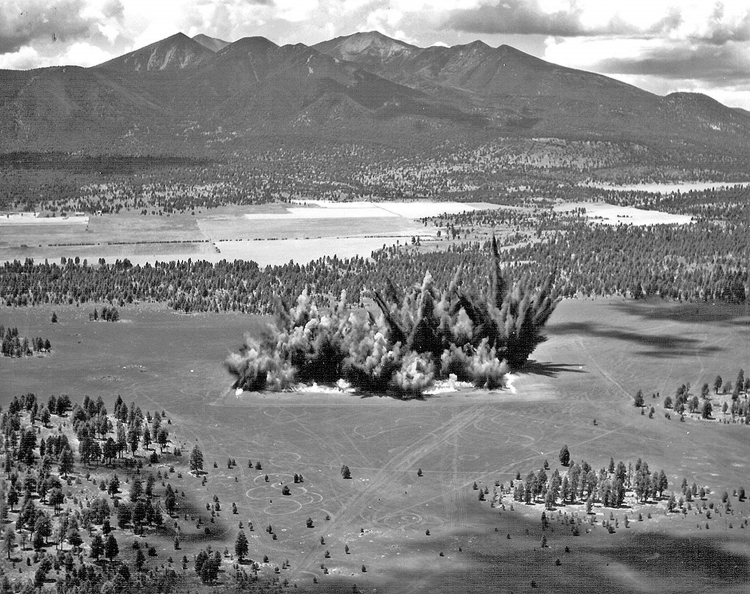
This 1968 photo provided by the U.S. Geological Survey Astrogeology Science Center shows craters being created in a volcanic cinder field east of Flagstaff, Ariz. Astronauts who walked on the moon used the site for training.
U.S. Geological Survey Astrogeology Science Center
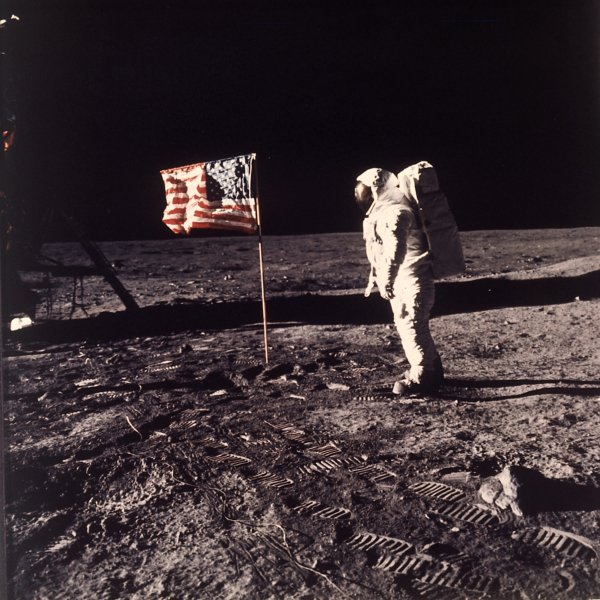
By the 20th century, moon hoaxing had been turned on its head. The fiction now is not about men in the moon. It is that they have never been there. In this iteration, the six astronaut-crewed lunar landings that 600 million people worldwide saw on television in 1969 did not occur.
By the following summer, skeptics began claiming inside knowledge that the lunar “landing” was actually staged in the Arizona desert. The Flat Earth Society claimed Walt Disney staged the landings.
Bill Kaysing, pied piper of these moon landing conspiracy buffs, self-published a pamphlet in 1976 titled “We Never Went to the Moon: America’s Thirty Billion Dollar Swindle.”
Inspired by this tale, Warner Brothers released a star-studded 1978 thriller called “Capricorn One,” that posits a government-faked Mars landing.
As American University professor Howard McCurdy noted, “To some, the thrill of space can’t hold a candle to the thrill of conspiracy.”
The trajectory of moon hoaxes offers several object lessons. The first is that fake news has a long history, the subject of first article in this three-part series on the subject. The second is that we like fakes. They are fun. They entertain us, confirm our prejudices, and offer order in a random world.
At the same time, fake news is corrosive to democracy. Conspiracy theorists thrive when all manner of facts can be called into question. Fake news-produced cynicism and governmental disfunction is the subject of this final column.
The best way to think of political fake news is as a whip for those who seek to drive people to their point of view no matter what the cost to truth. It is a species of propaganda. Like propaganda, it serves the purposes of the fakers – even if they think their goal is good – and not necessarily those who might come to different conclusions if they had the facts.
Each advance in communication technology has brought hope that a bright new age of enlightenment lay around the corner. And each time, new opportunities for adulterating facts emerged. Budding journalists in the mid-1600s said the printing press would “putt all the old Fables out of dores.” But the English Civil War spurred an increase in the number of pamphlets that spat out fake speeches, false atrocities, and over-the-top demonization of opponents. They were called “paper bullets.”
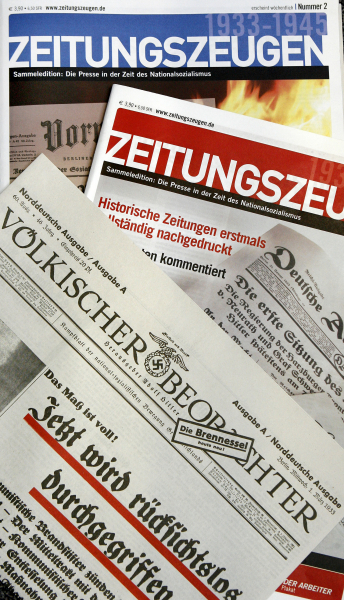
A reproduction of the Nazi newspaper ‘Voelkischer Beobachter’ is seen on two copies of the magazine ‘Zeitungszeugen’ in Berlin, Germany, Thursday, Jan. 22, 2009. (AP Photo/Michael Sohn)
The Royal Society for Improving Natural Knowledge was subsequently formed to reform language. It promoted methodological thinking such as the scientific method. The society took as its motto Nullius in verba, “take nobody’s word for it.” (We know how that turned out. In the early 20th century, propaganda became a science.)
I have been guilty of Pollyanna thinking myself. Thirty years ago, I foresaw news moving to electronic formats and reporting moving increasingly toward people with little journalism training but broader perspectives. I thought it would usher in a Golden Age.
When I made my prediction, profitable mass media – either in print or over the then-Big Three broadcast networks – had enough money for highly professional reporting and codes of ethics to guide how the work was done. I banked on the establishment media remaining as powerful as ever while including new voices. But new technology hobbled the old establishment model.
Low-cost computer-based entities took advertising away from old-line mass media and allowed individuals to seek out the narrow news they wanted, rather than rely on trained editors to give them the broader range of news they needed. Today the networks remain but have fewer evening news viewers. When wildly successful podcaster Joe Rogan hosts moon-landing denier Bart Sibrel on his show, he reaches an audience nearly three times as large as “CBS Evening News,” the onetime legacy media gold standard.
Some newspapers thrive, but hundreds have disappeared, turning one community after another into a news desert.
The values of the oldline media exist but no longer hold sway. A new breed of new media journalists can hew to ethical standards, but the field welcomes pretend journalists who have no interest in checking facts or even in finding them. Their goal is not information. It is disinformation posing as fact-based journalism.
Not long ago New Yorker essayist Stephen Marche looked back nostalgically at the Royal Society’s “take nobody’s word for it” admonition. “I wish,” he wrote, “that motto were inscribed at the top of every smart phone.” But it won’t be, because well-sourced facts are not important to the profitability of social media the way they were to legacy media. Fake news has become a business model because many consumers derive more gratification out of news that confirms their point of view.
On July 4, 1898, the St. Joseph News-Press/Gazette ruefully observed, “These are the days when peddlers of fake news are getting in their works.” It is worse today. In 1898, fake news traveled over information pathways littered with a few fakes. Now, thanks to new technology, fake news travels over information highways that are congested with falsehoods.

View of a business center, believed to be the location of a “troll factory” in St. Petersburg, Russia. Russian bots and trolls are deploying increasingly sophisticated and targeted tools. (AP Photo/Mstyslav Chernov, File)
A recent study in the Proceedings of the National Academy of Sciences reported on the widespread extent of faking in science journals, which should be bastions of the scientific method. Paper mills produce the fake studies for tenure-hungry professors and find ways to circumvent the vetting process. The number of such papers has doubled every 18 months between 2016 and 2020.
Fact-checking organizations can be effective at exposing fakes, but can be turned upside down by those with no interest in truth. Russian propagandists posing as NewsGuard posted a recent video claiming to expose efforts by the Armenian government to tamper with upcoming parliamentary elections. The video said Armenian operatives had secretly visited France to “gain experience in vote manipulation.” The goal was to undermine Armenian democracy by sowing distrust in election results.
Democracy depends on facts. It privileges free speech to ensure that informed opinion shapes decisions. But free speech is also a convenient playground for those who promote falsehoods. The disinformation objective of our foreign adversaries is not to shape specific policies so much as to sow confusion and cynicism. The first pillar to fall in a failed democracy is information.
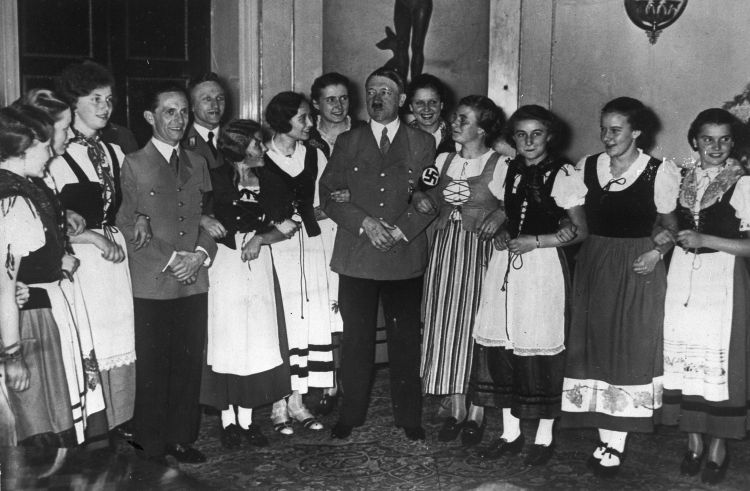
A group of German girls in native costumes are seen with Nazi propaganda minister Dr. Joseph Goebbels, front row, left, and Chancellor Adolph Hitler, center, on Goebbels’ 40th birthday, Oct. 29, 1937. (AP Photo)
“The big joke on democracy,” observed Joseph Goebbels, chief propagandist for Hitler’s Nazi party, “is that it gives its mortal enemies the tools of its own destruction.” If there are no universally accepted facts, there is only power to hold us together.
One of the sinister aspects of hyperactive, technology-driven fake news is that so many of the fakers who take advantage of free speech rights are anonymous. One of the best ways to assess the quality of information is to know the source and its motives. Anonymity removes accountability. Whatever one may think of the weakness of legacy newspapers and broadcast networks, they could not avoid responsibility for the mistakes they made. It is impossible to humiliate a Russian disinformation bot.
Solutions to these problems will be, at best, incremental, as it was in reforms that fenced back patent medicine advertising a century ago. Tackling anonymity is a good place to start. Section 230 of the Communications Decency Act treats Google, Facebook, and other social media as though they are telephone companies, which have no responsibility for what people say to each other on their phones. The difference between the phone companies and social media is that social media reaches millions simultaneously the way traditional mass media do. In recent months Meta, parent company of Facebook, announced it would replace its professional fact checkers with volunteers. If the goal is to minimize fake news, this is the opposite of what needs to happen.
Meanwhile Congress is engaged in finding ways to regulate AI, which is also on a wild ride that can take us over a cliff. Each day we get a new lesson in the ways that AI is put to some evil purpose, not the least dangerous of which is to make up explosive news fakes that rattle our democracy. We urgently need guardrails.
If this three-part series has a single lesson, however, is it that we should not worry only about the fakers. It is we who must take responsibility. We must be able to read news that makes us uncomfortable. When we see a fact that makes us feel good, we should check out the source, and if the fact is supremely important to our point of view, we should see if it is contested and by whom. “Take nobody’s word for it.”
In an epigraph to his book about a fellow faker, Clifford Irving began with a quote from 12th-century pundit Jean Le Malchanceux. It was a joke. The pundit never lived. But his fictional advice is as good as the Royal Society’s: “If fools did not go to market, cracked pots and false wares would not be sold.”
John Maxwell Hamilton, an RCP columnist, is at work on a biography of the journalist-faker William Francis Mannix. His recent book “Manipulating the Masses: Woodrow Wilson and the Birth of American Propaganda” won the Goldsmith Prize.
[ad_2]
Source link
