
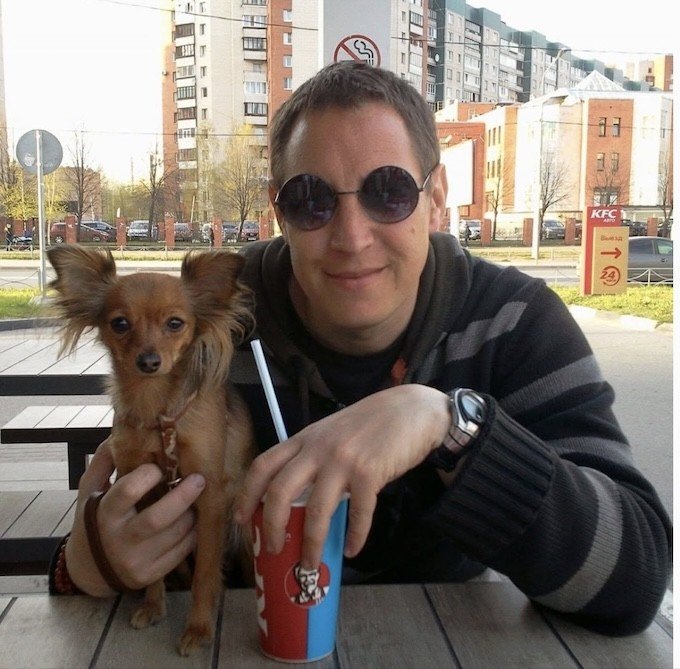
My friend Artem Ivanovich Kirpichenok would not hurt a fly. On 2 August 2026, he arrived in Tel Aviv and – somehow – ended up in prison. What we know is that he was arrested by the Shin Bet, Israel’s secret police. There has been no contact with him since. There has been no official reason for his detention. A historian and writer who is unusually gentle and kind has now disappeared into the Israeli prison system.
Artem was born and lived in St. Petersburg (Russia), although he lived in Israel for fifteen years and graduated from the Hebrew University (Jerusalem). He later took a PhD in History from the Department of Slavic Studies at the Center for Arab-Eurasian Studies. Working as a journalist, Artem wrote for TRT Russian (Turkey) and Caliber (Azerbaijan), where he reported on the Israeli policy toward the Palestinians and on the Israeli war on Gaza. In 2018, Artem travelled to Iran, where he visited several cities and wrote about them on his personal blog.
During the past few days, agitated about Artem, I have taken refuge in literature produced in and about our city of St. Petersburg (when we were born there, it was Leningrad). In March 1901, Maxim Gorky published Song of the Stormy Petrel about an event in the city: students in the city protested over the conscription of their fellow student in Kyiv for a war that no-one wanted; and so, the Tsar’s Cossacks came to attack these students at Kazan Cathedral. The song appeared inside a longer satirical piece called Spring Melodies, which the authorities banned. Spring Melodies is set in a land of birds, where Siskin – a small bird who stands in for the youth – sings this song. Gorky slipped the song out of Spring Melodies and published it in the journal Life. That song was later canonized in the Soviet Union as a great revolutionary song.
I love the accident of it. The most dangerous text of that era slipped by the censors because it pretended to be a harmless little bird song. I never spoke with Artem about this song, but it is impossible to imagine that he would not have – like myself – memorized it and sung it in our Soviet schools.
There are two main characters in the song: the petrel and the penguin. The petrel fights the storm, ‘soars with pride’, and as the wind picks up, perishes, but with its dignity intact. The penguin, on the other hand, ‘hides his fat body among the crags’, and therefore survives the storm. But the storm has other ideas. To rewrite Gorky’s song, we must add in verses that show how the storm now hunts the penguin as well – how there is no escape from the wrath of the storm. Artem Kirpichenok is a charming and impractical man who belonged to no political party and no activist group, who never donated money to any political cause or signed any statement. He published books about history and wrote mostly ironic posts on his personal Facebook page. He was not a penguin (he held strong views on a range of topics), but he was not a petrel either (he did not advertise his views for the wider public).
Impossible not to have a view on Israeli government policy these days, but Artem’s views are not so different than those held by the mainstream Israeli newspaper Haaretz. In which case, the question is what has Artem done and why has he been sitting in a Shin Bet prison without habeas corpus for a week? If Artem had been part of a movement or a public figure, then there would be press releases demanding his release. But he is a private individual. So, who will stand for someone like him?
To arrest Artem is to make private individuals afraid and to make them internalize their penguin-like condition, to shut up, and sit quietly in the corner. Arresting a bespectacled writer with a narrow audience is both easy and makes for a perfectly instructive example. Before Artem was arrested, it seemed to many of us – me included – that there were ‘anomaly zones’ out there: in those anomaly zones, one could be somewhat safe from arbitrary arrest. It was felt that as long as you did not cross certain well understood line, you could write, read, and speak about pretty much anything. Don’t join a party, don’t donate to certain organizations, don’t say certain things. But the lines that seemed to exist have now been erased and what you whisper in your kitchen can now get you into a prison cell.
The everyday curdles into a nightmare. The kitchen and the prison are becoming the same room. We have become like frogs that do not notice that the water in which they are swimming has started to come to a boil. We have made straightforward cannibalism normal.
When Artem was arrested, his old blog opponents said, what did he expect, going to Israel, when he could have sat quietly in Petersburg and minded his own business. Sorry. That’s just the attitude of the frog. There are no safe places left. There are no crags left to hide a penguin. Artem is not the hero-petrel. He is much more like the penguin. And so, it is now getting clear to us, that the penguin hunt has begun. Anyone at all can be picked up and tossed into the darkness.
Gorky did not know much about penguins. Although they look defenseless, they can stand their ground as a pack and peck their way out of trouble; in water, penguins are agile and fast, forming ‘rafts’ to beat adversaries and escape. Artem needs his penguins to act in unison. Please make noise for him.
Nika Dubrovsky is the director of the David Graeber Institute.
