
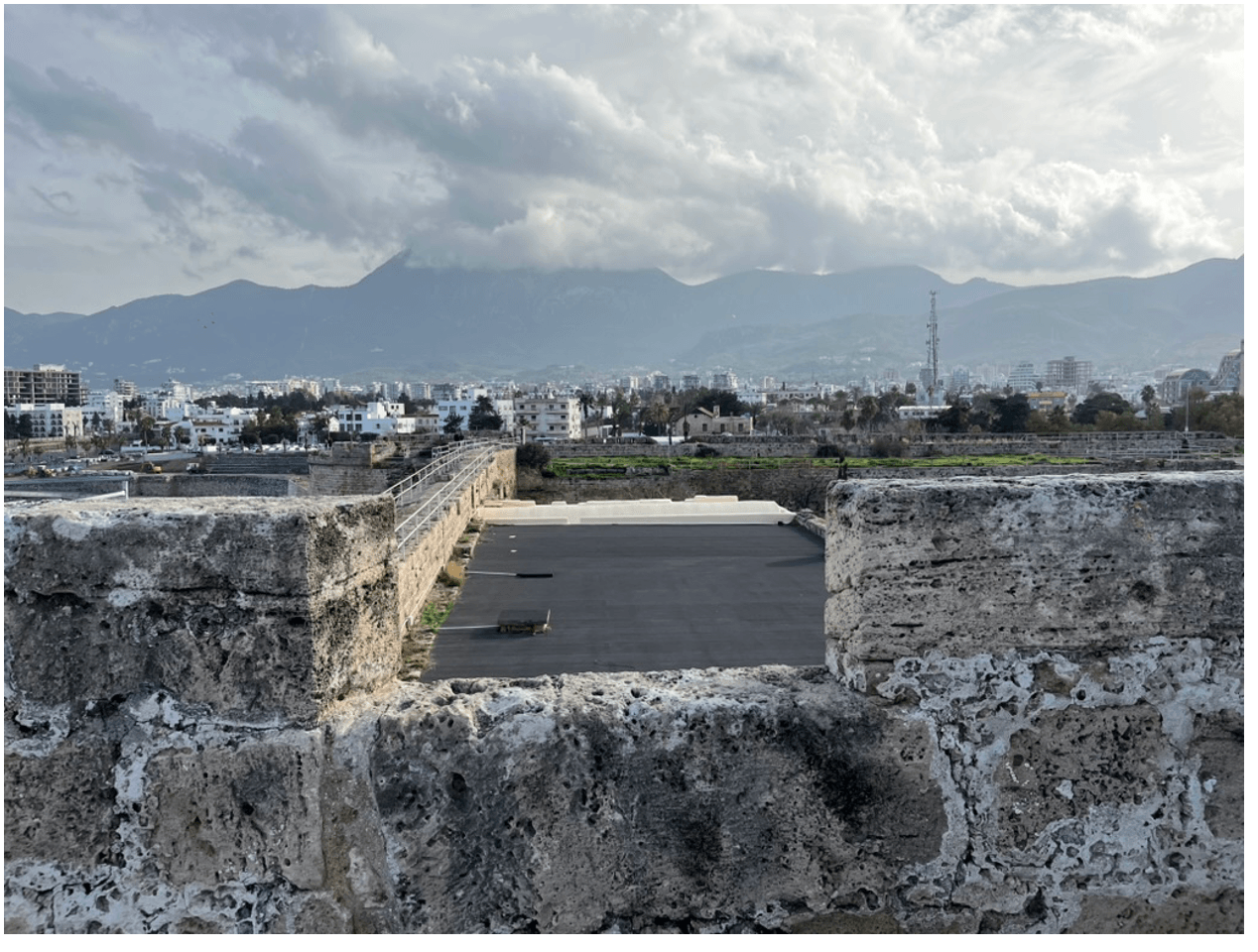
From the old fortress in Girne (in Turkish Cyprus) looking up at the Kyrenia Mountains, in which the author Lawrence Durrell lived in the 1950s, as he describes in his memoir Bitter Lemons of Cyprus. Photo by Matthew Stevenson.
During one of my days in Nicosia, I decided to travel north to the coastal town of Girne, which before the division was known as Kyrenia. On my map it was labelled as Keryneia, and some of the guide books raved about its Venetian fortress in the old port.
I associated the town with Lawrence Durrell’s celebrated memoir, Bitter Lemons in Cyprus, which was published in 1957 and in which he writes: “Venice will never be far from me in Cyprus – for the lion of Saint Mark still rides the humid airs of Famagusta, of Kyrenia.”
I first read Bitter Lemons in the late 1970s, around the time I read his Alexandria Quartet and some of his other books set in the Greek islands (he lived for many years on Corfu, north of the main town). I read Durrell while commuting to work in Manhattan, perhaps to remind myself that one reward of a day job might be the occasional trip to the Mediterranean.
In Nicosia I still had my rented bicycle, and for a while I thought that to get to the north coast (it’s not along the Green Line) I would ride over the Kyrenia Mountains. But the more I studied the maps (admittedly some pre-dated partition), the more it became clear that I would once again be riding on the shoulder of an autoroute, and by that point I had had my fill of truck exhaust.
In the end I locked my bicycle near the mini-van station in north Nicosia, and there paid a driver a few euros, even though the official currency for the Turkish Republic of Northern Cyprus is the Turkish lira. (I never did get to an automated teller machine to have some lira in my pocket, but no one minded.)
In the careening mini-van, I was glad that I had left my bicycle behind, as the driver drove at chicken-scattering speeds and used the shoulder/bike lane to cut around slow-moving farm equipment.
As I didn’t exactly know where I was going, I stayed on the bus until the last stop, which was just above the historic harbor. From the bus stop, it was easy to explore the Venetian ramparts overlooking the sea, which was angry with February whitecaps.
I even found near the port the old Anglican Church of St. Andrew, which had a sign out front that read: “ALL WELCOME… Baptisms By Appointment…. Funerals By Arrangement.”
Sitting in old Kyrenia made me want to reread Bitter Lemons, but I didn’t find a copy either in Girne or later back in Nicosia. Only when I got home was I able to order one in the mail.
Durrell was in his forties when he moved to Cyprus, no doubt looking for a cheap place in the sun to write his books and drink the local wines. He had lived in Alexandria, Egypt, during World War II, when he was a press officer attached to the British legation, but it was only after he left Cyprus in 1956 that the four novels of the Quartet—Justine, Balthazar, Mountolive, and Clea—were published.
In effect, the four novels are one: each tells the story of various failed love affairs from another perspective. The novels capture dissolute expatriate lives on the edge of World War II in Egypt (Rommel’s tanks were only stopped at el-Alamein, which is about sixty miles west of Alexandria).
I only struggled with the novels when Durrell’s language became rococo, as when he writes about Justine:
There are some characters in this world who are marked down for self-destruction, and to these no amount of rational argument can appeal. For my part Justine always reminded me of a somnambulist discovered treading the perilous leads of a high tower; any attempt to wake her with a shout might lead to disaster. One could only follow her silently in the hope of guiding her gradually away from the great shadowy drops which loomed up on every side.
With time and perhaps the sea at your feet, The Alexandria Quartet can be a rewarding read (and at the very least might impress your hosts in the Hamptons).
As my arrival in Girne coincided with a spring downpour, I ate lunch in a restaurant with a glass front overlooking the Venetian walls and the sea. It reminded me, in some ways, of Alexandria, where I went with my family in 2007.
Although we landed in Cairo on a flight from Rome, the trip began in Alexandria, where we went in search of the Pharos lighthouse (an ancient wonder of the world) that fell into the sea in 1303 during an earthquake.
Then, on our way to the new Alexandria library (to replace that which burned in Roman times), we walked past Villa Ambron, where Durrell had lived on the upper floor from 1943-45.
Except for a few buildings scattered around the city, most of colonial Alexandria was gone, except Durrell’s faded villa was still standing as the city debated whether it should be restored and turned into a museum about local history.
When we walked past it, the concrete pillars were crumbling, and there were shutters on the windows and boards over the entrances. A woman we asked at the library said that even though the building had been sold to a developer, there was a good chance that Villa Ambron might be saved, due to local conservation laws. But in Egypt (where a red light is “a suggestion”) laws are made to be broken, and the wrecking ball took down Durrell’s writing tower in 2017 to make way for a block of modern flats.
No wonder in the Quartet Durrell spoke of “the indifference of the natural world to the constructions of art.”
What makes Bitter Lemons a great book is that—as was said of F. Scott Fitzgerald’s This Side of Paradise—“it never fails to live.”
From his 1953 arrival by boat in Limassol in February until his escape from the growing civil unrest in 1956, Durrell tells the stories of his island life—his endless coffees with neighbors, his romantic infatuations besides many beaches, his days as a school teacher in the mountains, and his last act as a government official reporting to the governor in a time of growing conflict.
Best of all, he tells his stories as if writing a long letter to a friend:
But I had already begun to see the island as whole, building my picture of it from the conversations of my host. With him I spent three winters snowed up on Troodos, teaching in a village school so cold that the children’s teeth chattered as they wrote; with him I panted and sweated in the ferocious August heat of the plains; suffered from malaria at Larnaca; spent holidays among the rolling vineyards of Paphos in search of vines to transplant; like him I came back always to the Kyrenia range, to cool my mind and gladden my heart with its greenness, its carpets of wild anemones, its castles and monasteries. It was like returning to a fertile island from a barren one – from Cephalonia to Corfu.
The last part of the book—as Cyprus is subject to increasing political violence, most at the hands of Greeks demanding union (enosis is the term often used) with Greece—is largely about the house he buys and restores in the hillside village of Bellapaix (later Bellapais), at least when he’s not drinking coffee under what he calls the “Tree of Idleness.”
The sprawling row house (wedged into a steep hillside) had a series of connected rooms and arched hallways, and sitting well above Kyrenia the elegant garden caught cooling breezes even during the worst of the summer heat. It was a short drive down to the sea. He writes nostalgically:
The dawn was breaking before we were ready almost, rushing out of the night-sea beyond Cape Andreas, a steeply mounting flush upon the bronze faces of the mountains. A dense dew lay upon everything as we drove back through the silent fields to Kyrenia for breakfast. There were to be many such mornings, many such evenings spent in good fellowship and wine, before the vagaries of fortune and the demons of ill luck dragged Cyprus into the stock-market of world affairs and destroyed not only the fortuitous happiness of these friendships but, more tragically and just as surely, the old tried relationships on which the life of the little village itself was founded.
The political violence that drove Durrell away from his job at Government House and off the island was an early round of the troubles that ended in 1974 with Cyprus in partition.
In the mid-1950s, followers of Archbishop Makarios III sought to drive the Turks off the island and to unite Cyprus with Greece. As well, they wanted Cyprus’s independence from Britain. But under either scenario, colonial officials like Durrell (despite his deep roots in Cypriot village life and ability to speak the language) looked a lot like a target. He writes:
From the vantage-point of Whitehall, too, the angle of vision changed, for here in London Cyprus was not only Cyprus; it was part of a fragile chain of telecommunication centres and ports, the skeletal backbone of an Empire striving to resist the encroachments of time. If Cyprus were to be frivolously wished away then what of Hong Kong, Malta, Gibraltar, the Falklands, Aden – all troubled but stable islands in the great pattern? Palestine and Suez had been questions of foreign sovereignty; they had never been Crown possessions. Cyprus belonged, from the point of view of geography and politics, to the Empire’s very backbone. Must it not, then, be held at all costs?
Unfortunately for all concerned, Archbishop Makarios saw himself as a clerical Marshal Tito, someone in the Levant who could be a bridge not just between Greek Cypriots and Greece, but also a sympathetic ear to Eastern Europe and Russia, who (he may have speculated) might facilitate independence from Britain or later from NATO.
All that Cold War posing accomplished was to turn American mandarins (from the 1960s onward) into advocates for partition so that the West would not lose its Cyprus listening posts and airfields so close to Middle Eastern oil. Even after independence, Britain had retained what were called Sovereign Base Areas.
Keep in mind that Durrell left Cyprus in 1956 just before Britain and France made a colonial mess of the Suez Crisis. It was bad enough that Gamal Abdel Nasser had the canal; as a follow-on, no one wanted to find Cyprus among the rebellious ranks of the non-aligned.
Well into Bitter Lemons Durrell makes mention that he had given over a room in his Bellapaix house to his young daughter, then about age four.
When I first heard mention of a daughter, I wondered if I had missed something in an earlier chapter. When I went back in the book, I saw no earlier reference to Sappho, whose mother was Eve Cohen (the inspiration for Durrell’s Alexandrine character Justine and Durrell’s second wife). But Eve wasn’t in his life at this time, apparently.
Durrell is one of those writers who makes little reference either to spouses or romantic partners, except elliptically, and in Bitter Lemons his mother gets more mentions than his lovers. So it intrigued me that Durrell had a young daughter and that she occasionally came out to Cyprus to stay with her father.
In looking for more details about Sappho, I discovered that she had died by suicide in 1985, at age 33, and that in letters and journals she accused her father of raping her in 1967, when she was fourteen. Numerous obituaries of Sappho’s short and troubled life make reference to her father’s alleged abuse, and link it to her suicide.
I realize that authors can adopt any persona that they choose (and few cast themselves as a child abuser), and the Durrell of Bitter Lemons is humane, engaged, good company, and eloquent with his prose. He writes as he is leaving the island:
The white wine tasted sharp and good and as he raised his glass Panos gave me the toast of the day: ‘That we may pass beyond’ (i.e. the present troubles) ‘and that we might emerge once more in the forgotten Cyprus – as if through a looking-glass.’ In a way, too, he was toasting a dying affection which might never be revived – one of those bright dreams of deathless friendship which schoolboys still believed in, of an England and Greece which were bondsmen in the spirit.
So spoke the Englishman who became the beacon for so many Britons who went abroad in the 1950s and 60s, especially to the Mediterranean, in search of a best-selling book, if not winter sun and affordable wines.
At the same time, I now find the evidence of his sexual abuse to be overwhelming, such that I ask myself how I missed this dark side in so many of his books. Surely it must be there, as in the Quartet he writes: “Art like life is an open secret.” And with Durrell, Daddy’s little secret most likely claimed his daughter’s happiness and her life. And life has no more bitter lesson.
This is the seventh in an occasional series about travels through the Balkans to and from the Green Line in Cyprus.
