
For much of recent history, China has sought to shed the more onerous aspects of its old command economy. After the disastrous failures of the Great Leap Forward and Maoism further impoverished an already poor nation, a new crop of leaders like Deng Xiaoping pursued market-oriented reforms intended to bring China the prosperity that capitalism had delivered for Western countries like the United States. Now, nearly five decades on, politicians in the United States—including, remarkably, many conservatives—seem interested instead in going down the path from which Beijing seems to have turned.
Impressed by China’s recent economic and technological progress, the right is increasingly reaching a remarkable conclusion. The free market, they contend, has disappointed, and the solution is something that looks suspiciously like socialism with American characteristics. A heaping dose of industrial policy is needed to provide what laissez-faire could not and protect our national prosperity.
This tendency was on display last year when the Trump Administration took a 9.9 percent stake in Intel, making the federal government a significant shareholder in the company. Now subsidized by the taxpayer, Intel has become a private entity in which the state has an unusual and intense interest (and should the company fail to maintain control of its foundry business, the state has a warrant to increase its stake by another 5 percent).
This is not nationalization, yet. But the acquisition of a government stake potentially marks Intel as a company that is “too big to fail,” removing a lot of normal risk from its incentive structure. Without the real prospect of failure, corporations lose the price signals that check against the misallocation of capital. It puts one in mind of the corporate bailouts of the Obama administration. Once again, Washington is taking money from middle class taxpayers to subsidize massive corporations.
Another kind of intervention has also been tried with chip exports—the White House last year reached an unprecedented deal to take a cut of the revenue chipmakers Nvidia and AMD make from exports to China. The government has also wielded export controls to dictate to whom these companies can sell their wares, leading Nvidia to cut more than half of its previously authorized Asian customers (although here the White House has admirably refused the calls of China hawks to impose much more draconian controls, allowing—at least in theory—the export of fairly capable H200 and H20 chips).
In a pure market economy, the uses to which China puts a primarily commercial technology would be immaterial to its citizens’ ability to purchase them. Sellers are constantly producing goods that consumers use for unintended purposes, yet a manufacturer doesn’t retain a perpetual claim over use once sold. Nvidia itself could have decided that selling to China is too risky, but it didn’t. Licensing requirements substitute political games for market competition, and make the manipulation of government officials, not success selling their wares, the criterion of companies’ success. Political connections trounce innovation. By excluding American companies from major markets, Washington enables foreign competitors to take over the global market as domestic firms bleed customers.
Proponents of AI export controls often cite the PRC’s incorporation of AI into its defense establishment, but a dizzying array of technologies are “dual-use.” Washington is asserting an alarmingly expansive view of what is required for “national security,” which is increasingly invoked as a magic incantation to hypnotize the masses and expand state control.
The administration is also increasing state involvement in the economy by deciding which AI models Americans can use. This controversy has intensified as Chinese companies release increasingly capable open-weight AI models, including Moonshot’s Kimi, Alibaba’s Qwen, and DeepSeek. These models, while they lag the capabilities of leading American models (though not always by much), are cheaper and more adaptable. And they allow users to download and modify them on their own, while American models typically keep users permanently dependent on a closed platform.
Naturally, this makes them attractive. And the government, overindexing on both China hawkishness and the concerns of the American companies whose business models would be put under threat, has inserted itself again. Recent reporting suggests the White House is considering restrictions that would amount to a ban on Chinese open-weight models like Kimi. If this were to be pursued, it would be disastrous for competition and innovation in this most important of technological sectors. In fact, U.S. chipmaker Nvidia has said as much: “These Chinese models are excellent,” its CEO, Jensen Huang, noted in a recent interview. “Open-source models that are excellent should be used.”
A final charge levied to bolster the case for strong measures against Chinese AI is that Chinese firms have “stolen” American technology through model distillation, a process by which Chinese bots use outputs from more advanced U.S. models to improve the capabilities of their own models. In reality, this complaint exposes the futility of export controls. If Chinese firms can mimic American capabilities by merely studying public outputs online, Washington cannot expect to preserve a technological monopoly through restrictions and inspections. And there is a genuine difference between hacking into private servers and studying information voluntarily provided to a consumer. If such imitation counts as theft, American firms will be incentivized to redefine competition as espionage, slowing overall technological development. Instead of improving their own systems, the state-sanctioned winners will be content to rely on the hand of government to guarantee their positions, keeping prices high for diminishing returns.
This obsession with protecting leading American developers reflects a fundamental misunderstanding of how technological development actually works. As Jeffrey Ding’s pathbreaking work on technological growth has shown, what matters in technological revolutions is less who gets there first and more who is better at adapting and using the breakthroughs in question. And when it comes to AI, a more open, diffusion-focused approach is far likelier to deliver lasting gains than a narrow focus on security.
Subscribe Today
Get daily emails in your inbox
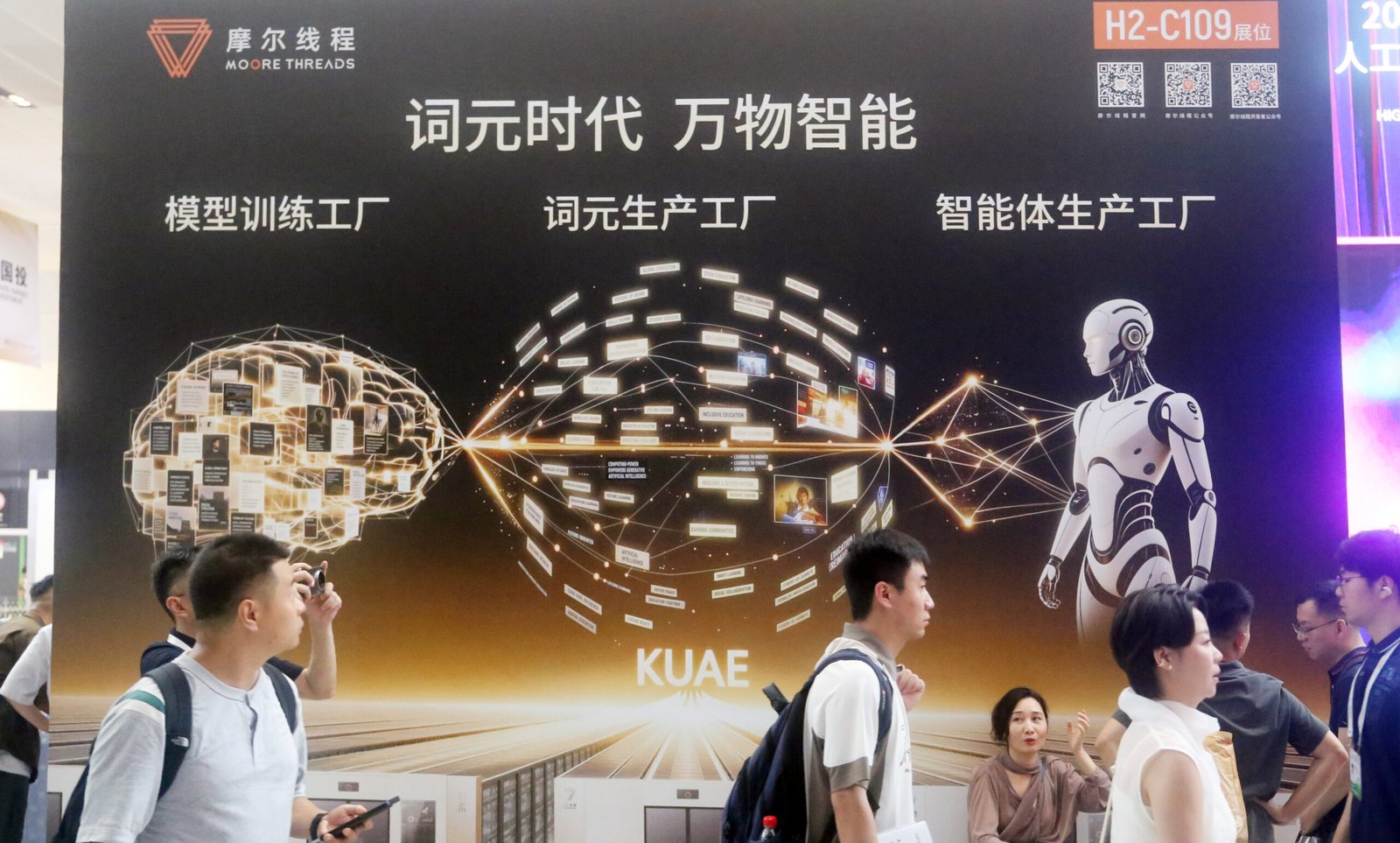
Beijing, for its part, seems to have grasped this. China continues to move with celerity toward a diffusionary model of AI development, which has resulted in rapid capability advances. A year ago, America’s leading models were comfortably ahead in the Artificial Analysis Intelligence Index. China has narrowed that gap dramatically in the past 12 months; as of July, Moonshot’s Kimi K3 model ranked fourth in the index, only beaten out by Anthropic’s Fable 5 and the two versions of OpenAI’s GPT-5.6 model.
None of this is to suggest that China is a bastion of free market capitalism. Other elements of its economy are heavily shaped by state decision-making, and Xi Jinping doesn’t strike one as a devotee of Ludwig von Mises. But China’s leaders have been, on the whole, pleased with their experimentations with competition, which has helped to build incredibly successful companies and sectors. The CCP can be ruthlessly pragmatic, and it seems to have discovered that an open, diffusionary approach to AI delivers results.
This fact should give the right’s industrial policy boosters pause. Rather than abandoning the capitalist ethos that has undergirded American success, now is the time to recommit. Embracing openness and competition will help ensure that the United States remains at the forefront of technological progress for decades to come. Rejecting these values would cede the field to an increasingly entrepreneurial China.
