
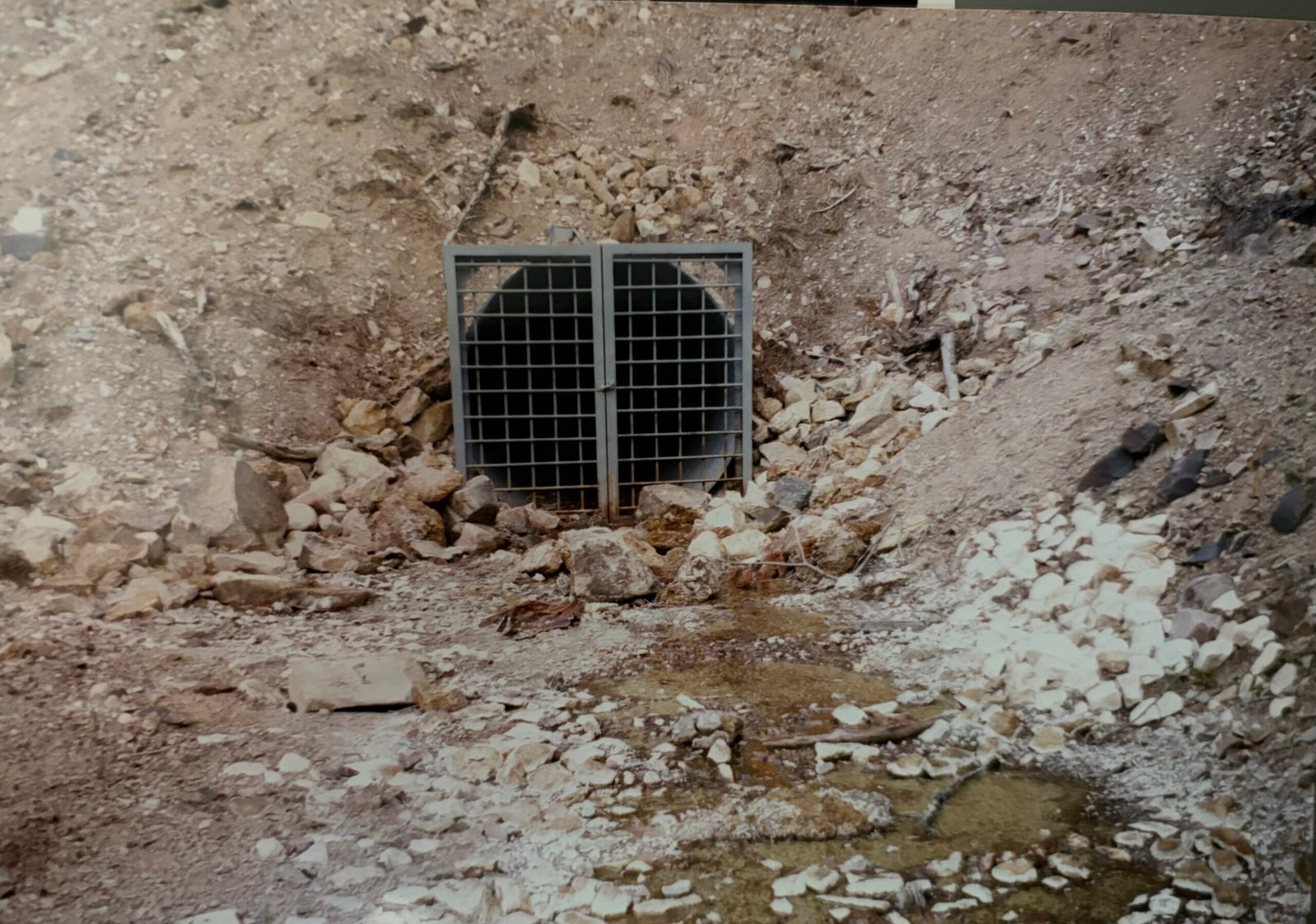
Drainage pipe from an abandoned uranium mine in southwest Utah. Photo: Jeffrey St. Clair.
Most people who society labels “environmentalists” begin their vocation in defense of their own local environment. If they continue that campaign, the work of a lifetime and beyond in itself, at first, they see the opposition as one or more “special interests,” influencing local politicians from the mayor to the congressman and US senator. But after a few years of legal and political struggle, you conclude it is more than a set of special interests; it is your whole local society.
After you have simmered in that pot for a few years, you might be ready to understand a message from muckraker Lincoln Steffens from the first years of the 20th century: “Here then, is our guide out of the labyrinth. Not the political ring, but big business—that is the crux of the situation. Our political corruption is a system, a regularly established custom of the country, by which our political leaders are hired, by bribery, by the license to loot, and by quiet moral support, to conduct the government of city, State and Nation, not for the common good, but for the special interests of private business. Not the politician, then, not the bribe-taker, but the bribe-giver, the man we are so proud of, our successful businessman—he is the source and sustenance of our bad government. The captain of industry is the man to catch. He is the trail to follow.”
And if Canadian mining companies should wrap themselves in the stars and stripes, set up US offices and buy the appropriate licenses along with the appropriate politicians, the corrupt system we call the “American Way of Life” is secure from the terrible threat, the ultimate danger of environmental consciousness, composed of two dreadful premises: first, that growth has limits; second, that political decisions affecting the environment and defenseless residents “shall do no harm.”
To the ruin of sleep and disposition, my investigations into environmental destruction and the laws meant to obstruct it, to the terrible conflict on the Colorado Plateau between its residents, the Diné, Ute, Hopi, and several Pueblos, and the Uranium mining and milling complex, composed of transnational mining companies, billionaire speculators in small modular (nuclear) reactors, data centers and dubious forms of radioactive mine-waste cleanup, local, tribal, state and federal politicians, and the ever-compliant “captured” environmental regulatory bureaucracies. And when the elephantine National Security fiction is introduced, what shred of conscience that can’t be bribed is terrified into submission.
Our old friends, Energy Fuels, Inc., which has dumped several hundred thousand dollars into Congress to make it illegal to buy Russian power-plant-ready nuclear fuel (with the big loophole that until domestic production someday, maybe, catches up with the Russians) – I mean it is a Matter of National Security! Don’t think! Don’t consider where the Nuclear Power Industry will put the waste from its “clean energy” plants, the old large ones, and the proposed “small (nuclear) modular reactors.”
The company, whose ultimate headquarters is in Toronto, after a half dozen years of constant flak, wrapping itself in the red, white, and blue, has nearly removed the crimson shadow of the Maple Leaf. It operates a uranium mine in the Kaibab National Forest on the rim of the Grand Canyon above the village of Supai, home of 200-400 Havasupai people, and a destination for 20,000 tourists a year. It trucks the ore from the mine about 300 miles north through the Navajo Reservation into the Ute Mountain Ute Reservation, to its mill at White Mesa, Utah.
Before reopening and renaming this mine, now that uranium prices are climbing again, public comment stressed two points strongly: the danger of contaminating aquifers in the canyon rim that would contaminate the drinking water for the Havasupai and many tourists besides; and the dangers of radioactive spills from truck accidents on the Navajo Nation roads.
The scientific opinion? According to the EPA in 2024, “The main finding is that current well data are insufficient to rule out a connection between the two aquifers. Therefore, the potential for groundwater contamination resulting from operations at the Pinyon Plain Mine site cannot be assessed fully without additional investigations.” A standard government bureaucracy copout under political pressure from mountain-state senators and representatives.
But, as Amber Reimondo, energy director at Grand Canyon Trust reported. (1) “Dye tracer studies around and inside the Grand Canyon have shown that water can flow long distances, vertically and horizontally, in unexpected ways and sometimes very quickly. As groundwater researcher Laura Crossey explains: ‘I don’t think that a reasonable response is to say, ‘let’s wait and see,’ because cleaning up an aquifer that’s kilometers deep in the earth is simply not going to happen. It’s a one-way street. What we should do is prevent the possibility that those precious places become contaminated.’”
Energy Fuels’ response to predictable rising levels of toxicity in the more than 80 million gallons of water it has pumped out of the mine since an upper aquifer was pierced in 2016 has been to ask for a higher standard of acceptable toxicity on the polluted water. And the Department of Environmental Quality of the great state of Arizona granted their request.
The political corruption of environmental law and regulation is increasing the likelihood of dangerous contamination of the Supai village drinking water every day and it will continue to increase until it becomes the reality Havasupai leaders have been trying to protest against for a quarter century to protect one of the most beautiful waterfalls and pools on the floor of the Canyon.

A 20 foot wide breach in the tailings pond. dam at the Church Rock Uranium Mine. Photo: EPA.
Reimondo also described the toxic soup in the massive holding pond outside the mill, which contains much of the 80 million gallons pumped out of the mine. “Back at the end of 2016, when the need for constant water management first started, water pumped out of the sump at the bottom of the mine shaft had lead levels at the EPA safe drinking water level, while uranium levels were four times and arsenic levels 29 times the safe drinking water level.“Fast-forward to the end of 2023, when mining began. The arsenic levels jumped to 812 times the safe drinking water limit. Lead hit 243 times, and uranium six times.”
The pond is a toxic hazard for wildlife, particularly birds.
Haul No!, a Diné group that opposes the trucking of uranium ore through the Navajo Nation, has energetically protested Energy Fuels Inc. hauling ore 300 miles from the Pinyon Plain Mine to their uranium mill near Blanding, Utah. Haul No! predicted that there would be accidents and possible spills. In the last couple of weeks, there was an accident caused by a truck passing an EFI truck full of ore, which fortunately resulted in just a fender bender. However, within a few days, another EFI truck, empty on its return trip, was evidently blown over by a powerful gust of wind. Flak from all authorities reassured the public that there had been no spill of radioactive material. Impatient drivers behind heavily loaded ore trucks on two-lane highways is a recipe for dangerous driving and accidents. Sooner or later, an ore truck will overturn and spill radioactive waste, which will be worse than when a logging-mill chip truck overturns on a county road in northern California.
Samuel Gilbert2. described what happened in another corner of the Navajo Nation in the summer of 1979, three months after the Three-Mile Island disaster, when the dam of a uranium-mine tailing pond collapsed. It was the largest radioactive spill in the United States, second worldwide only to Chernobyl.
“A few weeks later, at 5:30 a.m. on July 16, 1979, the dam failed, releasing 1,100 tons of uranium waste and 94 million gallons of radioactive water into the Rio Puerco and through Navajo lands, a toxic flood that had devastating consequences on the surrounding area.
“’The water, filled with acids from the milling process, twisted a metal culvert in the Puerco,’ according to Judy Pasternak’s book Yellow Dirt: A Poisoned Land and the Betrayal of the Navajos. ‘Sheep keeled over and died, and crops curdled along the banks. The surge of radiation was detected as far away as Sanders, Arizona, fifty miles downstream.’ According to a Nuclear Regulatory Commission report, radioactivity levels in the Puerco near the breached dam were 7,000 times that of what is allowed in drinking water.
“The heavily contaminated water flowed over the river banks, creating radioactive pools. ‘There were children up and down the river playing in those stagnant pools, and they were deadly poisonous,’ Jorge Winterer, a doctor with Indian Health Service in Gallup, New Mexico, said after the spill.”
You can imagine the health results, particularly in view of the lack of cleanup of the spill site and 20 more sites contaminated by different mines. This is a place, as one woman put it, where people are afraid to have children. According to researchers with the Southwest Research and Information Center, the mine owners were aware of cracks in the dam that burst and did nothing. Less than one percent of the solid tailings waste was cleaned up.
Eric Jantz, legal director of the New Mexico Environmental Law Center, told Gilbert, “Governments took meaningful measures to deal with the Three-Mile Island accident while neither the federal nor New Mexico governments have taken any steps to remediate the Church Rock spill even after 40 years.”
Of course, cleanup of that kind is very expensive and when an aircraft carrier costs $13-15 billion and $25 billion to operate over its life span, unless it meets an end before it’s time in the Arabian Sea. And a battery package of patriot missiles costs over $1 billion, and over a projected 60-year life, the F-35 fighter jet is expected to cost $2 trillion.
We pay these costs for National Security. The citizens living around Church Rock, who don’t pay as high taxes, pay with kidney disease and cancers, contaminated water, contaminated pasture, and contaminated sheep. This is the area where Muttonman was born, the Navajo answer to Spiderman. (3)
But, it is claimed that salvation is at hand in the form of a new technology developed by a cabal of political hacks and billionaires called Disa Technology. It is called high-pressure slurry ablation and it purports to take mine tailings into a magic box, spray it with water, separate radioactive particles from non-radioactive particles, and sell the hot particles to the Energy Fuels Inc. mill on the Ute Mountain Ute Reservation in Utah. The Nuclear Regulatory Commission has granted them a permit to deploy this technology on mine tailings from Gallup NM to Spokane WA.
Jantz, of New Mexico Environmental Law Center, commented on the DISA license application to the Nuclear Regulatory Agency, writing:
“In its speculative scenario where it assumes DISA’s hypothetical HPSA operations will perform flawlessly. NRC fails to consider the only actual data available that indicates HPSA waste (coarse fraction) will, in many cases, leach contaminants into the ground and groundwater. By any standard, the NRC failed to take the required “hard look” at HPSA…The TetraTech Report, which is the sole data source for the NRC’s analyses, indicates that ablation byproduct material, i.e., the coarse fraction left behind after ablation, would have uranium and radium concentrations high enough to make areas where the coarse fraction remains unsuitable for residential or agricultural use in most cases…Additionally, NRC fails to consider impacts of climate change on water availability. Had NRC done so, it would have found that water scarcity will increase dramatically in arid Southwest regions, including New Mexico, and a FONSI (Finding of No Significant Impact–ed) would be inappropriate…Given increasing water scarcity in New Mexico and around the Southwest and DISA’s proposed water usage, NRC cannot justify a finding of no significant impact, even on a generic level.” (4).
There are three or four other uranium mines in various stages of permitting for reopening on the periphery of Navajo Nation, whose tribal council passed a law prohibiting uranium mining within the boundaries of the Nation. However, in the Church Rock area there is a checkerboard situation of private and tribal land holdings.
But, continuing to load fact upon fact just avoids stopping and facing them.
It is nauseating that government treats these citizens this way on behalf of Steffen’s bribe-givers, a few billionaires speculating in data centers, small modular (nuclear) reactors, uranium mines, and political hydrology cleanup scams.
Notes.
1) Reimondo, Amber: https://www.grandcanyontrust.org/blog/pinyon-plain-uranium-mine-80-million-gallons/; https://www.grandcanyontrust.org/blog/arsenic-raises-concern-at-grand-canyon-uranium-mine/
2) Gilbert, Samuel:https://www.vice.com/en/article/church-rock
3) Vincent Craig (June 6, 1950 – May 15, 2010) was a Diné cartoonist, comedian, and singer/songwriter, known for his comic strip Muttonman.
4) Hatch, Bill: https://www.counterpunch.org/
