
[ad_1]
Partisanship is not new in Washington, D.C., but for many years there was a place on the eastern border of Capitol Hill where Republicans and Democrats could scream and shout – not at each other – but in shared euphoria, with the same goal in mind. That venue was Robert F. Kennedy Memorial Stadium when the Washington Redskins were playing at home.
Over the years, the team boasted 32 inductees into the Pro Football Hall of Fame, garnered three Super Bowl trophies, and in the 1980s and 1990s, fans would literally rock the upper deck until it swayed while belting out the “Hail to the Redskins!” fight song.
Despite President Trump’s entreaties, most Commanders fans have accepted the new name and passion for the politically incorrect old hymn is gradually waning as well – partly because the team’s young followers don’t even remember the epic games at RFK. But city leaders would like to recapture the old magic, not to mention the lost revenue, and bring the team back to D.C.
Congress shares this aspiration in a bipartisan way. The U.S. Senate, in what the New York Times called “a shocking unanimous vote,” approved the Washington Commanders’ bid to be given title to the 180-acre lot where RFK once stood.
Team President Mark Clouse was appointed two years ago, and now he’s helping lead the rebuilding of the NFL team’s former playground. Robert F. Kennedy Memorial Stadium, which opened in 1961, is in the process of being completely demolished. An entirely redesigned edifice is planned to rise in its place. The new stadium should be finished by 2030. Until then, the Commanders will continue to play in suburban Maryland.
The projected cost – borne by the team’s ownership – is some $2.7 billion, making it the largest private investment in the city’s history. The city has committed to providing $1.1 billion in roads and other capital improvements.
Plans to demolish the old stadium began in 2023, though they were not approved by the National Park Service until April of the following year. In May of this year, all the steel was fully removed from the site.
“There’s a lot of what I would call small decisions, but I think the biggest decision is really making sure that we anticipate all the needs of the stadium and the construction, and that we ensure that when we’re done, we’ve anticipated all the different uses, how to make it operationally efficient, sustainable,” Clouse commented at an Axios event on July 15.
Each week has its own deliverables.
“If you drive by the site, you’ll see construction out there,” he said. “Right now, we’re doing like storm sewers, infrastructure work. And next spring will be the official groundbreaking as we start going up, not going down. And so that’s exciting, to be right on schedule, right on track.”
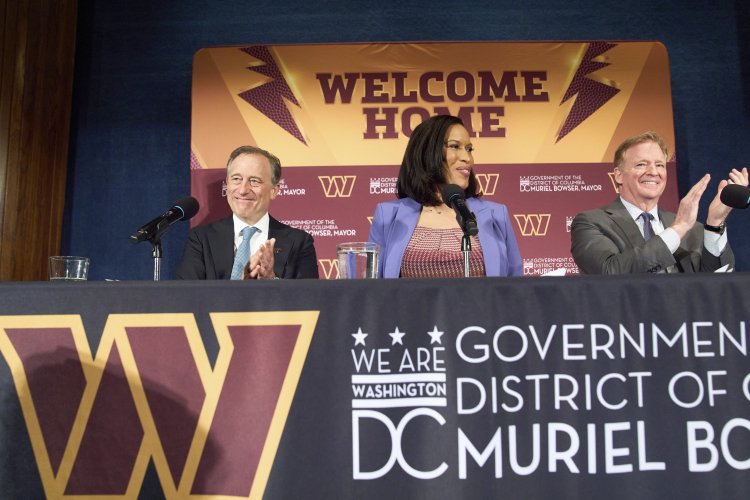
The city has been heavily involved in the process. On June 30, Mayor Muriel Bowser (who is retiring) and the D.C. Office of Planning unveiled the new plan and invited the public to submit feedback until Aug. 14. More than 1,700 people offered their input.
“Throughout this process, our team met with hundreds of residents and received more than 4,000 comments online,” said Anita Cozart, director of the D.C. planning office. “We’ve created this draft plan with you in mind – whether you’re a neighbor, a business owner, a sports fan, or excited to see the redeveloped campus as a new hub in the District.”
Clouse lauded the district’s cooperation. “I am very lucky to be working with the district, especially the mayor and the District Council,” he said. “They understand the economic significance of what this means to D.C. to not just build a space, but develop the community, which has always been the vision, and so that makes life a lot easier.”
Despite the district’s efforts to gather community feedback, a private dinner between some City Council members and the team’s executives has sparked controversy. In addition, although the Commanders are financing the construction costs, the team is paying next to nothing ($1 annually) to lease the city-owned land, which has raised questions among critics.
Several groups have sprung up in opposition to the new stadium. No Billionaires Playground maintains that housing in the area is a greater need. While the current plan is to have housing built by 2035, group member Nick Sementelli expressed skepticism. “There is no target deadline for the housing with any kind of teeth in it,” he said.
“If the conditions aren’t right to build housing in five more years, they can just sit on it and pay $1 in rent and not worry about it,” Sementelli commented. “There’s nothing in there that says, if it doesn’t get done, the city gets any of the money back. If it doesn’t get done, then they have to give their land rights back. And in fact, until it gets done, this team gets to use the land next to it as more parking.”
He also pointed out the land’s value. “The only thing that the city is supposed to be getting from this is the stadium will accelerate the nearby housing,” he said. “This is some of the prime waterfront real estate in the city.”
Meanwhile, Advisory Neighborhood Commissioner for Kingman Park, Ebony Payne, has said that 67% of people living in the area surveyed said they wanted something other than a new stadium. “People’s least desire was really the stadium itself,” she said.
Another group, Homes Not Stadiums, also wants housing. However, they are interested in how public land was deeded to a billionaire in the first place.
“This is about priorities. We can either build homes for 20,000 families or lease public land to a billionaire for a dollar. Residents deserve a say,” commented Adam Eidinger, the group’s treasurer.
The group’s alternative would be to rezone the area and create a mixed-income neighborhood. But first, they are trying to pass a ballot initiative which would take away the mayor’s ability to make sports deals with tax money and public land. While the date to make their case isn’t until Aug. 8, the group hopes to apply the rule retroactively if it succeeds.
Clouse rejects those characterizations, arguing that the plan is designed to minimize harm to the community. “We’re not cutting it into an urban area. We’re actually taking something that had kind of been abandoned. Utilizing that as the anchor, and then developing the community out from it.” He is encouraged by the example of other D.C. stadiums that are less isolated than RFK, such as Nationals Park, which has helped spur broader investment and redevelopment in the Navy Yard area.
The last time the Washington Redskins, now Washington Commanders, played at RFK Stadium was in 1996. The stadium has also been home to the Washington Senators, Washington Whips, D.C. United, Washington Diplomats, and Washington Nationals, and has even hosted the Howard University Bison. However, the RFK Campus Master Plan encapsulates more than just a place for sports.
“I can tell you that from the very beginning of this journey, the vision was to be much more than just a stadium,” Clouse said. “Really what we want it to be is a thriving community, not just an entertainment center, but a fully integrated community.”
The plan creates six districts and maps out a place for parks, retail, entertainment and recreation, as well as 5,500-6,500 new homes, at least 30% of which would be accessible to low-income residents. There would also be a new roadway system, space for commercial development, and more access to the river and heritage islands nearby.
The 180 acres of land designated for the RFK campus sits along the Anacostia River and is an underserved area. The new campus is expected to provide around 30,000 construction jobs and 2,000 permanent jobs as well as generate roughly $24.2 billion total and $5.1 billion in taxes that go back to the city.
Clouse spoke about the decision to put a roof on the stadium. While the move was controversial, and he credits Bowser with pushing it, Clouse said, “One of the benefits of that is that building will be operational, we hope, 200 nights a year, and that means that the people that work in the stadium have full-time jobs.”
Although the stadium will not be completed in time for the 2027 NFL Draft on the National Mall, Bowser leaves office believing she set her vision for the site’s transformation in motion.
“We are taking another step forward in our promise to District residents and businesses – to plan not just for a world-class stadium, but for a community-centric 365-day campus that will drive growth for years to come. Now, let’s work together toward the final goal – to finalize a plan rich in amenities like housing, parks and entertainment,” she said.
[ad_2]
Source link
