
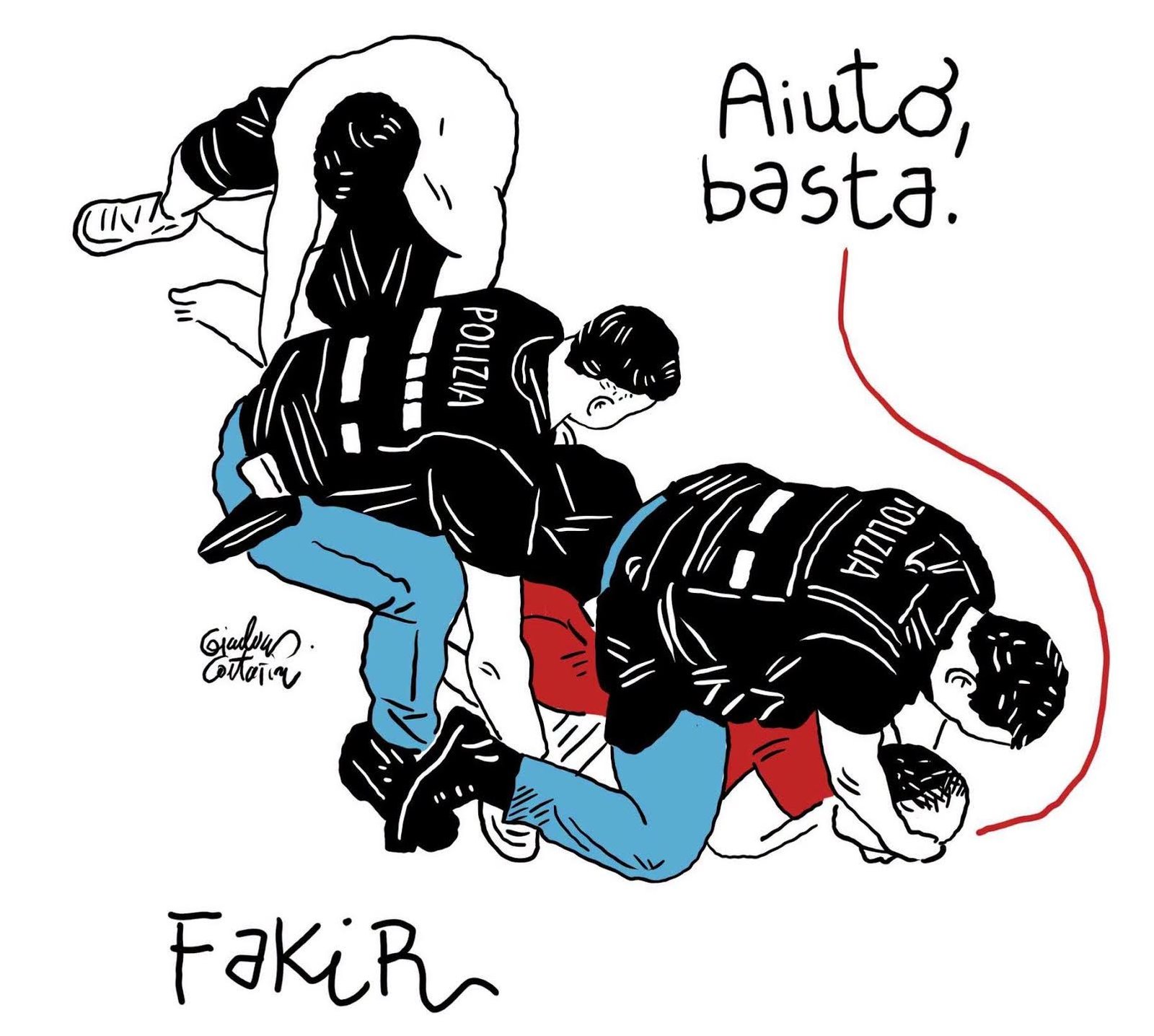
Art by Gianluca Costantini
On July 19, 2026, in the working-class Pilastro neighborhood of Bologna, a 42-year-old Moroccan-origin man named Abderrahim Fakir died face-down on the asphalt of Via Svevo while police restrained him. The video is unmistakable. Two officers pin him to the ground, forcing his hands behind his back. Pepper spray has already been used. A civilian helps hold his ankles. Fakir’s voice cuts through the footage, raw and desperate: “Basta, aiuto! Basta!” Help. Enough. Medical personnel stand nearby and do not intervene until he has stopped moving. He never gets up.
The images immediately evoked George Floyd. Protesters gathered in Pilastro within hours, kneeling with fists raised, chanting that this was a state killing. The comparison is not rhetorical excess. The mechanics of death — prolonged prone restraint, compression of the chest, a man begging for air while the weight of the state holds him down — are the same. Preliminary autopsy findings report blood in the lungs and clear signs of crushing and compression. The family lawyer has stated that the evidence points to asphyxia from that compression. Full toxicological and histological results will take up to ninety days. Two police officers and four medical workers are under investigation for involuntary manslaughter. Head and facial injuries have also been noted.
Fakir was not an undocumented newcomer. He was a long-term regular resident of Italy and the owner of a small moving company. In the weeks before his death he had sought psychiatric care, first at a hospital emergency room on June 20 and then through visits to a mental health center. The state that failed to protect him in life was present and decisive in the final minutes of it.

Art by Gianluca Costantini
This killing did not occur in a vacuum. It takes place against the backdrop of a deliberate and accelerating hardening of the Italian security apparatus under Giorgia Meloni’s government, an apparatus that has spent the last two years systematically expanding the criminalization of protest, dissent, and even youth itself.
The 2025 Decreto Sicurezza, later converted into law, marked a qualitative shift. Blocking a road or railway with one’s own body, once treated as an administrative offense, was turned into a criminal act. Alone, the penalty can reach one month in prison or a fine. When done by more than one person, as in any actual demonstration, the sentence jumps to six months to two years. Damage during protests carries heavier penalties. New “revolt” offenses were created for prisons and migrant detention centers, criminalizing even passive resistance to orders. The law was written with climate activists, social movements, and anti-eviction organizers in its crosshairs. Amnesty International and other human rights groups warned at the time that it would create a hostile environment for peaceful protest. Those warnings have proven accurate. Activists now face cascading fines, rapid criminal charges, and the constant threat of prison for tactics that were previously treated as civil disobedience.
In 2026 the government pushed further. Additional measures tightened the net. On July 23, just days after Fakir’s death, Meloni’s cabinet approved a bill that reverses the burden of proof for the criminal responsibility of minors aged 14 to 18. Under the new proposal, young people in that age range are presumed to understand the nature and consequences of their actions unless they can prove otherwise. Meloni framed it in classic law-and-order language: “Those who do wrong must be held to account, even if they are minors.” The measure is sold as a response to youth crime and the so-called “maranza” phenomenon, but its effect is to pull teenagers deeper into the adult punitive system and to expand the state’s capacity to process, detain, and criminalize the young.
At the same time, the government has advanced legislation adopting the IHRA working definition of antisemitism, including its highly contested examples that treat certain forms of criticism of the State of Israel as antisemitic. The Senate approved a version of the bill in March 2026 and sent it to the Chamber. Critics, including Amnesty International and a long list of human rights organizations, have warned that embedding this definition into Italian law risks transforming legitimate political speech and protest against Israeli policy into potential criminal or administrative targets. In a country where dockworkers have blocked arms shipments and where solidarity with Palestine has been one of the most vibrant expressions of grassroots politics, the message is clear: the boundaries of acceptable dissent are being redrawn by the state.
These legal and political developments do not stand alone. They sit within a longer history of security cooperation between Italy and Israel. For two decades a bilateral military memorandum of understanding facilitated exchanges in training, technology, joint exercises, and the organization of armed forces. Italian police cooperation with Israeli counterparts has been publicly described by the Polizia di Stato itself as consolidated and productive. Although Meloni’s government suspended the automatic renewal of the defense agreement in April 2026 amid the ongoing war on Gaza, the prior years of partnership formed part of a wider international pattern. Israeli security forces, including the IDF and national police, have for years trained foreign law enforcement agencies—especially in the United States but also elsewhere—in tactics developed under conditions of prolonged military occupation and population control. These exchanges have focused on crowd control, use of force, surveillance, and methods of rapid dominance. Critics of these programs have long argued that techniques refined against a captive civilian population travel outward, contributing to the militarization of ordinary policing and to forms of restraint that treat the human body as something to be immobilized at all costs. The prolonged prone restraint that killed both George Floyd and Abderrahim Fakir belongs to this broader repertoire of control, one that has been circulated through international training circuits even when direct lines of transmission remain difficult to document in any single case.
These are not isolated technical adjustments. They form a coherent project. The same government that expands police powers, criminalizes the physical occupation of public space by protesters, lowers the threshold for treating teenagers as fully responsible adults, and moves to police speech about Israel is the government under which a man can be pinned to the ground in a Bologna street until he stops breathing. The continuity is not accidental. It is the logical outcome of a politics that treats security as the highest value and treats dissent, especially from below, from immigrants, from the young, and from those who challenge the prevailing order, as a threat to be managed by force and by law.
There is an international dimension. Meloni’s Italy has aligned itself with the authoritarian turn visible in the second Trump administration, sharing a language of order, of “those who do wrong,” and of the need to restore hierarchy against movements from below. The Italian security state and the American one are not identical, but they are increasingly speaking the same dialect, and both have drawn, in different degrees, on models of control refined in the laboratories of occupation.
The people of Pilastro and of Bologna did not wait for the autopsy results or the political explanations. They took to the streets. They named what they saw. They connected the death of one man to a larger machinery of repression. That connection remains the necessary starting point for any serious accounting.
Abderrahim Fakir’s death is an Italian tragedy, but it is not an isolated one. It belongs to a growing international tapestry of repression in which states, facing movements that refuse to accept the prevailing order, respond by expanding the reach of police power, narrowing the space for protest, circulating militarized methods of control, and treating the lives of the marginalized as expendable. Justice for Fakir requires more than an investigation into two officers and four medics. It requires a confrontation with the political project that made his death possible and that continues to expand.
