
Photograph by Nathaniel St. Clair
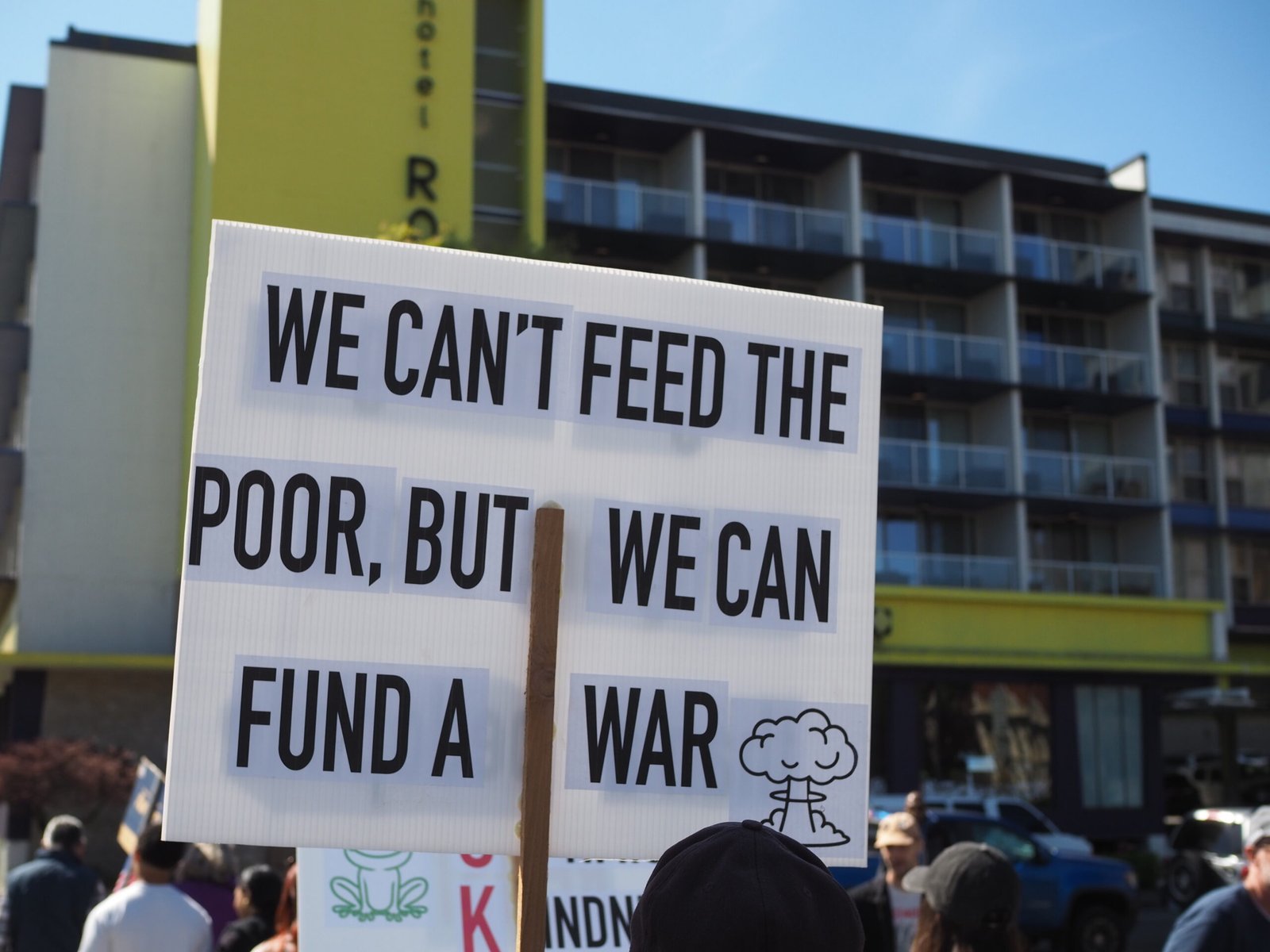
The U.S. House of Representatives voted on July 22 to increase defense spending by US$73 billion. At about the same time as the House vote, the Office of the United Nations High Commissioner for Refugees (UNHCR) announced that it will be moving to a smaller building in Geneva because of budget cuts.
The contrast could hardly be starker. One decision expands America’s capacity to wage war; the other diminishes its capacity to save lives. “Without immediate support, women and girls at extreme risk of rape and other abuse are losing access to services that kept them safe. Children are being left without teachers or schools, pushing them into child labour, trafficking or early marriage. Refugee communities will have less shelter, water and food.” UNHCR High Commissioner Filippo Grandi warned in March 2025.
Under its mandate, UNHCR is responsible for 122 million refugees and internally displaced people worldwide. The United States’ contribution to UNHCR was around $2 billion in 2024, 40% of the voluntary funding. It has been slashed to $868 million. More than 5,000 staff have been laid off.
At a time when one in every seventy people on Earth has been forced to flee, what will an additional US$73 billion for the Pentagon do for those 122 million people?
UNHCR’s situation is part of a broader pattern of U.S. humanitarian cutbacks. Under Donald Trump, Foreign Operations and Related Programs (which includes development assistance, humanitarian aid, economic assistance, and much global health funding) has fallen from roughly $36 billion to about $19 billion, a 47% cut. The result is an estimated US$3–4 billion annual reduction in U.S. support for Geneva-based international organisations and the vulnerable people they serve.
The World Health Organization (WHO) has had to shrink its program budget after the U.S. announced it would leave the organization and reduce funding. The organization is cutting its biennial budget by about 21%. The UN human rights office (OHCHR) has suffered a near-100% reduction in U.S. voluntary funding.
Does all this matter?
Peer-reviewed studies published in The Lancet estimate that if the current dismantling of U.S. foreign assistance continues, it could contribute to around 14 million additional deaths by 2030, including more than 4.5 million children. These are projections, not observed deaths, but they illustrate the scale of what is at stake.
For UNHCR, for example, in Sudan and neighboring countries it means cash assistance that allowed refugee families to buy food and pay rent has been reduced or suspended for many households. For the WHO, it means reduced support for disease surveillance, making it harder for countries to detect outbreaks of diseases such as cholera, measles, and mpox early. For the OHCHR, it means fewer human rights officers deployed in conflict-affected countries and reduced monitoring of arbitrary detention, torture, and attacks on civilians.
The effects are not limited to UN agencies. The consequences extend equally to global HIV/AIDS programs coordinated through Geneva-based UNAIDS and supported by the U.S.-funded PEPFAR initiative. Through PEPFAR, the United States has helped save more than 26 million lives since 2003 and currently supports HIV treatment for more than 20 million people. Yet UNAIDS warns that if U.S.-funded HIV programs are permanently dismantled, the world could face 6.6 million additional HIV infections and 4.2 million additional AIDS-related deaths between 2025 and 2029. Such a reversal would rank among the greatest setbacks in the history of the global response to HIV/AIDS.
“In countries with a high level of HIV, funding for condom programming declined by 93%, and funding for programmes that ensure people can reach prevention services (e.g. supportive laws, regulations and policy environments) reduced by 80%,” said UNAIDS.
Some may argue that none of this affects the United States or its citizens directly, or even the country itself. Beyond humanitarianism as such, the question is whether these savings are strategically meaningful. Pandemics do not respect borders. COVID-19 demonstrated that a virus emerging thousands of miles away can shut down the American economy within months. Weakening the WHO’s capacity to detect and respond to outbreaks early is therefore not simply a problem for poorer countries.
The same applies to conflicts. Refugee crises, regional wars and state collapse rarely remain local. They disrupt trade, energy markets and migration, eventually affecting countries far removed from the original crisis. The war with Iran in the Middle East is affecting gas prices throughout the U.S.
Humanitarian cuts are often defended as unavoidable fiscal decisions. Every dollar a government spends on “guns” (defense, military, and security) is a dollar it cannot spend on “butter” (civilian goods and services such as healthcare, education, infrastructure, or foreign aid). This is the classic “guns versus butter” trade-off.
But that trade-off doesn’t hold now. For FY2026, the United States is expected to spend about US$1 trillion on defense. The estimated US$3–4 billion reduction in funding for Geneva-based humanitarian organisations amounts to roughly 0.3–0.4% of that budget. Yet the United States is not fighting a declared war. It is dismantling humanitarian institutions to save less than half of one percent of what it spends on its military.
What do these choices say about American priorities? During the COVID-19 pandemic, the WHO played a pivotal role in global coordination. With the likelihood of pandemics spreading, is gutting the WHO really in America’s interests? A saving of $3–4 billion may appear large in isolation, but it is almost invisible when viewed in the context of a trillion-dollar defense budget. What is the U.S.willing to sacrifice for relatively small gains?
Finally, what kind of power does the United States want to be? Military power and humanitarian leadership are two different forms of influence, hard and soft power, the power to compel and the power to persuade. Since 1945, the United States has exercised both.
That balance seems to be shifting. Reduced presence in the field to help the vulnerable, tens of thousands of unemployed humanitarians around the world, and symbolic empty offices in Geneva are reflections of the United States’ over–militarization.
Obsession with hard power is crowding out soft power. There is no longer a balance between the two. Joseph Nye, who coined the term “soft power,” was Assistant Secretary of Defense for International Security Affairs under Bill Clinton and received the Department of Defense Distinguished Service Medal. He understood that America’s influence rested not in choosing between hard and soft power, but in their complementarity.
The House vote was more than a budget decision. It was a statement about what the United States now values. Washington voted for another US$73 billion for the already bloated Pentagon while cutting billions from the institutions that keep refugees alive, contain epidemics, fight HIV/AIDS and defend human rights. All this to save less than half of one percent of the defense budget. That is an abandonment of American humanitarian leadership. Another tragic chapter in the MAGA March of Folly.
