
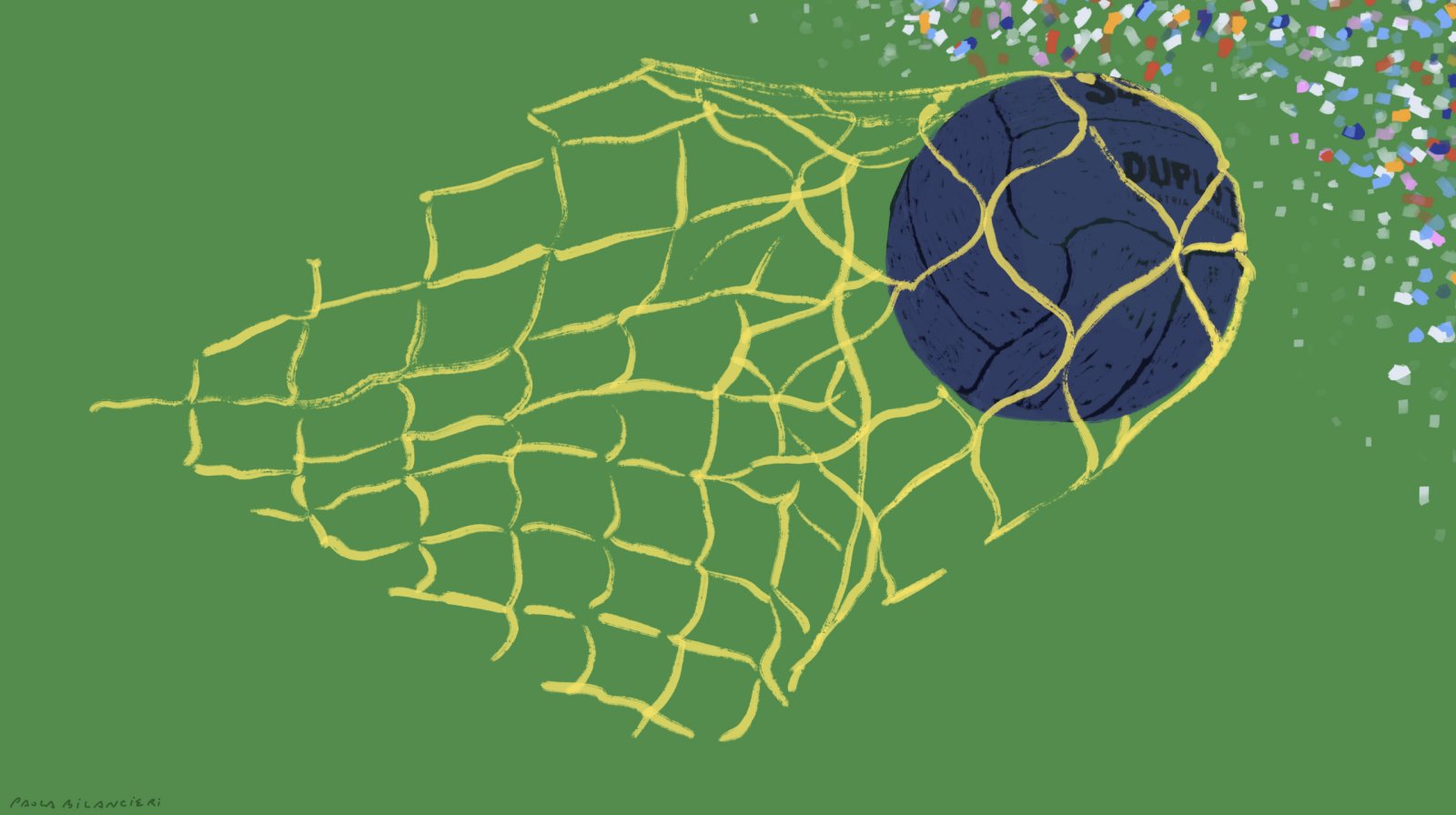
Soccer player Ghiggia (Uruguay) scores a goal that silences a whole nation. Illustration by Paola Bilancieri.
In 1950, the match between Brazil and Uruguay was the final of the 1950 FIFA World Cup. In the final game of the tournament, Brazil needed only a draw to become world champions. Its rival, Uruguay, smaller, slower, supposedly outmatched, needed a miracle to win.
On the morning of July 16, 1950, Rio de Janeiro woke as if to a coronation. The streets pulsed with drums, paper flags, and the certainty of a nation rehearsing its own triumph. Convinced that Brazil would be that year’s World Cup winner, the newspapers had already printed the headline “These are the world champions.” Gold medals bearing Brazilian names waited in velvet boxes.
The mayor of Rio de Janeiro, Ângelo Mendes de Moraes, delivered a speech on the day of the game, saying, “You, players, who in less than a few hours will be hailed as champions by millions of compatriots! You, who have no rivals in the entire hemisphere! You, who will overcome any other competitor! You, whom I already salute as victors! And Jules Rimet, known as the “Father of the World Cup,” since he spearheaded the creation of the tournament to unite nations through sport, had prepared his victory speech in Portuguese before the match.
One of the few dissenting voices was Paulo Machado de Carvalho, leader of São Paulo FC, and later head of the Brazilian squad that won two World Cups. During a visit to the Brazilian team before the game, he found several politicians, journalists and photographers already anticipating victory. He warned the Brazilian coach that all these visitors were upsetting the players, only to be ignored. Frustrated, he told his son, “We are going to lose.”
Inside the new Maracanã — a concrete bowl stadium holding more than 170,000 people, though many swore it was closer to 220,000 — the air trembled with anticipation. While the whole stadium was filled with boisterous Brazilian fans, only a handful of Uruguayans sat scattered in the stands, blue dots in a sea of yellow.
Two minutes into the second half, Brazil was the first to score. São Paulo forward Albino “Friaça” Cardoso shot low past the Uruguayan goalkeeper Roque Máspoli. The stadium convulsed. The noise was not cheering but something closer to a physical force — a roar that shook the stadium’s steel beams. It felt, for a moment, like destiny had finally spoken.
Then Obdulio Varela, Uruguay’s captain, did something strange. He lifted the ball from the net and walked — slowly, defiantly — toward the referee. He argued in Spanish that Friaça had been offside, demanded an interpreter, and stretched the moment until the crowd’s frenzy thinned into confusion. A Brazilian player spat at him. Varela didn’t blink. When things cooled down, he took the ball to the center of the field and told his team, “Now is the time to win!” Later, Varela would say he wasn’t protesting the goal. He was cooling the stadium. And Uruguay took control of the game.
What followed has been told so many times it risks sounding mythical. When Uruguay was on the offensive, Brazil showed the frailty of its defense. Alcides Ghiggia’s run down the right, crossed to Schiaffino for the equalizer, and the sudden hush that fell like a curtain. And then, eleven minutes from the end, Ghiggia again — this time shooting, not crossing. The ball skidded past the Brazilian goalkeeper’s outstretched hand and into history.
The Maracanã did not erupt. It collapsed into a silence so total that players later said they could hear their own breathing. Brazil, a country built on music, had no music left. When the English referee George Reader signaled the end of the match, a black cloud fell over the stadium, and it became lifeless, like a cemetery. It was reported later that eight Uruguayans died that day, and several Brazilians committed suicide. In the hours that followed, the city dimmed. Radios went quiet. Celebrations dissolved into stunned stillness. Some fans never made it home. Others wandered the streets as if emerging from a natural disaster.
Brazilian players and fans conducted themselves with grace in defeat. The Uruguayan newspaper El Día declared Brazil “the other winner. It stated, “if before the match we respected the Brazilian sporting power, after the encounter our respect grew and even more profoundly admired the great spirit demonstrated by Brazilians in adversity.”
Varela, the man who had broken Brazil’s heart, slipped into a bar that night. He expected anger, maybe violence. Instead, the Brazilians raised their glasses to him. He drank with them, humbled by their grief. The next day, when Uruguay returned home to a nation in ecstasy, Varela refused the spotlight. “My heart is with the people who are suffering,” he said.
In the photographs of the celebrations, Obdulio Varela is the only one not smiling.
This piece first appeared at Meer.
