
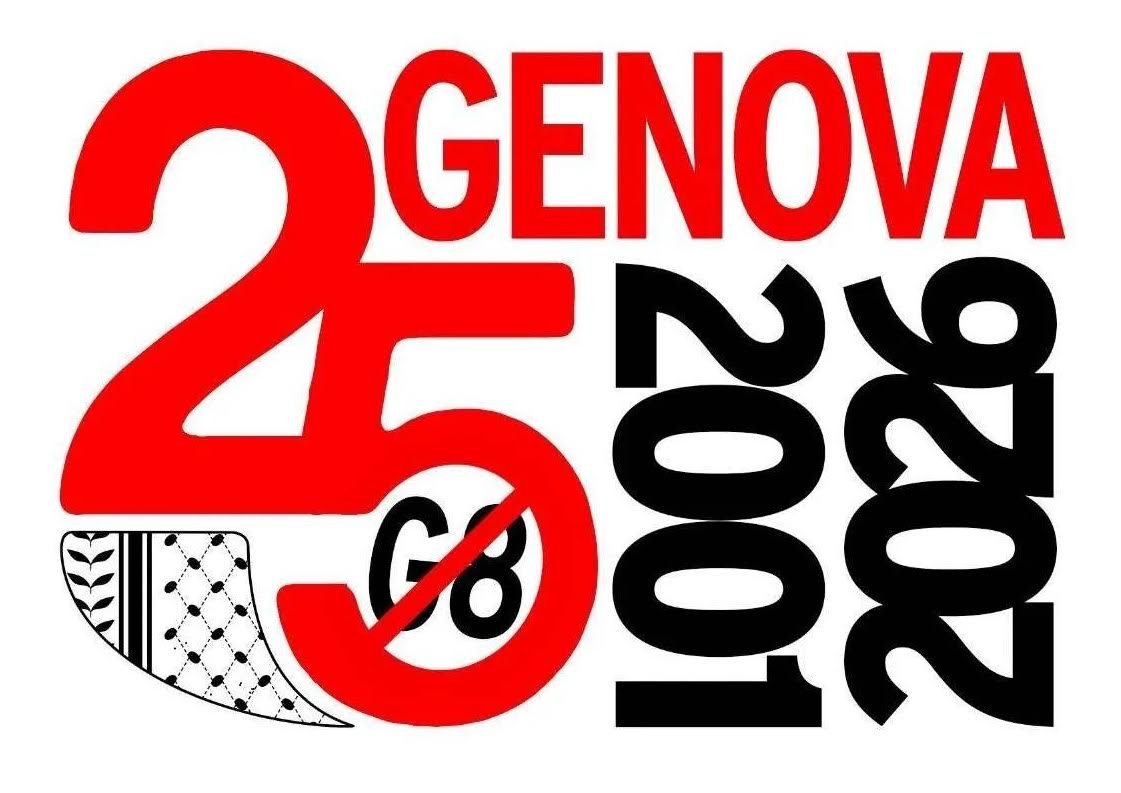
On July 20, 2001, in the historic port city of Genova, the global ruling class met behind the Red Zone while the Italian state showed the world exactly how far it would go to protect them. Silvio Berlusconi played host to George W. Bush, Tony Blair, and the rest of the G8. Outside, hundreds of thousands of people from every corner of the planet had gathered to declare that another world is possible. Among them was Carlo Giuliani, twenty-three years old, the son of a CGIL trade-union militant, raised in a family that understood class struggle as a living tradition.
What happened that day—and in the nights that followed—was not a “clash.” It was a deliberate, coordinated suspension of the rule of law. Italian and international police turned the streets into a war zone. Residents watched as young people on their way to the beach were beaten in clouds of tear gas. Old women and shopkeepers were attacked simply for being on their own streets. The New World Order, cornered by a rising global movement, lashed out with the ferocity of a wounded beast.
In the many conversations I have had over the years with Italians who were there that week, a common thread always emerges. They speak of a sensation that is almost impossible to describe unless you lived it: the sudden, total suspension of the basic rights of individuals to protest, to gather, even to walk the streets of their own city. The rule of law itself was set aside. Police forces were given full reign to be as violent as they wanted, with the open support of the Italian state and the world leaders gathered behind the barriers. After the Battle of Seattle two years earlier — the uprising so powerfully documented by Jeffrey St. Clair and Alexander Cockburn in 5 Days That Shook the World — it felt as if a lesson had to be taught to the international movement from below: a crushing blow delivered, fear deliberately instilled. The message was unmistakable: this far, and no further.
Carlo was one of those who fought back. When the Carabinieri jeep found itself surrounded in Piazza Alimonda, he picked up a fire extinguisher. A shot rang out from inside the vehicle. The bullet struck him in the head. Then the jeep ran over his body—backwards and forwards. He was left to die on the pavement while the leaders of the richest nations on earth continued their lunch.
I wrote about this on the tenth anniversary. The facts have not changed. The photographs still show the gun pointed at Carlo’s head. The official story—that the bullet “ricocheted”—was always a transparent cover-up. Mario Placanica, the carabiniere who fired the shot, was never put on trial. He was later promoted. The courts protected the chain of command.
That same night and the next, the state completed its lesson. Police stormed the Armando Diaz school, where activists and independent journalists were sleeping. What they did there has been described by one of their own as a “Mexican butcher shop.” Bones were broken. Faces were smashed. Blood covered the floors. Evidence was planted. Then the survivors were taken to the Bolzaneto barracks, where the real torture chamber waited: beatings, forced fascist songs, threats of rape, people forced to stand for hours in their own urine and blood, medical staff who participated in the humiliation. This was not rogue violence. This was policy. This was the Italian state, acting on behalf of the global elite, teaching an entire generation what happens when you challenge the order of capital and empire.
Twenty-five years later, Genova remembered:
On July 19, 2026, a national corteo of between five and ten thousand people wound through the same streets. They started near the Diaz school, where a banner proclaimed “Don’t clean up this blood – nessuno cancelli questo sangue.” They moved through Via Tolemaide, site of the first major police charges in 2001, past the headquarters of CasaPound—where activists of Genova Antifascista erected a symbolic plasterboard wall declaring the area a “zona denazificata”—and on to Piazza De Ferrari. Smoke filled the air. The central slogan was clear and unapologetic: “In ogni caso nessun rimorso” — In any case, no remorse.
The next day, July 20, the crowd returned to Piazza Alimonda itself. Organized by the Comitato Piazza Carlo Giuliani under the motto “Chi non ha memoria non ha futuro” (Whoever has no memory has no future), the gathering titled “Per non dimentiCarlo” – To NotForgetCarlo filled the square with speeches, music, and testimony. Flowers were laid at the memorial. An extinguisher was placed on it — the same object Carlo had held in the final seconds of his life. At 17:27, the exact minute of the shooting, the piazza fell silent.
Elena Giuliani, Carlo’s sister, spoke with the clarity of someone who has carried this wound for a quarter of a century. “I temi di allora sono ancora tutti terribilmente, tragicamente presenti oggi,” she said—the themes of then are still all terribly, tragically present today. Wars. The genocide in Palestine. Climate collapse. Repression in the streets, in the prisons, in the migrant detention centers, at the borders. She pointed to a recent George Floyd style killing of a Moroccan immigrant named Abderrahim Fakir under police restraint in Bologna and drew the straight line: “La repressione di allora continua… Quello che noi chiedevamo allora è ancora valido ed estremamente necessario.” The repression of then continues. What we asked for then is still valid and extremely necessary. There was never a trial for her brother’s killing. The case was dismissed quickly. She demanded institutional responsibility and an end to the culture of impunity.
Participants unrolled a long white sheet across the square, transforming it into a collective shroud. A text inspired by Paola Caridi’s work on Gaza was read aloud, insisting that not a single name be forgotten. Activists from the Freedom Flotilla Italia and Global Sumud Flotilla stood among them. The crowd answered with the old chant, renewed for a new generation: “Carlo è vivo e lotta insieme a noi, le nostre idee non moriranno mai” — Carlo is alive and fights together with us; our ideas will never die. In that moment the memory of Genova 2001 fused, without apology or hesitation, with the struggle against the ongoing genocide in Palestine.
This is the sentiment of those who were there and those who have taken up the torch. Not nostalgia. Not passive mourning. A living, political refusal. The people who walked the corteo and filled Piazza Alimonda understand that the suspension of the rule of law in July 2001 was not an aberration. It was a demonstration of the permanent readiness of the capitalist state to use lethal force and systematic torture when the movements of the exploited and the oppressed grow too strong. The same logic that protected Bush, Blair, and Berlusconi now protects the architects of the war on Gaza, the privatizers, the climate destroyers, and the new fascist currents rising across Europe.
Carlo Giuliani was killed for resisting an unjust system that places profit and empire above human life. His mother, Haidi Giuliani, has described him simply and powerfully: “Mio figlio, con la sua canottiera, è una figura fragile che si ribella alla prepotenza” — My son, with his tank top, is a fragile figure who rebels against arrogance. In Palestine, that same system has claimed thousands upon thousands of lives — children, journalists, medics, students, entire families — whose only crime was to refuse disappearance, to insist on remaining on their land, to resist. The fire extinguisher in Piazza Alimonda and the rubble of Gaza are not separate stories. They are chapters of the same book. The Italian state that ran Carlo over to protect the G8 is the same state that today facilitates the arms shipments and political cover enabling the slaughter. The movement that gathered in Genova this July understood this clearly: the fight against capitalist globalization and the fight for Palestinian liberation are one struggle.
The murder of Carlo Giuliani was never just about one young man and one bullet. It was the moment the mask slipped. The global elite, meeting in luxury while the planet burned and the poor were crushed, authorized the Italian state to show us the price of resistance. They wanted us to be afraid. They wanted the movement that had grown from Seattle to Genova to scatter and die.
It did not die.
Twenty-five years later, the fire extinguisher still rests on the memorial in Piazza Alimonda. The jeep still rolls over the body in the photographs. And the people who were there — and the people who have come after — still refuse the order that required Carlo’s death to protect itself. In Genova this year they made the connection explicit: from Piazza Alimonda to Gaza, the same system, the same resistance, the same demand that another world is possible.
Carlo lives because the struggle he died in continues. Palestine lives because its people refuse to die. Another world is still possible. And the state that killed him, and that enables the killing of so many others, still has blood on its hands.
