
[ad_1]
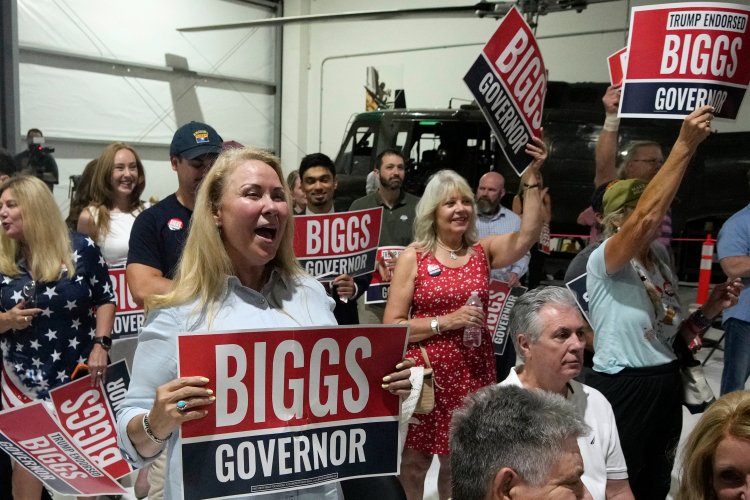
Arizona’s Republican primary voters sent a clear message Tuesday: The party still belongs to Donald Trump.
Across three marquee races – for governor and for two open U.S. House seats – the candidates he endorsed came out on top, reaffirming his grip on the state’s conservative base heading into a high-stakes midterm cycle with control of the House and Senate hanging in the balance.
The results come against the backdrop of a state that has swung sharply in Trump’s favor. Arizona backed Joe Biden by a razor-thin margin in 2020 – just 0.3 points – but flipped decisively to Trump in 2024, when he carried the state by roughly 5.5 points. That rightward shift has fueled GOP confidence heading into the fall, even as Democrats continue to hold the governorship and both Senate seats.
Biggs emerges as GOP’s choice for governor
Rep. Andy Biggs will face off against incumbent Democratic Gov. Katie Hobbs, after handily defeating GOP primary rival Rep. David Schweikert. With 70% of the vote in late Tuesday night, Biggs was leading Schweikert 72% to just 15.4%.
Biggs has been one of the House’s most reliably conservative voices since arriving in Congress in 2017, previously serving as chairman of the House Freedom Caucus, the chamber’s hardline conservative bloc. He’s also earned a reputation as a fierce advocate for election integrity – a stance that resonated with grassroots Republicans still wary of the irregularities many conservatives believe marred the 2020 contest – and is a co-sponsor of the SAVE America Act, one of the president’s top legislative priorities for tightening election security nationwide.
Trump’s endorsement was pivotal. The president had originally lined up behind businesswoman Karrin Taylor Robson, but when she stepped aside in February to spare Republicans a costly primary fight, Trump threw his support to Biggs – even though he’d backed Schweikert in past congressional races. That endorsement proved decisive in a state Trump carried twice, in both 2016 and 2024.
Hobbs, by contrast, faced no opposition in her own primary, coasting to the Democratic nomination. She first rose to prominence as secretary of state during the contentious 2020 election, then won the governorship in 2022 by narrowly defeating conservative firebrand Kari Lake, becoming the first Democrat to hold the office in nearly twenty years.
The general election is already drawing national attention. Cook Political Report considers Hobbs the most vulnerable Democratic incumbent governor on the ballot this cycle – a notable distinction given that most other competitive governor’s races this year, including Wisconsin and Michigan, are open seats without an incumbent to defend. Still, the outlet recently shifted its rating from “toss up” to “lean Democratic,” citing Hobbs’s fundraising lead and relatively strong approval numbers.
Some analysts have suggested Biggs’ unapologetically conservative record could be a liability in a general election, though supporters counter that his firm stances on border security, spending, and election integrity are precisely what Arizona voters are looking for after four years of Hobbs, especially in a state that has trended rightward at the presidential level.
Democratic operatives, unsurprisingly, wasted no time attacking him. DGA Executive Director Meghan Meehan-Draper previewed Hobbs’ general election strategy, casting Biggs as too MAGA for Arizona and arguing he’s spent his time in Congress pushing extreme policies that hurt Arizonans while prioritizing “his own extreme agenda and powerful insiders first.” She also argued that Biggs had ducked scrutiny of his record during the primary and claimed even members of his own party see him as too extreme for the state.
Republicans, for their part, moved quickly to rally around their nominee. Republican Governors Association Chairman and Montana Gov. Greg Gianforte congratulated Biggs on the win, pointing to his record of fighting to lower costs, grow the state’s economy, and secure the border. Gianforte declared that Biggs would put “Arizona families first” as governor, while casting Hobbs as focused on special interests rather than affordability, housing, and job creation. He framed the contest as a clear choice for voters, predicting Biggs is “the leader to get the state back on track.”
Trump’s coattails extend down ballot, Democrats reject their left flank
Elsewhere on the ballot, Arizona Democrats delivered their own message about the direction of their party. Rep. Greg Stanton, four-term incumbent and former Phoenix mayor, trounced progressive challenger Kai Newkirk in the 4th Congressional District 68% to 32% with 79% of votes counted – a lopsided result that was already in the primary’s final stretch when the local chapter of the Democratic Socialists of America declined to endorse Newkirk despite his membership in the organization.
Newkirk had hammered the moderate Stanton over his acceptance of corporate donations, but the establishment Democrat won comfortably, bucking a wave of progressive primary upsets seen elsewhere this cycle, including in New York and Colorado.
Biggs’ decision to run for governor opened up his 5th Congressional District seat, and Trump’s endorsed successor, former Pinal County Sheriff Mark Lamb, won the nomination in the heart of MAGA country despite a late barrage of negative press that undercut his image as a family-values candidate. Lamb rose to prominence for taking on Mexican cartels smuggling drugs across the border and into Arizona.
As of late Tuesday night, Lamb was besting Keenan 59% to 41% with 73% of votes counted.
Late in the primary The Arizona Republic detailed claims from multiple women and a longtime friend who alleged Lamb shared explicit photos of himself and his wife. Screenshots reportedly showed Lamb using threats of legal action to intimidate women into silence.
The newspaper also reported his laughter in response to racist and anti-LGBTQ comments in a private message thread, and his recent purchase of a multimillion-dollar ranch property in Tennessee.
Lamb and his campaign have generally denied the allegations, calling them a “massive smear campaign.” Despite the scandal, Trump reaffirmed his endorsement of Lamb, which helped the candidate withstand a barrage of negative advertising from his self-funded primary challenger, Daniel Keenan.
Keenan seized on the negative coverage, sinking more than $1.6 million of his own money into attack ads positioning himself as the cleaner alternative.
A handful of state Republicans publicly called on Lamb to exit the race, but Trump held firm, reaffirming his endorsement in mid-July and praising Lamb as a “MAGA Warrior” committed to the conservative movement.
In the end, Trump’s strategy of standing by him appears to have worked: Lamb pulled through comfortably in a district considered such a lock for Republicans that the primary winner is all but guaranteed a seat in Congress this January.
Trump’s influence also shaped the race next door in the 1st Congressional District, where Schweikert’s campaign for governor left the seat open. Former NFL kicker Jay Feely, who had originally launched his campaign in the 5th District, switched races entirely after Trump personally asked him to step aside and clear the way for Lamb – a request Feely honored without hesitation, a move his backers point to as evidence of the kind of party loyalty and discipline Republicans value.
Feely went on to defeat two credible rivals, state Rep. Joseph Chaplik and tech executive John Trobough, to secure the nomination.
In the Democratic primary, former state representative Amish Shah comfortably defeated former TV journalist Marlene Galan-Woods and two other candidates. Democrats have targeted the 1st District as a top opportunity to flip its control.
Hobbs goes on offense early
After Biggs’ widely expected primary victory, the Hobbs campaign immediately released a new digital video, “Big Problem,” attacking his record in Washington and tying him to the affordability concerns that have dogged Republicans nationally.
While avoiding mentioning Trump, the ad hits Biggs for voting against measures to lower health premiums, reduce prescription costs, and cap insulin prices, while noting he’s kept his own taxpayer-funded congressional health plan. It also faults him for backing an increase to the Social Security retirement age, downplaying inflation, and supporting a tax proposal that independent analysts estimate would raise costs on everyday purchases by 23%. The video closes by highlighting Biggs’ opposition to a bill addressing the rape kit backlog and his vote against releasing the Epstein files.
The video is running across the campaign’s digital and social platforms, an early sign that affordability and cost-of-living issues – rather than the culture-war fights that have defined some of Biggs’ career – may be where Hobbs chooses to focus her reelection message.
Debate fight already brewing
Even before the general election campaign officially began, Hobbs’ team was already going on offense over debates – a move that has invited scrutiny of her own record. Copper State Victory, the coordinated campaign arm for Arizona’s top Democrats, criticized Biggs late last week for skipping a Republican-organized primary debate, signaling that debate participation will likely become an early flashpoint in the governor’s race.
The attack, however, has opened Hobbs up to charges of hypocrisy. Despite decades in Arizona public office, Hobbs has a thin debate record in recent years. The last time she appeared on a debate stage was in October 2018, during her run for secretary of state. Four years later, running for governor in a nationally watched race against Lake, Hobbs declined to debate her Republican opponent at all, holding firm even as pressure mounted from voters and the press.
Hobbs argued that Lake, whom Trump later nominated to head the U.S. Agency for Global Media, was more interested in “creating a spectacle” than having a substantive discussion. She pointed to the Republican primary debate earlier that year, which had devolved into chaos and ended up mocked on late-night TV.
Susan Crabtree is RealClearPolitics’ national political correspondent.
[ad_2]
Source link
