
Life Inside the Fortress: Everyday Reality Challenges Kremlin Narratives in Kaliningrad
In official discourse, Kaliningrad is increasingly portrayed as Russia’s western fortress: resilient, patriotic, and under constant external pressure. Yet propaganda must also compete with people’s everyday experience. Rising prices, logistical disruption, security alerts and the militarisation of public life shape how residents perceive the consequences of Russia’s war. This article examines that tension between official narratives and lived reality.
The everyday economy of war: food prices and shortages
The weakest point of Kremlin propaganda in Kaliningrad Oblast is the collision between the official picture of the world and the everyday economy. A person may repeat familiar formulas about ‘unfriendly countries’, ‘sanctions pressure’, and the ‘threat from the West’, while at the same time seeing that the ordinary food basket is becoming more expensive, familiar goods periodically disappear, and the region is increasingly dependent on complicated and costly logistics. In Kaliningrad, the war is felt through the price tag.
This does not mean that the region has experienced a permanent food crisis, but Kaliningrad lives in a state of heightened sensitivity to disruption. According to the Bank of Russia, in March 2026 annual inflation in Kaliningrad Oblast stood at 7.08 per cent, compared with 5.86 per cent for Russia as a whole. In December 2025, according to Rusprodsoyuz, the minimum monthly food basket in Kaliningrad Oblast cost 20 per cent more than the Russian average.
Potatoes became a symbolic example. Under normal circumstances, this is an almost invisible product, part of the routine of everyday stability. In June 2025, residents complained about the absence of potatoes in stores. The authorities explained that local stocks had run out and that the shortage in retail was later compensated by supplies from other regions and countries.
The authorities tried to present the situation as manageable – the shortage was not catastrophic, supplies would arrive, Belarus was ready to help, and local potatoes should not be exported but remain inside the region. But the very fact that the governor discussed restricting the export of potatoes from the region, while Belarus President publicly promised to provide Kaliningrad with food, shows that this was no longer an ordinary seasonal price fluctuation. For Kaliningrad, it is a reminder that if something breaks inside the region, replacing it is more difficult, because any compensation depends on a route.
Logistical anxieties
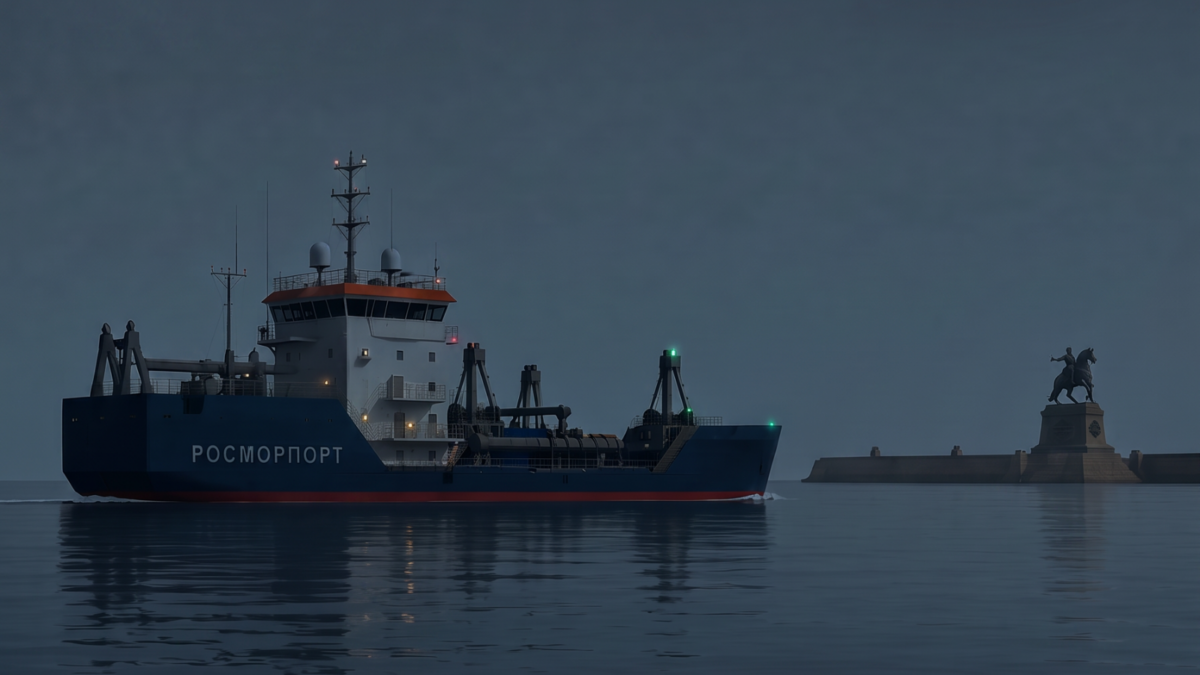
It is logistics that makes Kaliningrad’s everyday economy political. The lives through corridors, ports, ferries, quotas, subsidies, and bypass routes. Maritime transportation is a alternative to land delivery through the EU, where sanctions restrict the transit of certain goods.
In 2026, this dependence became even more visible. After sanctions against Lukoil, maritime shipments of petroleum products on the Kaliningrad route tripled to 61,000 tonnes. Since the end of 2025, the company has switched almost all such cargo from land transit to sea routes. This looks like adaptation, but it also demonstrates dependence. The region rests on the constant reconfiguration of routes.
For Kremlin propaganda, this situation is ambiguous. On the one hand, any difficulty can be explained by external pressure: sanctions, Lithuania, Poland, the EU, the ‘economic war of the West’. A clear example of this framing appeared already in 2025, when Federation Council Speaker Valentina Matviyenko said Kaliningrad needed special mechanisms to deal with ‘the opposition and the problems created by neighbours, “partners” in quotation marks’, again presenting the region’s economic and logistical difficulties as the result of hostile external pressure.
This makes it possible to direct public irritation outward rather than toward Moscow. On the other hand, the more everyday life depends on subsidies, ferries, supplies from Belarus, imported potatoes, and decisions by the federal centre, the less convincing the image of a stable fortress becomes. This is the key Kaliningrad paradox.
Sabotage, fear, and the militarisation of everyday life
The next layer of propaganda is not only the image of an external threat, but its constant movement closer to everyday life. If the narrative of the besieged fortress explains why the region is supposedly under pressure from NATO and the West, then reports about sabotage and terrorist attacks make this threat almost domestic. The danger is no longer somewhere in televised geopolitics, but nearby – at a communications tower, a gas pipeline, a road, a military convoy, a railway station, or an infrastructure facility.
Over the past years, the FSB reported multiple detentions of the residents of the region suspected of alleged sabotage activities, including arson attacks on transport and communications infrastructure.
In 2025, such reports moved even closer to ordinary urban infrastructure. In February 2025, the Kaliningrad FSB reported the detention of three Russian citizens who, according to the agency, had planned to set fire to the power supply equipment of a mobile communications base station ‘in Ukraine’s interests’. In May 2025, the FSB announced the detention of a 25-year-old Russian citizen who had allegedly been preparing a terrorist attack on the route of a military parade convoy during the 9 May events.
The main point here is not the number of cases, but the fact that Kaliningrad residents are encouraged to see danger not only in Ukraine, NATO, or ‘unfriendly neighbours’, but also inside their own region – in people nearby, suspicious contacts, other people’s phones, money transfers, conversations, and interest in infrastructure facilities. War thus becomes not only an external conflict, but also an internal regime of suspicion.
A separate element of this logic is the creation in 2025 of the BARS-39 combat army reserve. Formally, the authorities explained it as a measure to strengthen the region’s territorial defence. Governor Alexey Besprozvannykh said at the time that he had appealed to the Ministry of Defence after requests from residents and veterans’ organisations, while the first wave of reservists underwent training at the Khmelyovka training ground. Later, the governor himself, members of the regional government, and heads of municipalities joined BARS-39 and the official presentation emphasised that service and training would take place only within the region.
The political meaning here is more important than the military one. BARS-39 turns anxiety into organised behaviour. The population is invited not merely to believe that the region is under threat, but to participate in a ritual of protection – sign up, undergo training, receive a patch, guard ‘one’s home’. Even if most residents never join the reserve, the very fact of its public promotion normalises the idea that Kaliningrad lives in a special defensive regime.
The psychology of drone warfare
The topic of drones occupies a special place. Unlike Russian border regions that regularly face UAV strikes, Kaliningrad Oblast has no direct air corridor from Ukraine through Russian territory. A potential Ukrainian drone flying toward Kaliningrad would have to cross the airspace of other states or rely on a much more complicated scenario – for example, launch from the sea, from inside the region itself, or as part of a local sabotage operation. This is why the drone threat in Kaliningrad is perceived differently than in Belgorod, Kursk, or Rostov oblasts. Geographically, it is less obvious and requires additional explanation.
On 25 May 2026, residents of Kaliningrad Oblast received a warning of ‘drone danger’ for the first time. According to messages from the emergency warning system and regional authorities, ‘the warning system was triggered’, and Khrabrovo airport temporarily restricted arrivals and departures. At the same time, no public information was provided about a specific drone, its route, where it was detected, intercepted, or fell. This is crucial – it was not a confirmed strike or a downed aircraft, but a warning signal with an opaque factual basis.
Even if the real nature of the threat remains unclear, the signal itself produces the necessary psychological effect: the war suddenly appears not somewhere far away, but above Kaliningrad. Residents are invited to feel themselves part of the same danger zone in which Russian border regions live. This creates a sense of being tied into the same fight: the region may not be near the Ukrainian front, but it is nevertheless included in the overall map of the war.
In this sense, the drone warning of 25 May 2026 became a continuation of the ‘besieged fortress’ narrative. And the less obvious such a threat is from the point of view of geography, the more visible its political function becomes – to raise anxiety, strengthen trust in the security agencies, justify the militarisation of everyday life, and once again present Kaliningrad not as an exclave far from the front, but as Russia’s western frontier already drawn into the war.
The myth of the outpost: the price of reality
Kaliningrad Oblast shows how wartime Kremlin propaganda works not only through television narratives, but through the reformatting of everyday life itself. Kaliningrad is increasingly presented not as a distinctive European borderland, but as Russia’s western outpost surrounded by enemies. In this logic, the war against Ukraine stops looking like Moscow’s aggression and is presented instead as part of the supposedly necessary defence of Russia as a whole and Kaliningrad in particular.
But it is precisely local experience that makes this construction vulnerable. Kaliningraders can be encouraged to imagine themselves living in a protected fortress, yet their everyday life increasingly tells them something else – the region has become more closed, more expensive, more dependent, and more anxious. Propaganda can direct irritation outward – toward Ukraine, NATO, Lithuania, Poland, and the ‘collective West’ – but it cannot fully erase the personal feeling that life has deteriorated. That is why the main conflict in Kaliningrad is not between belief and disbelief in propaganda, but between the official mythology of the outpost and the real experience of people who see the price of war in shops, at borders, in supply routes, and in the changed
