
[ad_1]

Photograph Source: MichaelEmilio – CC BY 4.0
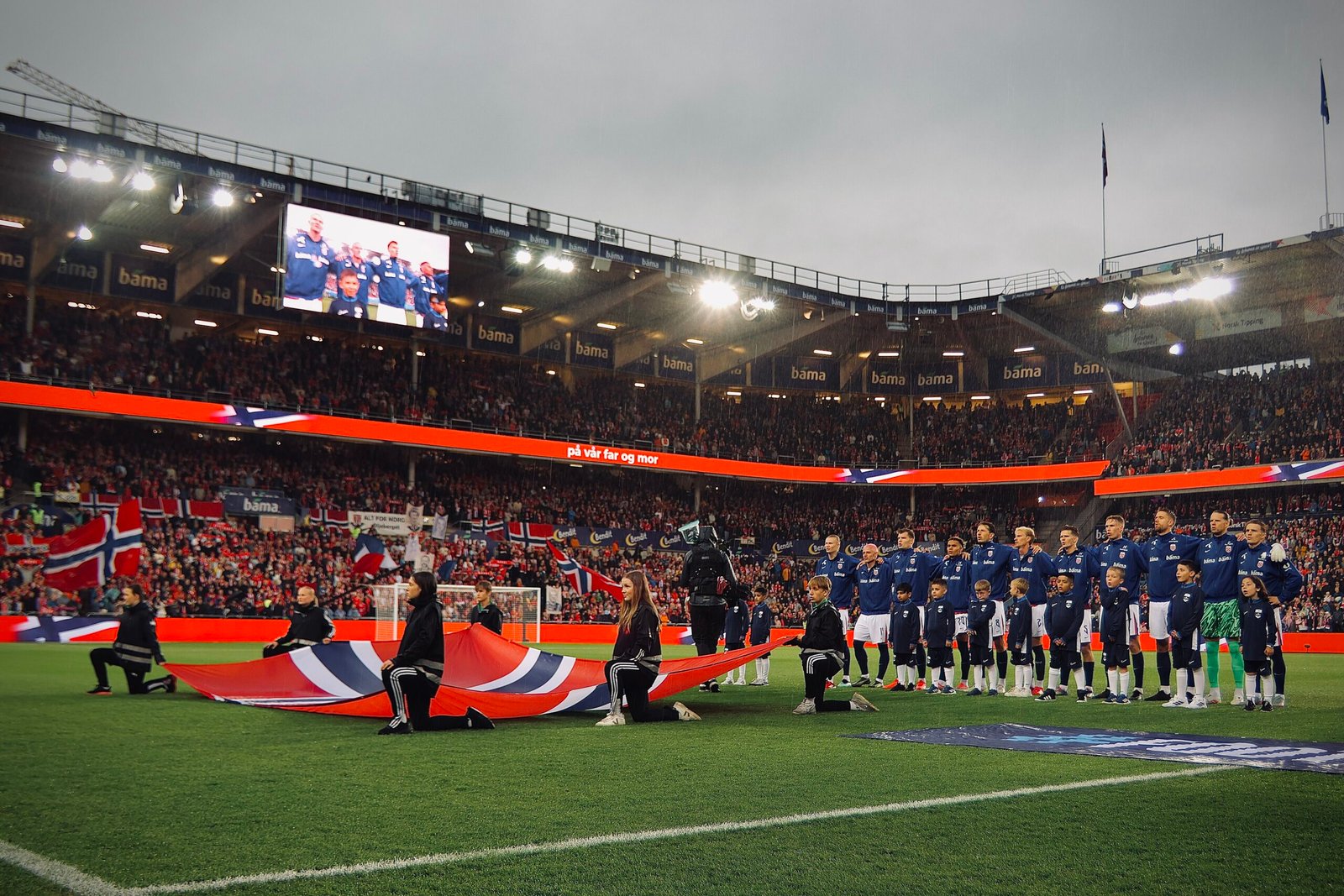
Norway stunned football royalty Brazil in the World Cup. Instead of dancing, posing or pounding their chests, every player sat down on the pitch and rowed in synchrony with their fans in the stands. “The Vikings took in their sails, put out their oars and rowed ashore before battle. So it fits perfectly with the national team—we’re going into battle,” said Ole Frøystad, “Mr. Row, Row” who invented the gesture. The nation of 5.6 million used the Viking gesture of rowing together to celebrate in what seemed the perfect image. “Everyone is rowing in the same direction to carry their team to the ultimate destination – victory,” declared an official FIFA explanation.
What makes a nation celebrate victory without showing off—or respond to defeat by rowing together instead of sulking?
“I think that the whole nation is rowing together, and with that, I mean that we are having a great party here and in Oslo and in all the other big and small cities all the way through Norway,” the Norwegian coach said after the victory over Brazil.
The habit of rowing together begins young. At my granddaughter’s primary school, there was a “friendship bench” in the playground. A child with no one to play with sits there. Other children know they are expected to walk over and invite the child into the game. No teacher gives an order. The institution itself nudges children toward inclusion.
The friendship bench is a small institution that teaches children to think about someone other than themselves. Norway’s sovereign wealth fund applies the same principle to a nation: it asks today’s voters to think about tomorrow’s citizens. The sovereign wealth fund is the national equivalent of a friendship bench—an example of ethical action across generations.
Long considered the gold standard of sovereign funds, the fund was established as the Government Pension Fund Global (GPFG) after Norway discovered large offshore oil and gas reserves in the North Sea in 1990. Rather than spend the revenues immediately, Norway decided to save most of the wealth for future generations. Today it is the largest sovereign wealth fund in the world, with assets of roughly US$2 trillion (the exact value fluctuates with financial markets and exchange rates). That amounts to well over US$300,000 per citizen. The government deposits surplus revenues from oil and gas production into the fund.
Under the so-called fiscal rule, the government is expected to spend only the fund’s expected long-term real return—about 3% annually—while preserving the principal for future generations.
Former Prime Minister Jens Stoltenberg said something close to the philosophy behind the fund: “We are transforming oil wealth into financial wealth.”
The striking thing is what Norwegians chose to do with the wealth. Rather than treating it as a windfall to be consumed, they treated it as a common inheritance. Former finance minister Sigbjørn Johnsen said: “We are borrowing from future generations when we spend oil money.” The same instinct symbolized by the football team rowing together—everyone pulling in the same direction—can be seen in a fund designed to benefit future generations rather than today’s voters alone. Successive Norwegian governments have resisted the temptation to let one generation consume what belongs to the next.
The fund is famous for its ethical guidelines. It has excluded dozens of companies for tobacco, coal, corruption, environmental destruction and serious human-rights abuses. It has even sold holdings in companies judged inconsistent with its ethical standards. In 2006, the fund dumped Walmart after concluding that the retail giant was complicit in serious and systematic labor and human rights abuses. In 2020, it blacklisted mining giant Rio Tinto after the company blasted apart the 46,000-year-old Juukan Gorge, an Aboriginal sacred site in Australia.
Norway has done several things that distinguish it from many other oil producers: it generates about 90% of its electricity from hydropower; it is the world leader in electric vehicle adoption. The sovereign wealth fund has become a major investor in renewable energy infrastructure alongside its traditional investments. Norway has adopted targets to reduce domestic greenhouse-gas emissions while using revenues from oil and gas to finance the transition.
The sovereign wealth fund is solidarity stretched across generations. The Norwegian Refugee Council (NRC) extends that same instinct across borders. With an annual budget approaching US$900 million and operations in more than 40 countries, the NRC has become one of the world’s leading humanitarian organizations. Its Secretary General, Jan Egeland, warns that “the global solidarity with people affected by conflict and disaster is frighteningly low.” In an age of rising nationalism, Norway continues to invest not only in future generations at home but also in strangers abroad. “Countries that can afford space programmes and World Cups can also afford to help people caught in war and disaster,” Egeland bluntly said.
Norway’s ethics are not without contradictions. A sovereign wealth fund renowned for its ethical investment rules is financed by oil and gas. Norwegians readily acknowledge the irony: the country has become rich selling the fuels it urges others eventually to leave behind. Also, Norway rows together, but not everyone is invited into the boat. The country has tightened asylum rules and immigration remains one of its most divisive political issues.
Those contradictions are real. But they don’t erase the instinct that first caught the world’s attention on a football pitch. The most revealing row was not after the victory over Brazil, but after the loss to England. On the pitch after the defeat, the players once again sat down and rowed together with their supporters.
When they returned to Norway after their defeat, the players were received by the King and the royal family at the Royal Palace. Outside the palace, they led the now-familiar rowing gesture, joined by members of the royal family and thousands of supporters. They then rode through downtown Oslo in an open bus parade cheered by an estimated 100,000 people.
Nations reveal their character not only by how they celebrate success, but by how they respond to failure. Winning impresses. Defeat reveals. The Vikings kept rowing.
[ad_2]
Source link
