
[ad_1]
Reprinted from Andy Worthington’s website.
While the attention of the conscious world is, quite correctly, focused right now on Rakefet Prison, an underground detention facility inside Israel’s maximum-security Ramla Prison Complex, where the pediatrician Dr. Hussam Abu Safiya is held without charge or trial, brutalized and in fear of death, it’s important not to forget that, in the Gaza Strip, the surviving Palestinian population is still suffering from an acute and enduring humanitarian crisis.
The crisis is engineered solely by the State of Israel, which has failed to abide by the requirement, in the ceasefire deal agreed last October, to allow 600 trucks of humanitarian aid — containing, at a bare minimum, adequate supplies of food, water, fuel and medical supplies — to enter Gaza every day.
Insight into the humanitarian crisis can be found via regular updates issued by UNRWA (the UN Relief and Works Agency for Palestine Refugees in the Near East), established in 1950, which remains the largest provider of educational and health support to the Palestinians, despite persistent efforts by Israel to destroy it.
The ongoing, Israeli-engineered humanitarian crisis on the ground in Gaza
UNRWA currently runs a total of 116 collective emergency shelters hosting 76,000 internally displaced persons, and in its most recent situation report provides a glimpse into the extent of the crisis and the extent of its involvement in trying to mitigate its worst effects. Between June 16 and 30, for example, UNRWA “distributed around 79 million litres of domestic and drinking water in various areas and from different sources, reaching over 860,000 displaced people daily”, and UNRWA teams also “collected around 6,000 tonnes of solid waste” inside its emergency shelters and the surrounding areas. In total, “More than 1,250 cleaning campaigns were conducted, benefitting over 1.4 million displaced persons”, via “cleaning emergency shelters, cleaning and clearing 500 manholes, as well as water desludging.”
UNRWA currently employs around 11,000 Palestinian personnel, who “continue to provide services and assistance to people in the Gaza Strip”, although all its international personnel have been banned from entering Gaza since January 2025, when a law passed by the Knesset took effect, which prohibited UNRWA’s operations “in areas that Israel considers its sovereign territory, including occupied East Jerusalem”, and sought to ban any contact with Israeli officials.
As UNRWA notes, “Since March 2025, the Israeli authorities have been blocking UNRWA from directly bringing humanitarian personnel and aid into the Gaza Strip. Despite the huge needs on the ground, UNRWA [has] therefore [been] unable to distribute the aid it had pre-positioned outside Gaza, which included enough food parcels, flour, and shelter supplies for hundreds of thousands of people.”
Food is arriving in Gaza via other UN agencies and NGO partners, and, over the two-month period from May 19 to July 11, 27,875 aid trucks reached their destination, with 80% of their contents consisting of food supplies.
Nevertheless, as reported by the UN Office for the Coordination of Humanitarian Affairs (OCHA), which also provides regular updates on the humanitarian crisis, in the latest reporting period (from June 29 to July 5), “overcrowding, inadequate shelter, and limited access to medical services, safe water, and sanitation continued heightening public health concerns and undermining people’s safety, dignity, and well-being.”
OCHA reported that, “Despite all ongoing response efforts, communicable diseases remain widespread, with more than 243,000 consultations reported … through 206 disease surveillance sites during the reporting period, and over one in five consultations linked to reportable infectious diseases.” As they added, “Acute respiratory infections and skin diseases remain the leading causes of illness, while waterborne diseases — including acute watery diarrhoea, bloody diarrhoea and acute jaundice syndrome — continue to increase, particularly in Khan Younis. During the reporting period, more than 18,000 cases of chickenpox, ectoparasite infestation and impetigo were [also] recorded.”
OCHA also reported that “essential services for an estimated 350,000 people living with chronic diseases remain severely disrupted”, and that “shortages of medicines, diagnostics and specialized equipment continue to affect the treatment of hypertension, diabetes, kidney disease, cancer and cardiovascular conditions.”
OCHA added that “shortages of critical items and inputs — including fuel, engine oil, generators, specialized equipment — persist across all sectors”, both because of funding shortfalls, and because of “Israeli restrictions that limit what and how much can be taken into Gaza.”
On July 11, Al Jazeera reported on the profound effects of Israel’s deliberate restriction on fuel supplies entering Gaza. With “about 90 percent of power lines destroyed”, hospitals have been obliged to rely on generators for power, but are having to recycle used engine oil because of the lack of fresh supplies, which “has resulted in generators malfunctioning”, or has “affected their performance.”
As a result, power cuts are regularly preventing the running of “essential life-saving medical equipment at hospitals such as ventilators, incubators and monitoring devices”, which “have rendered hospitals semi-dysfunctional and affected thousands of patients and medical staff in Gaza, where the flow of patients caused by new waves of bombings and disease continues.”
As Al Jazeera noted, focusing on Al-Aqsa Martyrs Hospital in Deir el-Balah, “Most of [its] main generators went out of service in early May 2026, when doctors and nurses were already struggling to cope, leaving the hospital to use secondary generators and solar energy or simply cut back on operations.”
Omar al-Ashtal, a surgeon at the hospital, told Al Jazeera that medical teams “are struggling to provide proper and essential services to patients due to erratic power supplies, especially in operating rooms, where electricity is essential.”
As Al Jazeera noted, “Intensive care units, operating rooms, anaesthesia departments and neonatal care are the most affected by the latest power crisis. Any interruptions to these departments can lead to serious life-threatening complications for patients, including babies in incubators.”
For the Israeli government, all of the above must be enormously satisfying, because all they seek, every minute of their wretched genocidal existences, is for Palestinian civilians to keep dying by whatever means possible.
Israel now militarily controls nearly 70% of Gaza
On July 10, NPR reported how, on another front, Israel continues to squeeze the surviving Palestinians into an ever-smaller proportion of their homeland. When the ceasefire deal was agreed last October, Israeli forces militarily occupied around half of the Gaza Strip, designated via a “yellow line”, which they marked with yellow-painted concrete blocks, from which they were supposed to steadily withdraw as the ceasefire progressed.
Instead, however, as they summarily executed anyone who strayed near the often unmarked line — many trying to get back to their homes, or what little remained of them — and as they also continued destroying whatever structures remained standing, to make Gaza uninhabitable, they also steadily increased the amount of land they control to around 60%, and, as NPR explained, “In mid-March, as the world’s attention was focused on the US-Israeli war on Iran, Israeli troops took control of 10% more of Gaza by designating what they call a new ‘orange zone’ that runs north to south.”
That means, as NPR clarified, that “Israel’s military now controls nearly 70% of Gaza.”
According to NPR, Israel’s military told aid groups about the new “zone”, which, they said, now requires them to secure “prior notification” to be able to enter. Because more than 400 aid workers have been killed in Gaza over the last 33 months, the aid groups “have suspended operations in northern Gaza’s orange zone until the situation is fully clarified.”
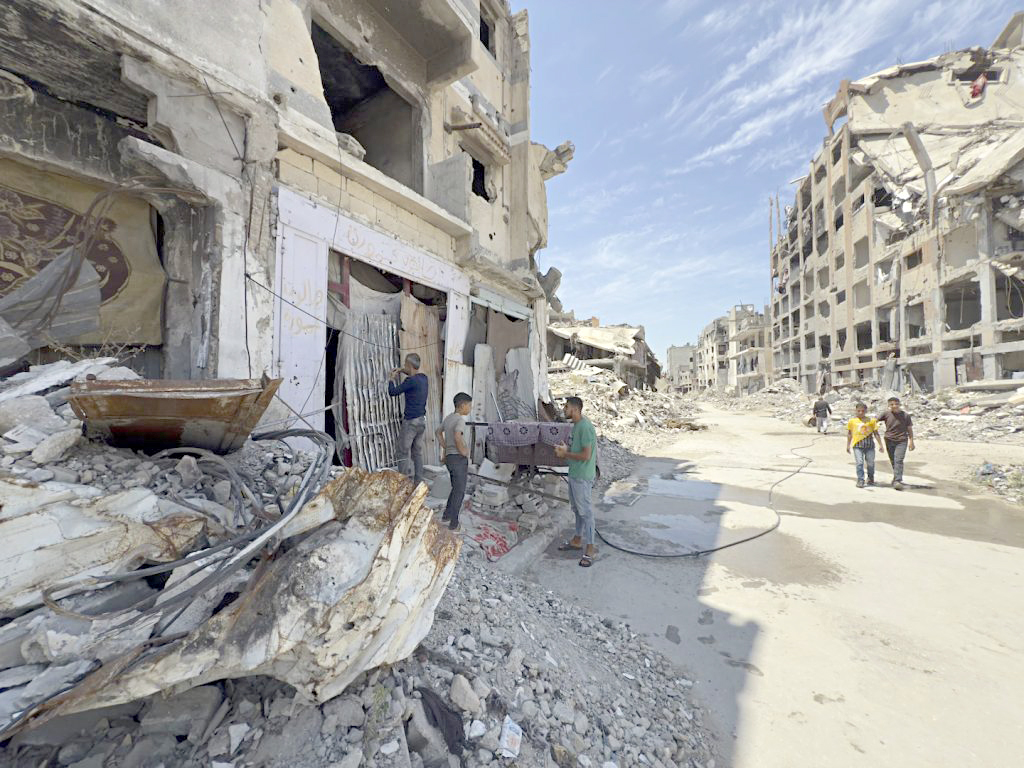
Members of the Al-Hattab family take turns filling water jugs at their ruined house in Al-Shujaiya, where they are still living. (Photo: Anas Baba/NPR).
NPR’s report focused on Al-Shujaiya in eastern Gaza City, once one of Gaza’s largest neighbourhoods, and home to over 100,000 people, where, today, as NPR explained, “fewer than 50 families remain”, down from 500 at the start of the ceasefire. NPR called it “a moonscape of rubble and debris”, noting that there are “no clinics, bakeries or shops in the area”, and “the closest source of drinking water is a half-hour walk away.”
Residents also confirmed to NPR that, since March, when Al-Shujaiya was absorbed into the “orange zone”, “aid operations have been halted”, and “ambulances need Israeli permission to enter.” They also said that, while “random bursts of tank fire are heard throughout the day.”, the “tank shelling and gunfire intensifies in the evening.” As “one resident, Abu Ahmed Humeid, said, “After sunset we put our hand on our heart and just pray. No one dares go outside.”
He also said, “Homes here get hit by Israeli fire because they’re trying to push us out of here, or at least these eastern parts”, adding, poignantly, “But we can’t leave this area. This is where we grew up, where our parents and grandparents lived.”
Sterile techno-concentration camps
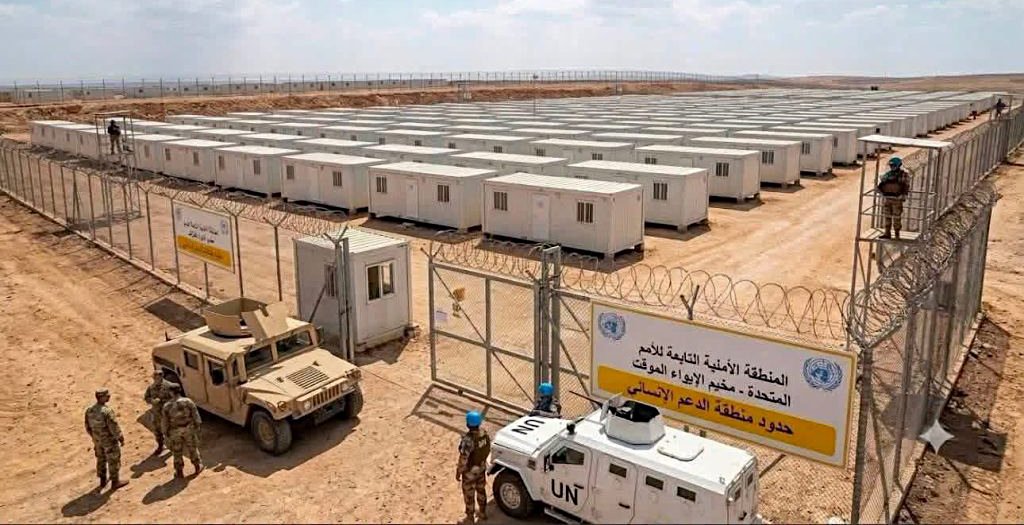
In contrast to this ongoing process of slow strangulation and extermination, a competing, but no less dispiriting vision emerged on July 1, when the Palestinian journalist Tamer Nahed posted a photo on X of a dystopian alternative future — one of sterile, identikit prefabricated housing units in a fenced compound overseen by armed soldiers in elevated surveillance towers.
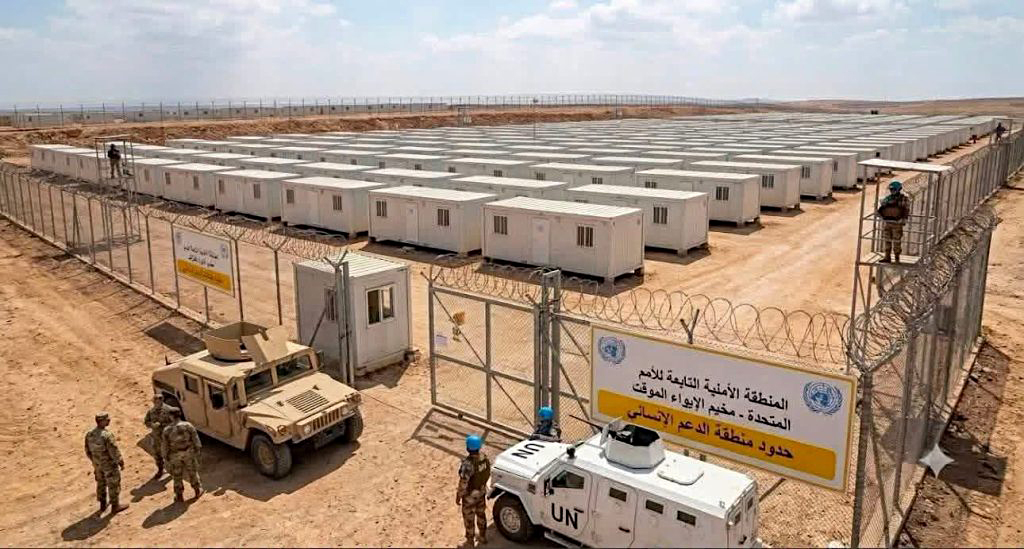
The “concentration camp” option for Gaza’s future: a photo posted on X on July 1 by the Palestinian journalist Tamer Nahed.
Tamer wrote, “I don’t know whether the world is truly aware or is deliberately turning a blind eye to what is happening right now in Gaza. But this is exactly how they are planning the so called ‘New Gaza’ they keep talking about. They want to impose oppressive camps inside the city, disguised as fake natural reserves, surrounded by harsh barbed wire that prevents anyone from leaving as if they are caging an entire population inside iron enclosures under the sky. This is the ‘future’ they are planning: tightly sealed prisons, all under the name of reconstruction.”
On the same day, Drop Site News posted a summary of developments on X, entitled, “Israeli Plan to Herd Palestinians Into Controlled ‘Shelters’ to Begin ‘Within A Matter of Weeks’”, drawing on an article in the Israeli newspaper Israel Hayom.
Their post stated that Israel was “preparing to channel Palestinians into fenced ‘humanitarian shelters’ in areas outside Hamas’s control” — in other words, in the 70% of Gaza controlled by Israel — which would be “policed by a foreign force.”
The specific location chosen is Rafah, once Gaza’s southernmost city, with a population of 1.7 million people, but which, as Wikipedia describes it, is now “largely destroyed and depopulated.” Since it was first attacked in May 2024, supposedly crossing a “red line” imposed by Joe Biden — which Israel, of course, contemptuously ignored — much of Rafah had been specifically levelled in preparation for the establishment of what Israel Katz, Israel’s defense minister, described last July as a “humanitarian city” on its ruins.
That was a deceptive description, of course, because what was planned and envisaged was actually vast, sterile, demilitarized camps, where 600,000 Palestinians would initially be resettled, with plans for the entire Palestinian population to follow, all subjected to “security screening” before entering, and, once inside, not allowed to leave.
This “concentration camp” plan — as it clearly is — was condemned by Michael Sfard, one of Israel’s leading human rights lawyers, who, as the Guardian reported, stated that Katz had “laid out an operational plan for a crime against humanity.”
He added, “It is all about population transfer to the southern tip of the Gaza Strip in preparation for deportation outside the strip. While the government still calls the deportation ‘voluntary’, people in Gaza are under so many coercive measures that no departure from the strip can be seen in legal terms as consensual.”
As he also stated, “When you drive someone out of their homeland that would be a war crime, in the context of a war. If it’s done on a massive scale like the plans, it becomes a crime against humanity.”
Israel, of course, has always sought to disguise its ongoing extermination of the Palestinians behind the illusion of “voluntary migration”, even though that remains an unimaginable outcome, because no one wants to be involved in the execution of a colossal crime against humanity, and, in western nations, rising hostility against refugees is such that no country will oblige Israel’s typically arrogant and self-absorbed demands that they help them with their Palestinian “problem.”
Drop Site News reported that, under the current manifestation of the plan, “unarmed civilians would be directed to a first zone in Tel al-Sultan, near Rafah”, where every structure has been systematically erased.
As Drop Site News described it, representatives of an international military presence — the International Stabilization Force (ISF), first proposed in the plans put forward when the ceasefire began last October, under a “Board of Peace” established by Donald Trump — “would deploy there from a newly built base, equipped to police the zones, while the Israeli military ‘continues to maintain and deepen its hold’ beyond the Yellow Line.”
As Drop Site News proceeded to explain, Israel Hayom reported that the camp or base for the force “has already been built,” and the Board of Peace has “begun identifying sites” for logistics warehouses, with “the groundwork underway now”, and with deployment expected in the coming weeks.
The newspaper called this a “pincer movement”, with “the military seizing more territory as the population is siphoned into the controlled zones, in the hope that Hamas is left ‘without a population, territory or resources.’”
Officials added that the new sites “would receive caravans and aid, but not the concrete needed to actually rebuild Gaza”, because its intention is, instead, to establish what Drop Site News accurately described as “a surveilled, checkpoint-controlled ‘planned community’ in Rafah designed to force Palestinians into what amounts to an Israeli panopticon, tracked and screened as a condition of receiving aid.”
Adding to the alarm, the Board of Peace recently launched a blistering attack on UNRWA, insisting, in a post on X, that “UNRWA has no place in the new Gaza”, and that they are “turning the page on the complex of perpetual aid dependency and conflict.” This provoked a stinging rebuke from Human Rights Watch, entitled, “UNRWA is Irreplaceable in Gaza”, drawing particular attention to the advisory opinion issued last Octber by the International Court of Justice (ICJ), which “made clear that Israel is legally obligated to enable UNRWA to operate to ensure the unhindered provision of humanitarian relief to civilians in Gaza.”
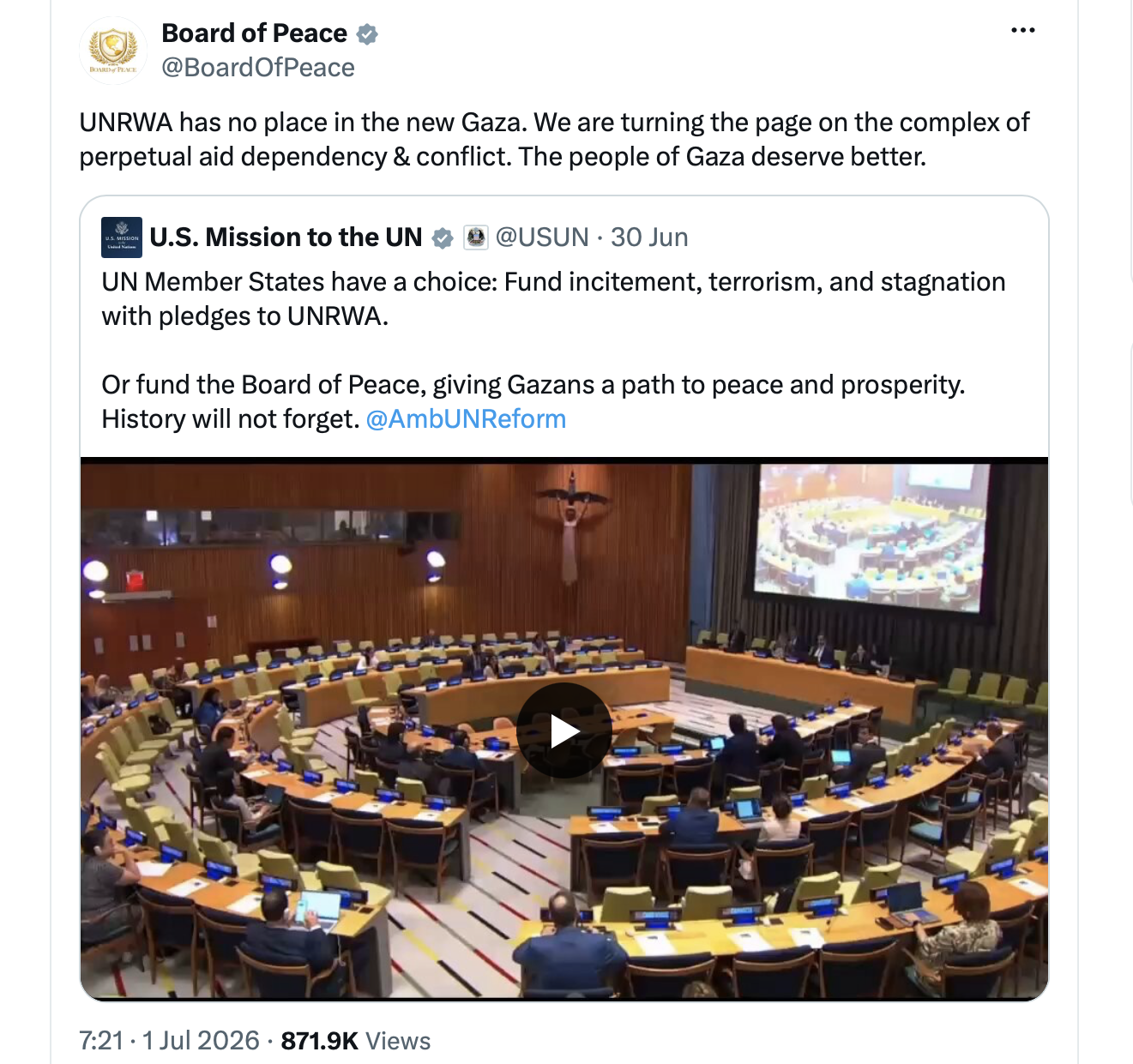
The Board of Peace’s disgraceful post on X on July 1, 2026.
On disarmament, an Israeli political source told Israel Hayom that, “as long as Hamas is unwilling to disarm”, the military would continue to eliminate its remaining leaders through targeted killings, “while remaining below the threshold of international criticism.”
The problem with both of the current realities — Israel’s continuing, militarized takeover of Palestinian land, and the sterile concentration camp option — is that both treat the Palestinians as either irrelevant, or as little more than cattle.
Over 1,000 days since Israel launched its ongoing genocide against the Palestinian people, killing at least 70 times more Palestinians than the number of Israelis killed on October 7, it remains completely unpunished in any way whatsoever, while the Palestinians are still treated as collectively responsible for one day’s armed response by Hamas and other Palestinian factions to 78 years of relentless occupation, dispossession, oppression and ceaseless violence and murder.
From the perspective of Israel and the US, every future scenario involves the complete disarmament of Hamas, even though Hamas never agreed to that, deferring disarmament discussions to the second phase of the ceasefire negotiations, on the understandable basis that the complete surrender of their weapons would lay them open to a merciless Israeli response.
They and the other Palestinian factions have, however, always maintained that they would hand over their weapons to a recognized Palestinian civilian replacement for the government in Gaza; specifically, the National Committee for the Administration of Gaza (NCAG), which was assigned that role under Trump’s “Peace Plan”, as a key component of the Board of Peace.
Since October, however, Israel has resolutely refused to allow the members of the Palestinian committee to even enter Gaza to begin to undertake its day-to-day administration, insisting — with the disgraceful support of the former UN official Nickolay Mladenov, appointed to head the Board of Peace as the colonial-sounding “High Representative for Gaza” — that the committee’s entry to Gaza is contingent on Hamas’ disarmament, even though that was not what was agreed in the ceasefire deal.
Hamas reclaims the narrative, announcing its dissolution and the handover of power to the Board of Peace’s Palestinian committee
On July 6, Hamas found a way to reclaim the narrative, when the Government Media Office announced that its Emergency Committee had been dissolved, ending its 19-year government in “a move intended to facilitate the transfer of administrative authority to the Palestinian-led National Committee for the Administration of Gaza (NCAG)”, as Drop Site News described it.
The Media Office stated that it “had received ‘full assurance’ that preparations for the handover had been completed and formally presented to Palestinian factions, clan leaders, and a United Nations observer”, adding that “only technical and professional staff would remain in their posts to prevent ‘an administrative and technical vacuum’”, and “stressing that all public employees are ‘fully prepared to work’ under the NCAG.” Their statement concluded by “urging all relevant parties to ‘expedite the immediate entry’ of the committee so it can assume its responsibilities.”
In response, on X, the Board of Peace stated, “We have taken note of the announcement today regarding the dissolution of the ‘Emergency Committee’ in Gaza”, noting that, “Ultimately, our assessment will be guided by actions, not promises, to meet the critical needs of the people of Gaza.” They noted that the “core principle” of its “roadmap” for peace “remains one authority, one law and one weapon”, adding, “This means the consolidation of all weapons under the control of the NCAG as provided for in the Comprehensive Gaza Peace Plan and United Nations Security Council Resolution 2803. A genuine transfer of authority must enable the NCAG to exercise its mandate independently, including taking the administrative and governance decisions entrusted to it.”
Will Hamas’ plan work? I certainly hope so, because, otherwise, the future for the Palestinians appears to be one aimed solely at “disarming the Palestinian resistance and the abandoning of the struggle for Palestinian national liberation”, as Drop Site News described it.
On June 23, in detailed analysis of the negotiations over the “roadmap” to peace, Drop Site News noted that, crucially, they seek to “erode Palestinian insistence that any long term deal must include a clear path to statehood, that Gaza and the occupied West Bank be treated as a single Palestinian territory, and that the rights of the Palestinian people to resist Israeli occupation and annexation be preserved.”
All of the above, while reflecting the Palestinians’ rights under international law, is also essential because otherwise, as a senior Hamas officials explained, it is nothing less than “an attempt to impose the surrender that Netanyahu failed to achieve through war.”
It is dispiriting enough that the Palestinians continue to be punished for being victims of a genocide, while the aggressors remain, apparently, above reproach. For the Palestinians to be politically erased after all they have endured, and for Israel to be rewarded for its monstrous depravity, would be an outcome of unprecedented injustice, an inversion of morality so grave that it would be as though, at the end of the Second World War, the Nazis were rewarded for having created Auschwitz.
Andy Worthington is a freelance investigative journalist, activist, author, photographer (of a photo-journalism project, ‘The State of London’, which ran from 2012 to 2023), film-maker and singer-songwriter (the lead singer and main songwriter for the London-based band The Four Fathers, whose music is available via Bandcamp). He is the co-founder of the Close Guantánamo campaign (see the ongoing photo campaign here) and the successful We Stand With Shaker campaign of 2014-15, and the author of The Guantánamo Files: The Stories of the 774 Detainees in America’s Illegal Prison and of two other books: Stonehenge: Celebration and Subversion and The Battle of the Beanfield. He is also the co-director (with Polly Nash) of the documentary film, “Outside the Law: Stories from Guantánamo”, which you can watch on YouTube here.
To receive new articles in your inbox, please subscribe to Andy’s new Substack account, set up in November 2024, where he’ll be sending out a weekly newsletter, or his RSS feed — and he can also be found on Facebook (and here), Twitter and YouTube. Also see the six-part definitive Guantánamo prisoner list, The Complete Guantánamo Files, the definitive Guantánamo habeas list, and the full military commissions list. Please also consider joining the Close Guantánamo campaign, and, if you appreciate Andy’s work, feel free to make a donation via PayPal or via Stripe.
[ad_2]
Source link
