
[ad_1]
I watched the New York Pride Parade on livestream. The parade is a major event in NYC, attended by well over a million people. Today, 11 years after Obergefell v. Hodges legalized same-sex marriage, the movement that once celebrated equality alongside most Democrats looks very different. The near-complete embrace of trans rights as seen in the parade, especially as it affects children, is likely to harm the Democratic Party in coming elections. (FYI, I’ll use the word “gay” as shorthand here for the various constructions, the most complete of which is the unhandy LGBTQQIP2SAA+.)
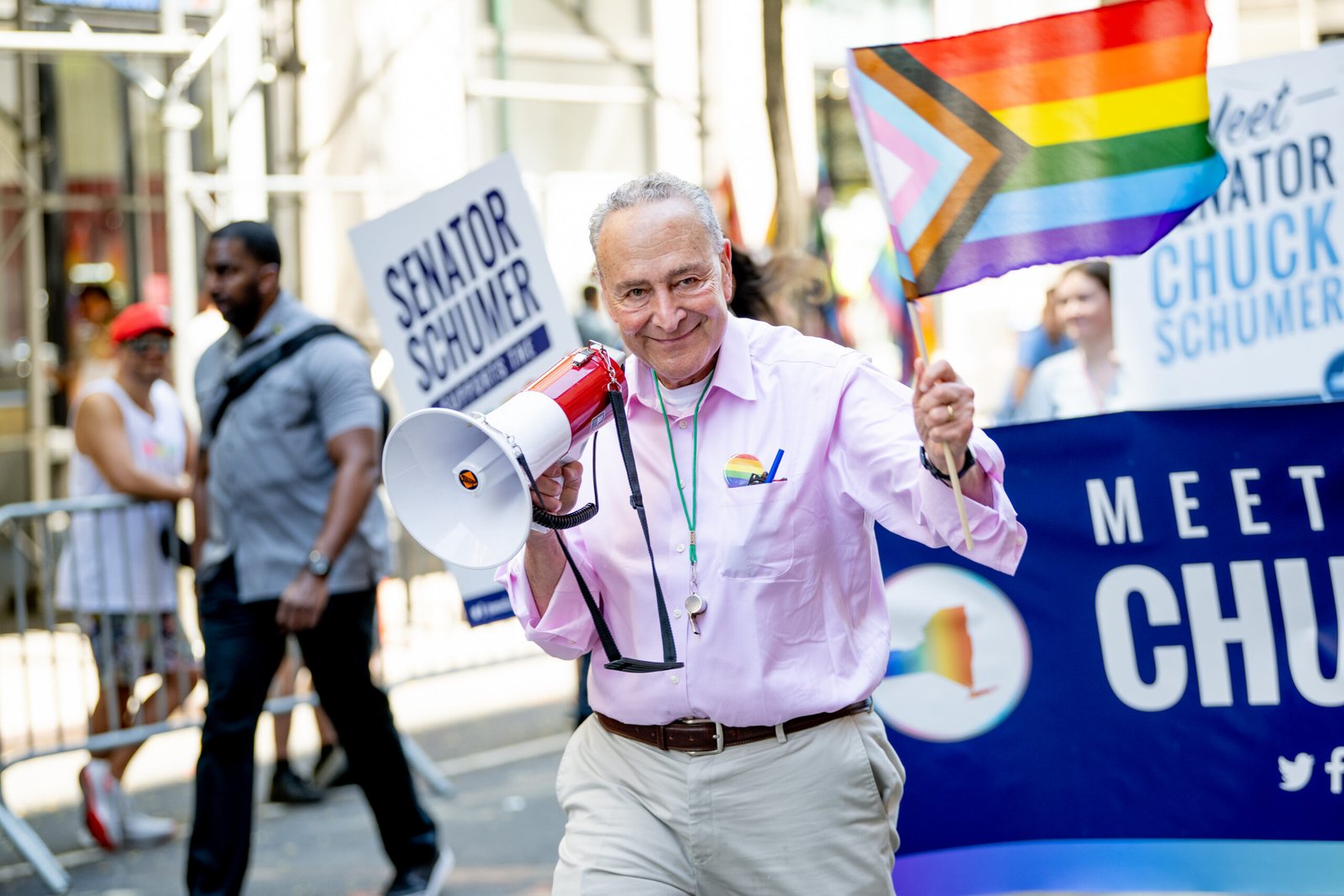
One of the most noticeable changes in the Pride Parade was the replacement of the once-ubiquitous rainbow flag with the “trans flag,” adding pink, brown, white, and black. Trans people were present in large numbers, had their own floats, and were noticeably name-checked by most of the speakers and signs I saw.
As in years before, Democratic politicians were also quite visible. But this year the senior pol, Sen. Chuck Schumer (D-NY), was booed. Some in the crowd turned their backs on him, and when the parade paused, they shouted out about how he did not support trans rights. Chuck yelled back he was the first major politician to ever attend a Pride Parade, back in the ’90s. Meanwhile, the all-in, modern trans-supporter Mayor Zohran Mamdani got some of the biggest applause of the day.
In Gallup polls from 1996 only about a third of Americans supported same-sex marriage. But by the mid-2010s, the figure had flipped and remained about two-thirds into the 2020s. This change culminated in the 2015 Supreme Court decision in Obergefell v. Hodges. In 2024 the Republican Party even removed opposition to marriage equality from its platform. Importantly, the Court ruling followed—not preceded—the broader cultural shift.
The emphasis that led to acceptance of gay rights was driven by several factors, key among which was the emphasis on marriage involving consenting adults, many of whom were already cohabitating in various statuses. Advocacy focused on the universal human rights already part of American law and society, such as the right to work, to own property jointly, and so on—nothing more than asking people to accept someone else’s private life. It did not include sexual “rights” for children.
Then something happened concurrent with the first election of Donald Trump. While it once was sufficient to support basic rights, the Pride Parade started to include overt anti-Trump messages. Signs started to read “Trans rights are human rights,” and the new flag was debuted. Far from “celebrating victory, defending the gains, and staying vigilant while winding down as a movement that had achieved its core objectives,” many gay groups did the opposite. They radicalized.
Democrats increasingly viewed gay activism as an important component of their electoral coalition. The letter Q and the term “queer” came to symbolize the idea that one’s sexuality was a political act. In the 2016 presidential election, gay voters embraced Hillary Clinton, promoting irrational fears as bizarre as Trump endorsing imprisoning gays in concentration camps. This voting pattern reflected a broader social shift, where identity-based politics became increasingly central to how one voted. The Democrats took full advantage of this, fanning the flames further in the next election cycle with careful allotments by gender identity (as well as race, disability, etc.) throughout the Biden administration, especially in the military.
The move from basic rights to gender identity made things much more complex as Trump took office a second time.
The gay rights movement prior to Obergefell v. Hodges demanded equality and mutual respect. No one’s straight life would change when gay marriage became legal. But then the shift started toward children, and the political advantage Democrats enjoyed because the majority of American supported same sex marriage began to fail. They advocated that gender—or sex?–was no longer biology but an undesired social construct. Medical schools began teaching newspeak like “chest-feeding” instead of “breastfeeding,” “birthing parent” for “mother,” and “person with a uterus” instead of simply “woman.” Many libraries became repositories of sexual education, often aimed at elementary-age kids “considering” becoming trans.
Divas in drag became a library staple in progressive areas. Teachers at some schools were expected to morph into gender coaches for those same kids, and rules were made that allowed schools in some areas to keep all this from parents, no matter how young the child. Schools in general also took the lead in transitioning to all-sex toilets, with biological boys being allowed to change in front of girls whose opinion of this was never considered.
It required a Supreme Court decision to allow states to keep biological boys out of girls’ sports. Quickly evolved medical standards saw doctors encouraged to perform “gender-affirming care” for pre-pubescents who were supposed to be experiencing gender dysphoria at an age when they likely could not correctly spell the term. This care, often called “support,” included things sometimes irreversible such as chemical puberty blockers, hormone therapy, and surgical interventions. Parental involvement varied, but in some cases was brought down to zero.
Democrats, greedy for votes, supported this all as received wisdom. No debate was allowed. Opponents were shouted down and canceled, called bigots and fascists, labeled homophobic. Even the author of many young voters’ childhood favorite books, J.K. Rowling, was ostracized because she did not support trans rights the woke way. Democrats intend to take this way of thinking into the midterms and the next presidential election. It is very unclear that this is a good idea.
Subscribe Today
Get daily emails in your inbox
In one post-election survey, cultural issues, including transgender issues, mattered more to swing voters than even immigration and inflation. Reality also plays a part. Predictions that a second Trump administration would seek to overturn same-sex marriage have not materialized, despite a conservative Court.
Instead, his Secretary of the Treasury is a married gay man with kids. Republican candidates have improved their messaging, focusing on education policy and parental rights, framing the issue as oversight and consent rather than identity or discrimination. In fact, the Supreme Court’s decision in Bostock v. Clayton County held that Title VII protects gay and transgender workers against discrimination at work, growing gay rights. Changes Trump made have negatively affected trans people in the military, but never drove things broadly back toward Clinton’s “don’t ask, don’t tell” days.
Public attitudes toward gay Americans shifted more rapidly than any other civil rights issue in U.S. history. They are shifting again. The public increasingly appears willing to separate support for gay equality from support for gender-identity activism. Whether Democrats recognize the distinction, that voters are sensing overreach, is an important question for the next election.
[ad_2]
Source link
