
[ad_1]
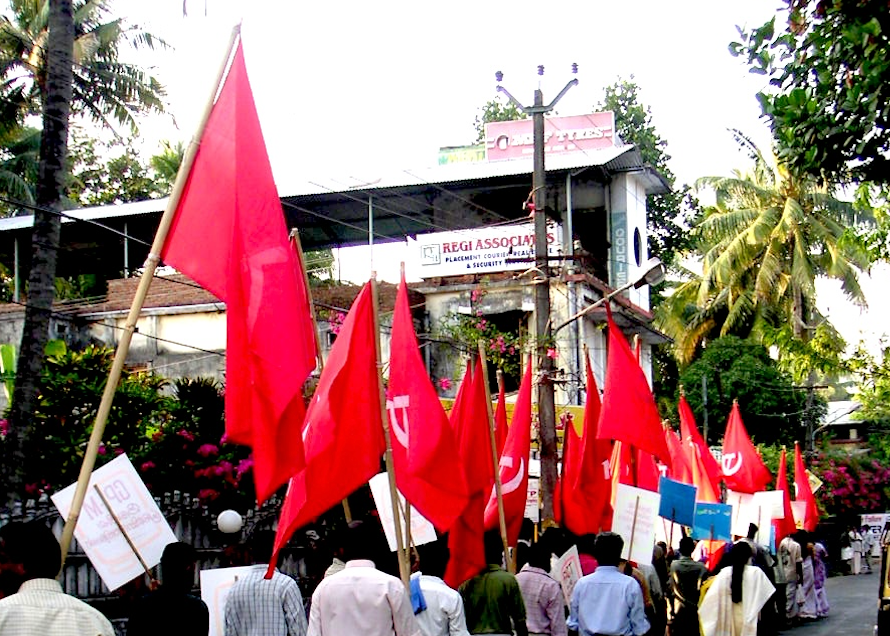
During the independence movement, communists had an uneasy relationship with the Indian National Congress (INC), seeing Congress as too moderate and too compromising with the British, while they supported a more radical, class-based struggle rather than constitutional methods like laws, elections and negotiations. But they still worked alongside Congress and through separate groups to organise farmers, workers and labourers, in the process raising questions of class, exploitation and economic inequality.
When the communist government first came to power in Kerala in 1957, it introduced land reforms, giving land to tenants and reducing the power of feudal landlords, improved education, and expanded welfare programs and public health. These later helped Kerala achieve high literacy rates and better healthcare.
In West Bengal, which became known for its long communist rule, sharecroppers were given security over the land they worked, village-level governance was strengthened and rural education was expanded. Gradually, however, the decline of industry, labour strikes and political violence eroded its base.
Factionalism within the communist movement weakened it, including splits into the Communist Party of India (CPI), the Communist Party of India (Marxist), the erstwhile Communist Party of India (Marxist-Leninist), the Communist Party of India (Marxist-Leninist) Liberation, and a six-decade long Maoist insurgency begun by the Naxalite–Maoist movement and most recently led by the banned Communist Party of India (Maoist). In March the Indian home minister declared victory over the 59-year insurgency.
Salim said that over the past few decades, those divisions had gradually narrowed, with Left parties increasingly coming together, especially now, in opposition to the Hindu right.
“With international developments, national developments and the challenges that we face, it is not a small thing that the communist parties, especially the CPI and CPI (M), have been coming together since the 1980s, more than 45 years,” said Salim. “Nowhere in the world are two political parties fighting together, be it electorally or protesting in the streets.”
“It is no small matter that, despite their different approaches to organisation and views on the revolutionary path, the Left parties have come together to face this fascistic strain and the current onslaught from the right,” he said.
‘Fear of the Organised Left’

Naxalite Movement rally in the 1990s. (Duggempudi Ravinder Reddy /Wikimedia Commons/ CC BY-SA 4.0)
Inspired by Maoist ideas, the Maoist or Naxalite movement revealed another divide within India’s communist movement: between those who supported parliamentary democracy and those who believed violent revolution was necessary.
The movement began in 1967 as a peasant uprising in the village of Naxalbari in northern West Bengal, where poor farmers and tribal communities revolted against landlords over land rights and exploitation.
Over time, the movement under the Communist Party of India (Maoist), a designated terrorist organisation, grew into one of India’s longest-running armed insurgencies, concentrated in the tribal areas of central and eastern India.
While the Naxalite movement became deeply embedded in the national consciousness, constantly highlighting the State’s neglect of the poorest and most marginalised communities, and the exploitation of their resource-rich homelands by large corporations, it also claimed tens of thousands of lives, including civilians, insurgents, and security personnel.
When the Congress Party led the government at the Centre, former Prime Minister Manmohan Singh called it the biggest internal security threat facing India.
The BJP government under Modi, claims to have crushed it by adopting a ruthless zero-tolerance policy, killing hundreds of militants, securing the surrender of thousands and declaring India to be “Naxal free.”
Salim said the root causes which gave way to such a violent struggle — poverty, neglect and exploitation — remain unaddressed, but the Naxal movement had always been “adventurism” that was never going to succeed and had been “fatal” for the organized Left movement.
“The rightist establishment and state power always prefer anarchism over the organised Left,” said Salim. “They fear the organised Left. When you had the farmers’ protest that left a mark and Modi had to bow to the pressure.”
Diminished Influence in Parliament

Lok Sabha chamber in the New Parliament building in New Delhi, May 2023. (Ministry of Parliamentary Affairs /Wikimedia Commons/GODL-India)
CPI (Communist Party of India) and CPI (M) regularly participate in elections, but their influence in Parliament has diminished.
At its peak, the Left Front won 251 of 294 seats in the West Bengal Assembly election in 1987.
In 2004, the Left held a combined 61 in the Lok Sabha — with CPI(M) holding 43 seats — while in the current Lok Sabha, three communist parties hold eight of 543 seats.
In the Rajya Sabha, the upper house, where the 245 members are chosen not directly by the public but by elected members in state legislatures, the number is five.
And on Campus
Even though having been elected only in parts of the country, communist and Left groups are among the most active in student politics in many colleges and universities, organising protests on issues ranging from labour rights and inequality to exploitation of resources and environmental degradation, to women’s safety and communalism and caste atrocities.
Since the BJP came to power in 2014, the government, its right wing ecosystem and much of the pro establishment media has increasingly portrayed the Left as dangerous and subversive, coining the term “urban naxals” and using it to target those who question or criticise the government.
At the same time, campuses such as Jawaharlal Nehru University in Delhi, once vibrant centres of left-wing politics and political debate, have been subdued through crackdowns on free speech and administrations aligned with the right. As spaces for independent thought, protest, dissent and debate have shrunk, right-wing student groups have grown louder and more powerful.
“It is true the campus always used to be the centre for the Left and progressive movement, but after (economic) liberalisation, this has also changed,” said Salim. “Private campuses have flourished where campus politics is not allowed, and secondly, in government-funded universities, there is hardly any democratic space anymore.”
When asked why communist influence in student politics seldom carried into mainstream politics, Salim said it was a challenge.
“Most of them move on to careers and livelihoods instead of organising workers and peasants,” he said. “Retaining them, that will be our task.”
Today, communism in India is at a crossroads.
Its past achievements remain significant, but its future relevance is uncertain.
Betwa Sharma is the managing editor ofArticle 14, the former politics editor at HuffPost India, and the former U.N./New York correspondent for the Press Trust of India. She has also reported for numerous publications, including The New York Times and The Intercept.
The views expressed may or may not reflect those of Consortium News.
Please Donate to the
Spring Fund Drive!


[ad_2]
Source link
