
[ad_1]
What would it take for humanity, let alone the US, to survive another quarter of a millennium? ask Peter Kuznick and Ivana Nikolic Hughes.
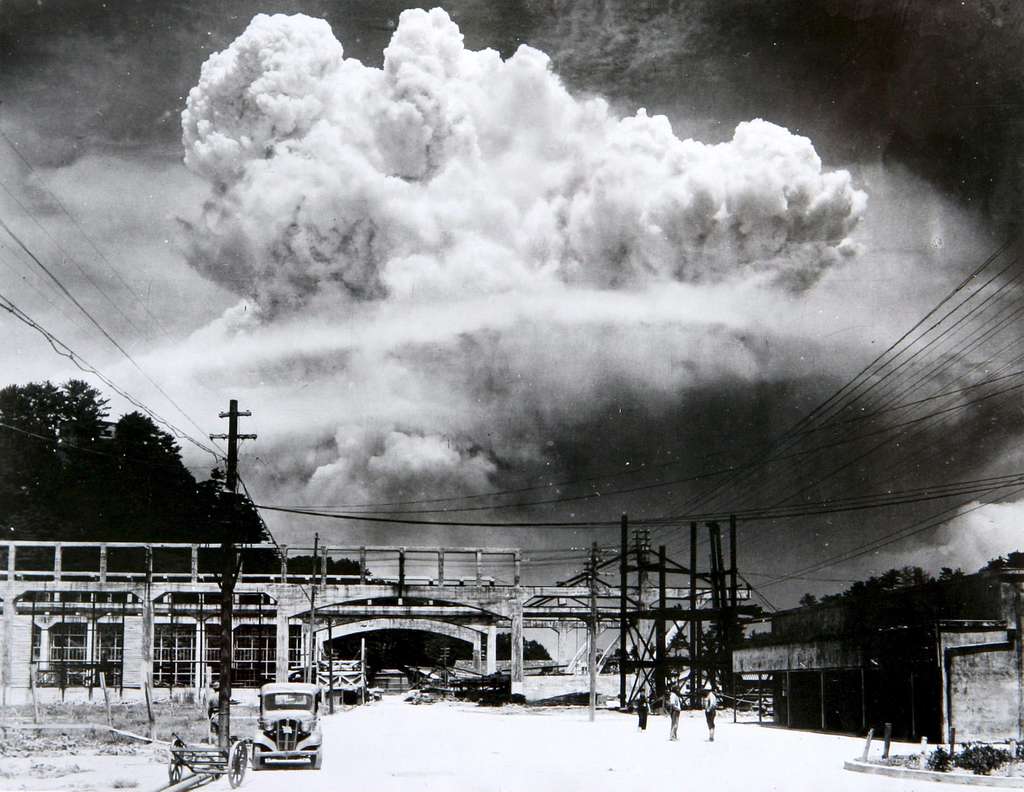
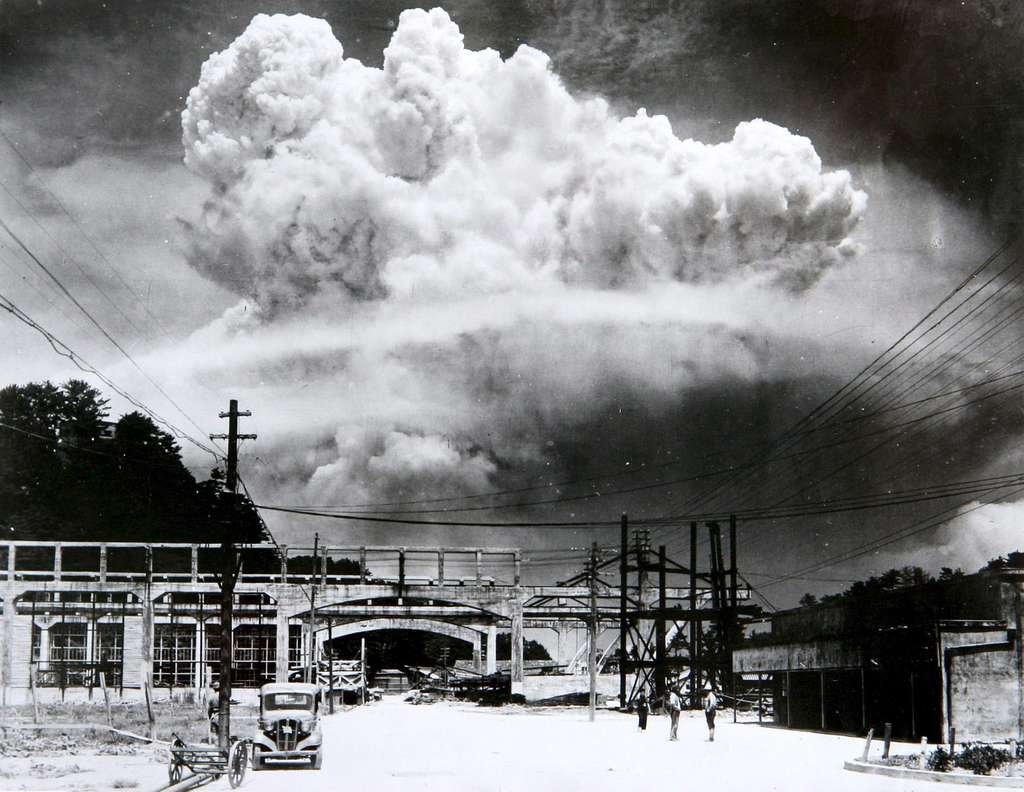
An atomic cloud hangs over the Japanese city of Nagasaki after the US dropped a second nuclear bomb on the country on August 9, 1945. (Hiromichi Matsuda, Wikimedia Commons, Public domain)
By Peter Kuznick and Ivana Nikolic Hughes
Al Jazeera Arabic
On Saturday night the skies across the United States were lit up with fireworks to celebrate an extraordinary milestone for the country, a 250th birthday of the longest-running experiment in republican governance in the modern era.
The broader history of the U.S., however, is replete with contradictions — from the founding in the name of freedom, individual rights, and equality (at least for propertied white men) in stark contrast to its genocidal treatment of Indigenous peoples before and ever since, to the promised pursuit of “life, liberty, and the pursuit of happiness” in sharp contrast to the economic development achieved on the backs of slaves forcibly brought from Africa, exploitation of workers of all races, and denial of basic rights to women until the 20th century.
Still, the Declaration of Independence was a visionary and enlightened document that illuminated a path forward, even if in more aspirational rather than tangible ways. Certainly, the country has long prided itself as a beacon of freedom, democracy, and opportunity.
Sadly, the U.S. has not lived up to its promises — having known only 16 years of peace in its first 242 years according to Jimmy Carter in 2019, having become the most powerful empire in history, and having spent nearly one third of its lifetime with the nuclear sword of Damocles hovering precariously above its own and all of Earth’s inhabitants’ heads.
And now, with the sad machinations of the second Trump regime, the nation is experiencing a degree of war, corruption, lawlessness, cruelty, discrimination, and Constitution-defying behavior that would have left the Founders aghast at how off course their country has drifted.
Given the breadth of the problems the U.S. has faced and continues to confront, we narrow our focus on this historic occasion to the world-threatening existence of nuclear weapons — something the Founders, despite their brilliance, could have neither foreseen nor imagined.
Initially pursued in response to the possibility of a Nazi bomb, the unnecessary and unjustifiable use of atomic bombs in Hiroshima and Nagasaki, the consequences of U.S. testing of more than a thousand atomic and thermonuclear bombs in the Marshall Islands, Kiribati, the Johnston Atoll, Nevada, New Mexico, Colorado, Mississippi, Alaska, and elsewhere, and the creation of a nuclear arsenal capable of ending most large life on our planet has been perhaps the nation’s most condemnable scourge against humanity.
At once a triumph of scientific ingenuity and a tool for not just immeasurable death and suffering, but the destruction of the planet itself, nuclear weapons have long fascinated the curious and worried the thoughtful, all while many with responsibility for them act as if this God-like power to bring death and annihilation is just a normal part of human affairs.
This is certainly the case in the United States, given its unique role and responsibility for the nuclear age and for many of its most serious crimes.
Dissident Physicists

Lise Meitner in Emil Fischer’s Chemistry Institute in Berlin, 1909. (Public Domain/Wikimedia)
The U.S. establishment quickly bought into the promise and importance of the new weapon, making the fateful decisions to embark on the Manhattan Project in 1941, to drop the bombs on Japan in 1945, and to move the Bikinians off their islands to make room for nuclear testing in 1946. That establishment included scientists, many of whom enthusiastically ushered in the nuclear age and continued to be its faithful promoters, including once the ability to power homes with the energy of the atom came along.
But not everyone was on board even in those early days. Physicist Lise Meitner, who famously provided an explanation of the laboratory observations of nuclear fission, but was snubbed for the Nobel Prize given for this discovery, stated, “I will have nothing to do with the bomb.” Columbia University’s Nobel Laureate, I.I. Rabi, similarly refused to join the Manhattan Project, stating “I don’t wish the culmination of three centuries of physics to be a weapon of mass destruction.”
And Joseph Rotblat, who unlike the other two did join the Manhattan Project, left Los Alamos in 1944 when it became clear that the Germans had abandoned their effort to build the bomb. He recalled that General Leslie Groves told him in March of 1944 that the “real purpose in making the bomb was to subdue the Soviets.”
Rotblat spent the rest of his life advocating for the abolition of nuclear weapons, drafting the Einstein-Russell Manifesto warning of nuclear disaster in 1955, founding the Pugwash Conferences on Science and World Affairs in 1957, and winning the Nobel Peace Prize for this work in 1995.
It wasn’t just the scientists who immediately saw that the nuclear age presented an existential challenge for humanity. Henry Wallace, Franklin Roosevelt’s vice p resident from 1941-1945, spoke at Madison Square Garden in 1947 about the need for peace, stating, “I hear no armies marching. I hear a world crying out for peace.”
On nuclear weapons, Wallace argued that, “The success or failure of our foreign policy will mean the difference between life and death for our children and our grandchildren. […] It may mean the difference between the existence and the extinction of man and of the world.”
Today, such fierce critiques are largely missing from the public discourse, with the general public having a visceral feeling that nuclear weapons are bad but very little actual understanding of just how bad they really are.
Most ordinary people have been convinced that nuclear weapons keep us safe, at best, or are a necessary evil, at worst, failing to recognize the unfathomable risk nuclear arsenals put us under. Such a risk puts not just the survival of the United States, but of life itself, in question, with the end of civilization an assured outcome of nuclear war. Shouldn’t we do something about this?
On June 10, then U.S. Director of National Intelligence Tulsi Gabbard, released a video warning that we are “closer to nuclear annihilation than ever before.” In January, before the U.S. and Israel went to war against Iran, the Bulletin of the Atomic Scientists placed the hands of its Doomsday Clock at 85 seconds before midnight—closer to Armageddon than it has ever been.
The Bulletin repeatedly warns about nuclear planners who believe that a nuclear war can be fought and won. And Donald Trump and other members of his regime repeatedly suggest that they may finally break the nuclear taboo.
What would it take for humanity, let alone the U.S., to survive another quarter of a millennium? One of many answers, but arguably the first and foremost answer, is the abolition and elimination of nuclear weapons. If the U.S. general public can demand this, and elected officials can deliver it, there might just be a way to someday celebrate the 500th Independence Day.
Ivana Nikolic Hughes is president of the Nuclear Age Peace Foundation and a senior lecturer in chemistry at Columbia University. She is a member of the Scientific Advisory Group to the United Nations Treaty on the Prohibition of Nuclear Weapons.
Peter Kuznick is professor of history and director of the Nuclear Studies Institute at American University in Washington, D.C. He is also the author of numerous books and co-author (with Oliver Stone) of The Untold History of the United States.
Views expressed in this article may or may not reflect those of Consortium News.
Please Donate to
CN’s Summer
Fund Drive!


[ad_2]
Source link
